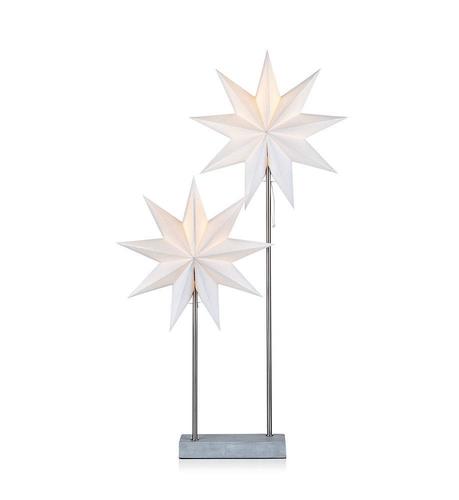
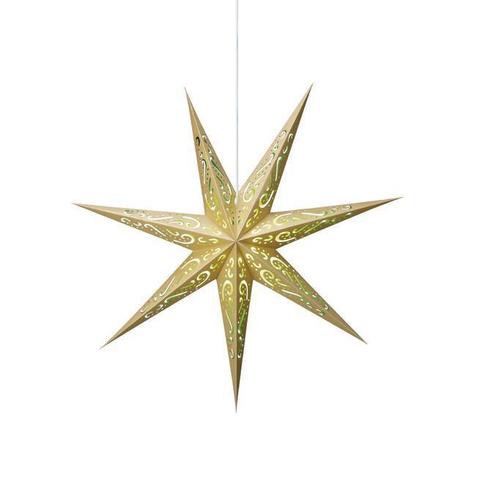
A paper star lantern is a folding star-shaped shade, made from layers of stiff paper, that you light from the inside and hang in a window or over a table. Paper is what makes it work: a 60 cm star weighs next to nothing, glows evenly when lit, throws a lacy pattern through its cut-outs and folds flat for eleven months of the year.
Glass, metal and wooden stars have their place, but none of them diffuses light quite like paper or packs away as neatly. The trade-off is that paper does not like heat or damp, which shapes almost every buying decision below.
How paper star lights are put together
Most paper stars arrive flat. You open the points one at a time, bring the outer two together and fasten them with the cord, ties or clip supplied. Inside sits the light, and there are three common ways of providing it:
-
a cable set with an SES (E14) lamp holder, usually around 3–3.5 m of flex with an in-line switch, into which you fit a small LED bulb;
-
a battery LED insert, typically running on two or three AA cells and sometimes fitted with a timer, handy for a window with no socket nearby;
-
a USB LED cable, which can be run from a phone charger or power bank.
Some stars are sold purely as decorations and are meant to hang unlit, and others are designed to sit over an existing ceiling pendant as a seasonal lampshade. Five- and seven-point stars are the familiar shapes; nine points and more give a busier, almost snowflake-like outline. Standing versions on a wooden or metal base also exist for windowsills and sideboards.
Choosing the size, bulb and finish
A useful rule of thumb is to make the star roughly a third of the width of the window. Before you buy, measure the gap between the glass and your curtains or blinds as well: a large star can be 10 cm deep.
| Where it goes |
Typical star size |
Worth knowing |
| Small casement, front-door side panel |
30–40 cm |
battery insert avoids trailing flex |
| Standard sash or casement window |
45–60 cm |
the size most people pick |
| Bay window, stairwell, high ceiling |
70–100 cm |
hang from a ceiling hook, not a curtain pole |
| Bulb for an SES lamp holder |
LED, 2–4 W |
stay under the star’s stated maximum |
| Colour temperature |
2700–3000 K |
cool white looks grey through paper |
| Cable length |
3–3.5 m |
measure from the hook to the nearest socket |
White paper gives the brightest glow and suits any room. Red, green, gold and black stars are moodier when lit, while velvet-flocked or glittered paper earns its keep during the day, when the light is off.
You need less light than you might think. A 2–4 W LED gives roughly what a 20–40 W filament bulb used to, which is plenty for the star to read clearly from the street without glaring inside the room. A frosted (opal) bulb spreads the glow more evenly across the points than a clear one, which can show up as a bright hot spot in the middle.
Where to hang it
The classic spot is the middle of the window, about two-thirds of the way up, so the lower point clears the sill. If the radiator sits right under the window, a standing star on a nearby chest of drawers keeps the paper away from the rising warm air. A row of small stars at the same height looks good in a long run of windows, and a big star over the dining table replaces the everyday shade for the festive weeks.
Paper stars are indoor pieces. A sheltered, completely dry porch is the furthest they should go; rain, frost and condensation will warp the paper within days.
Safety and care
Use a low-wattage LED bulb only. An old-style incandescent bulb runs hot enough to scorch and yellow the paper. Check that the bulb hangs in the centre and does not touch any of the points, and never put a candle or tea light inside or near a paper star. Plugging the cable into a timer means the star comes on at dusk and switches itself off at bedtime.
If your star keeps turning side-on to the street, the flex is twisted. Untwist it before hanging and clip it to the curtain pole or window frame.
Frequently asked questions
Are paper lanterns illegal in the UK?
The ones causing concern are sky lanterns: paper balloons lifted by a naked flame and released outdoors. A paper star lantern never leaves your window and is lit by a cool LED, so the debate around sky lanterns does not apply to it.
How do you light up a paper star?
Fit a cable set with an SES lamp holder and a low-wattage LED bulb, drop in a battery LED insert or use a USB LED kit. Whatever you choose, the light should hang in the centre without touching the paper.
What should I do with my paper stars after Christmas?
Take out the bulb, fold the star flat and slide it back into its sleeve or a flat box. Keep it in a dry cupboard rather than a damp loft or garage, where the paper will cockle.
How large should a paper star lantern be?
For most windows, 45–60 cm. Go larger for a bay window or tall stairwell and smaller for a narrow casement or a child’s bedroom.
Is it safe to leave a paper star on all evening?
With a low-wattage LED that is not touching the paper, yes. A plug-in timer takes care of switching it off, and the battery versions often have a timer built in.
Can a paper star be used as a lampshade all year?
Some are designed to sit over a ceiling pendant and work as a shade. Check that the fitting takes an LED bulb within the star’s limit.
If the soft light through paper wins you over for the rest of the year too, read more about paper lamps. More on seasonal and everyday decoration: home decor.