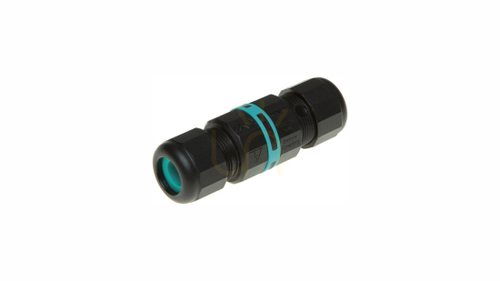
Electrical connectors and junction boxes join lighting cables and protect the places where those connections are made. The connector provides the electrical contact; the enclosure provides the space and protection specified for the finished assembly. Choosing them together is essential. A terminal that suits the conductor can still be unsuitable for an outdoor position if its housing, cable entries or installation conditions do not match the environment.
Start with the cable and the location. Identify the conductor construction and cross-sectional area, the cable's outside diameter, the number of connections and the conditions around the joint. An indoor ceiling connection, a weather-exposed fitting and a garden cable branch can need different arrangements even when they serve similar lights.
Choose the electrical connection and its enclosure together
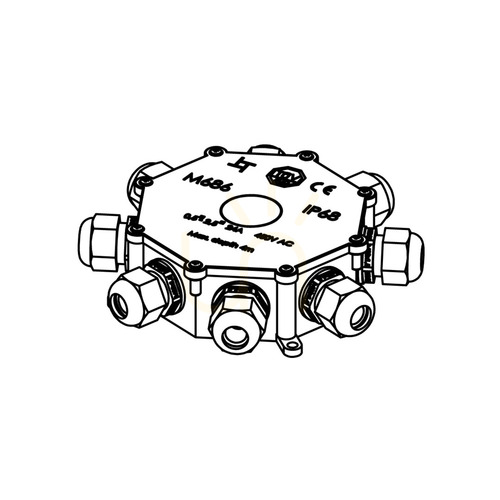
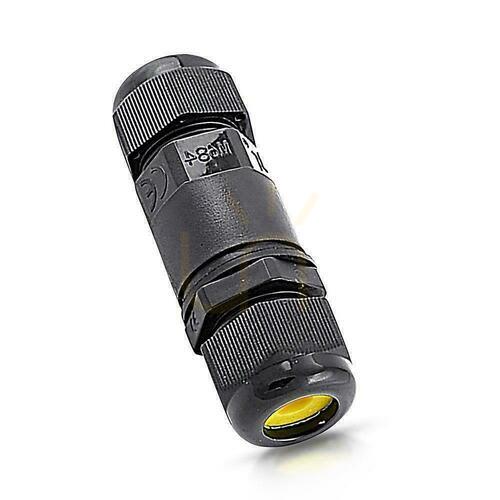
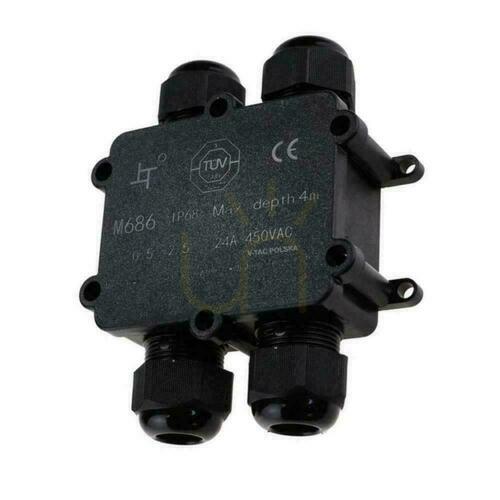
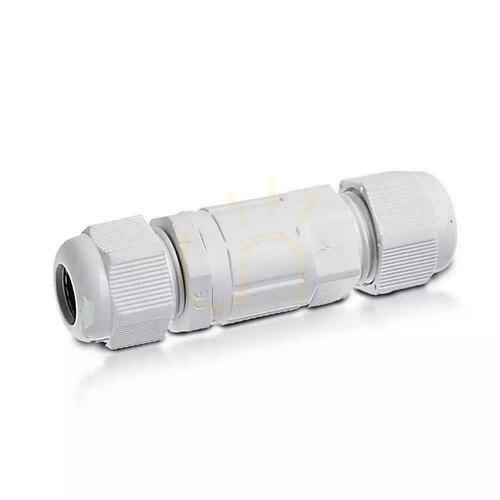
A terminal block, a lever connector and an inline cable joint solve different parts of the same problem. A terminal block provides a specified arrangement of electrical connections. A spring connector holds compatible conductors using its designed clamping mechanism. An inline joint may combine terminals with a housing and cable seals. A junction box provides space for connections and branching, sometimes with terminals included and sometimes without them.
Do not infer the internal electrical layout from the number of cable entries. Three cable openings do not necessarily mean three separate electrical poles. A multi-core cable needs an appropriate arrangement for its conductors, while each entry must suit the outside of the cable passing through it. The terminal diagram and the enclosure specification should both be checked.
| Component |
What it does |
What to compare |
| Screw terminal block |
Joins conductors in a defined arrangement |
Conductor type, cross-sectional area, current and tightening requirements |
| Spring or lever connector |
Clamps the conductor types approved for the mechanism |
Solid or flexible wire, permitted sizes, number of entries and release method |
| Inline cable connector |
Encloses a joint along the cable route |
Electrical poles, cable diameter, sealing and mounting conditions |
| Branch connector |
Allows cable routes to divide |
Internal connection arrangement, number of cables and shared loading |
| Junction box |
Houses connections and provides specified protection |
Working space, supplied terminals, cable entries and environmental suitability |
Solid and flexible conductors need the right terminal
Solid conductors and fine-stranded flexible conductors behave differently in a clamp. A connector intended for solid wire is not automatically suitable for lamp flex with a similar nominal size. Check the permitted conductor constructions as well as the range of cross-sectional areas. The mechanism's actual approval matters more than a familiar colour or shape.
Lever operation can make a connector convenient to use, but it is not a universal specification. Approved sizes may differ for solid wire, stranded wire and conductors fitted with ferrules. Whether a ferrule is required, permitted or unsuitable depends on the particular terminal and conductor. The preparation must follow that product's instructions rather than a rule assumed for every connector.
Conductor material also needs attention. A connector specified for copper should not be assumed suitable for aluminium or for joining different metals. Where a manufacturer allows a special combination, the associated conditions and accessories form part of that approval. An electrician should assess unusual conductor combinations and existing wiring before choosing a replacement terminal.
Cross-sectional area is not cable diameter
The conductor's cross-sectional area, expressed in mm², describes the conducting material. Cable diameter, expressed in mm, describes the outside dimension of the complete cable, including its covering. The first is important for the terminal; the second matters for a gland, seal or cable grip. Meeting one requirement does not prove that the other is satisfied.
Two cables containing conductors of the same nominal area can have different outside diameters because their insulation and construction differ. An inline connector may therefore have one approved range for the conductors and a separate range for the cable seal. Both need to suit the cable actually being used, including any difference between the incoming and outgoing cables.
A seal that is too large may not achieve its intended contact with the cable. A cable that is too large can put the wrong pressure on the seal or housing. Improvised packing, tape or an unspecified sealant is not a substitute for a correctly sized entry. Use the components and cable arrangement permitted for the enclosure.
Screw terminals and spring connectors
Both screw and spring connections can be appropriate when chosen for the intended conductors and conditions. Their holding mechanisms and installation requirements differ. A screw terminal needs the specified conductor preparation and tightening method. A spring connector needs an approved conductor size, construction and insertion arrangement. Neither type can be judged by speed of assembly alone.
There is no single tightening torque for every terminal block. Too little or too much force can create different problems, so the manufacturer's value and method should be followed. Likewise, more than one conductor must not be placed in a terminal unless the product is designed for that number and combination. An opening large enough to accept two wires is not proof of approval.
What an IP rating tells you
An IP rating describes protection provided by an enclosure under specified conditions. Its first digit concerns solid objects and dust; the second concerns water. IP44, IP65, IP66 and IP68 do not describe identical tests. Relate the rating to the environment and to the complete installed assembly, including the cable entries and any unused openings.
IP68 does not promise unlimited immersion at any depth for any length of time. The detailed conditions are defined by the manufacturer. Nor does that marking alone establish suitability for direct burial in soil. Mechanical protection, material compatibility and the intended installation method must be checked separately. Resistance to water jets and suitability for immersion are also different matters.
The rated protection depends on the enclosure being assembled correctly with suitable cables, seals and accessories. An unused opening may need its specified blanking component. A damaged gasket or cable outside the approved diameter range can affect the whole result. The number printed on an open housing is not protection by itself.
Outdoor lighting connections
Outside a building, a joint may encounter temperature changes, sunlight, dirt and physical strain as well as water. A sealed housing is not automatically UV-resistant or suitable for every garden location. Those properties should be stated for the material and application. A black plastic enclosure does not establish any particular outdoor performance on its own.
Plan where the connection will be secured and how it can be inspected. Cable entries should not be expected to absorb every pull or impact unless that function is part of their design. A gland may provide a defined seal and retention arrangement, but its exact purpose and limits need to be confirmed. The enclosure itself also needs the specified support.
For a branch feeding several lights, consider the common part of the connection as well as each outgoing cable. Three directions do not create three independent current allowances without regard to the input. The internal terminal arrangement, number of conductors and loading should be assessed as one system. The electrician designing the route can establish the suitable combination.
Space inside a junction box
Outside dimensions do not show all the usable working space. Seals, cable entries, mounting points and terminals occupy part of the enclosure. The remaining area must allow the conductors to be arranged without excessive pressure on the joints or unsuitable bending. Cable stiffness and the number of incoming routes can make a compact-looking box impractical for a particular installation.
Check what is supplied. Some boxes are empty enclosures, while others contain a defined terminal arrangement or cable-retention components. A product photograph may show an example installation rather than every included part. The correct cover, seals and accessories belong to the particular housing; a similar-looking replacement does not automatically preserve the original protection.
Access for inspection and maintenance should be considered during planning, not after the cable route has been concealed. Where a connection is described as maintenance-free, that claim applies to the specified product arrangement and installation conditions. It should not be inferred merely from the absence of terminal screws. Applicable installation requirements still need to be assessed by the installer.
Current, voltage and temperature ratings
Rated current and voltage describe permitted operating conditions for the component. They do not describe the joint's energy consumption or directly specify the circuit's protective device. The conductor, installation method and environment remain relevant. Putting an unsuitable connector inside a better enclosure does not increase the connector's electrical rating.
Temperature requirements can be different near a luminaire, inside a housing or in a position exposed to sunlight. The approved operating range must cover the actual application. Seals and cable coverings also have their own conditions. The housing material alone is not enough to establish the suitability of the complete joint.
A replacement should be selected from its full specification, even when the original part appears simple. Check why the old connection is being replaced and whether the surrounding cable or enclosure also needs attention. Heat damage, cracking or uncertain retention calls for examination of the cause, rather than simply choosing a larger terminal.
Lighting connectors with a different purpose
A track-lighting connector belongs to a particular rail system. Its geometry and contact arrangement are different from a general cable terminal, even if it carries power. An LED-strip connector is selected for the strip's contact layout, width and electrical design. A decorative ceiling canopy may hide wiring while also serving as a mounting component. Their names should not be taken as evidence of general-purpose installation compatibility.
System-specific parts should be matched to their stated family and use. A similar size is not permission to substitute a different component. The word universal is also limited by the conductor types, voltage and conditions stated by the manufacturer. It never means every wire, environment and mounting arrangement.
Information to gather before choosing
- The number, material and construction of the conductors.
- Conductor cross-sectional areas and each cable's outside diameter.
- Required voltage, current and operating temperature.
- The number of electrical poles, cable entries and branch routes.
- Water, dust, sunlight and mechanical conditions at the installation point.
- Working space, fixing method, access and any separately required components.
Selection, assembly and testing of fixed mains connections should be carried out by a suitably qualified electrician. This guide helps identify the information needed to compare products; it is not a wiring procedure or a substitute for the particular manufacturer's instructions. Conductor colours alone should not be used to infer the condition or purpose of an existing installation.
Questions about electrical connectors and junction boxes
Will every push-in connector accept flexible lamp cable?
No. Check the conductor constructions and size ranges approved for the terminal. Some are intended for solid wire; others also accept suitable flexible conductors. Any required preparation must follow the instructions for that particular mechanism.
Why do I need both conductor size and cable diameter?
The terminal must suit the conductor, while the seal or cable entry must suit the outside of the cable. These are separate dimensions. Two cables with the same conductor area may need different cable-entry sizes.
Can any IP68 connector be buried?
No. The IP marking alone does not establish direct-burial suitability. The manufacturer must permit the intended application and conditions. Cable type, mechanical protection and installation method also need to be considered.
Does a junction box always include terminals?
No. It can be an empty enclosure or a specified assembly containing connection components. Read the contents and accessory requirements. A photograph of a completed joint may include parts supplied separately.
Do cable entries tell me the number of electrical poles?
No. Entries are openings for cables, while poles describe the electrical connections. Check the internal arrangement independently, especially when joining multi-core cables or creating a branch.
Can two conductors share one terminal?
Only when that terminal is approved for the particular number and combination. Physical space in the opening does not establish suitability. An incorrect arrangement can affect contact quality and conductor retention.
Does a waterproof housing also resist sunlight?
Not automatically. UV resistance, operating temperature and water protection are different properties. Each must be confirmed where it matters for the intended location.
Is a screwless connection automatically maintenance-free?
No. Maintenance-free suitability depends on the specified product assembly and installation conditions. It cannot be inferred from the clamping method alone. The installer must assess the applicable requirements for the complete connection.
Compare the cable, electrical arrangement and environment before choosing the enclosure size. For other components needed around the connection, explore electrical accessories and check that each part suits the complete lighting installation.