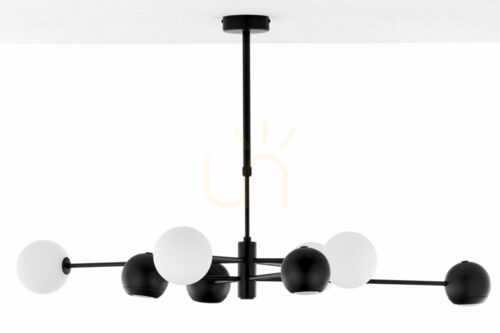
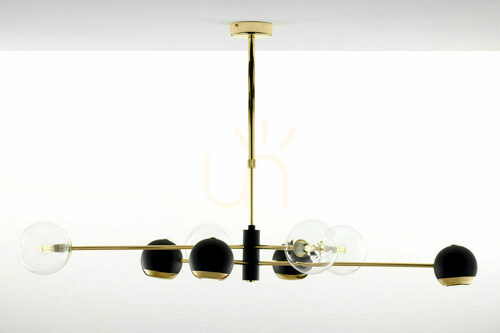
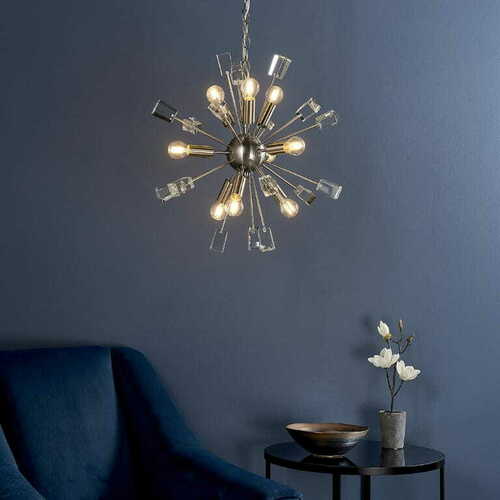
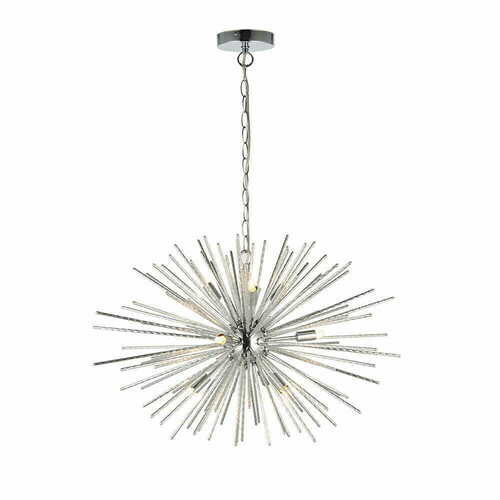
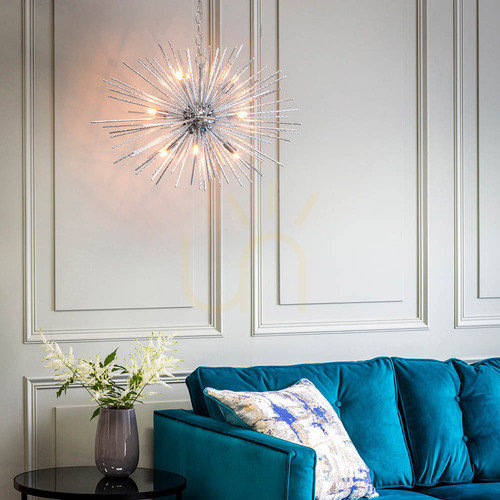
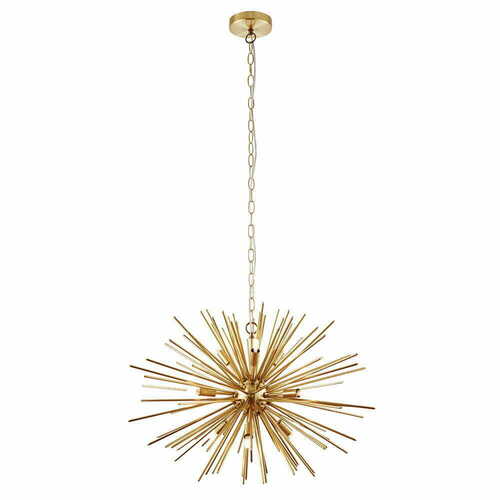
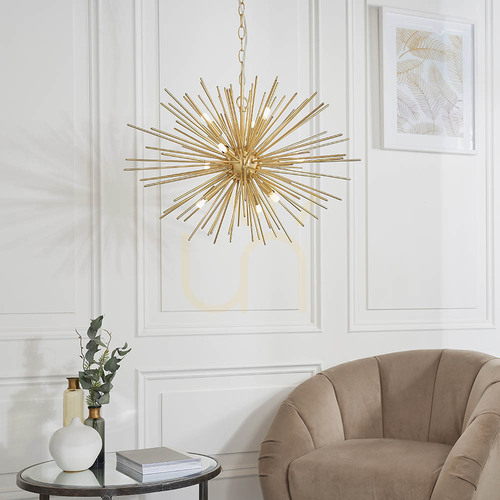
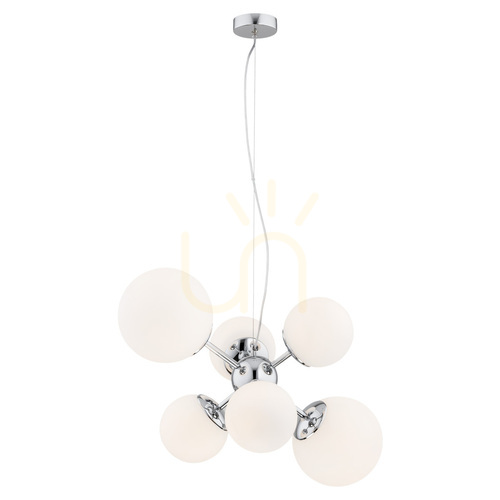
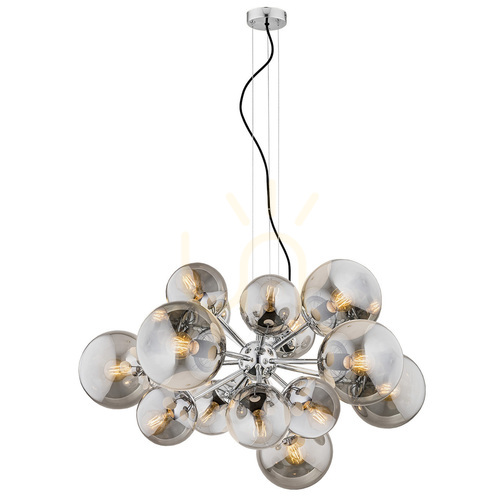
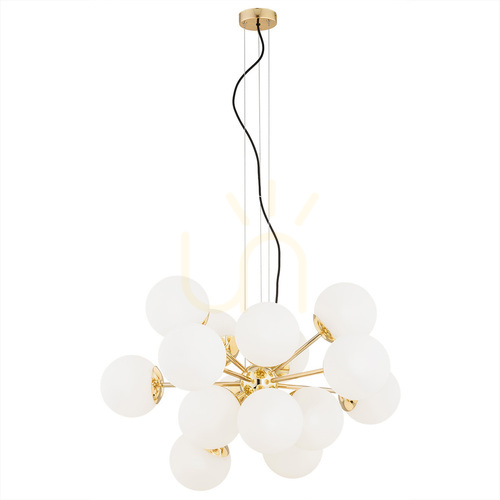
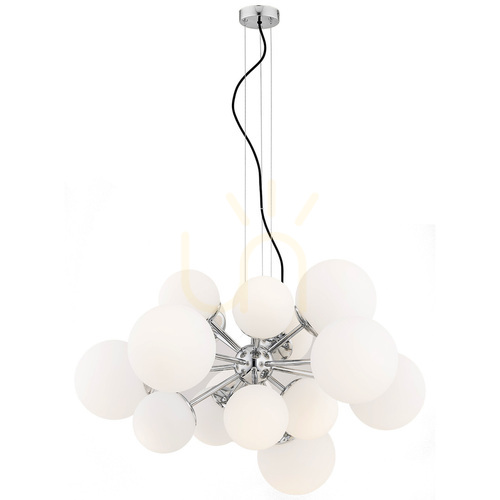
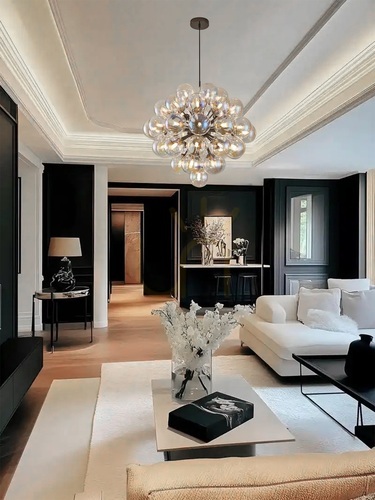
A Sputnik light is a chandelier built like a satellite: straight arms shoot out in every direction from a central sphere, and each one ends in a bulb, a glass globe or a tiny shade. Among chandeliers it is the one with no main shade at all, so the light comes from a dozen small points at once and the fitting doubles as a sculpture hanging from the ceiling.
The shape dates from the space age of the late fifties and the sixties, when the first satellite captured everyone's imagination, and it has come back with every mid-century revival since. You will see it as a restored vintage original or as a modern design that borrows the starburst silhouette.
Are Sputnik lights still in style?
They have settled into the same place as the bentwood chair or the globe pendant: a design classic rather than a passing trend. What has changed is the detailing. Older pieces lean on polished chrome and opal glass; current takes come in matt black, brushed brass, smoked glass and slimmer arms, which lets the same idea work in a Victorian terrace, a new-build flat or a converted barn.
How a Sputnik differs from other chandeliers
Most chandeliers gather their light into shades and throw it downwards. A Sputnik's bulbs sit on the outside of the frame, so light spills upwards onto the ceiling as well as down and sideways. The result is soft, all-round ambient light, with one catch: every bulb is on show, so bulb choice decides whether the fitting feels cosy or glaring.
It also takes up more visual space than its width suggests, because the arms trace a sphere in the air. Size down slightly compared with a solid pendant.
-
Bare-bulb Sputniks – lampholders at the tips, dressed with globe or filament LEDs.
-
Glass-globe Sputniks – opal, clear, smoked or amber globes that tame the glare.
-
Integrated LED – no bulbs to change, sometimes with adjustable colour temperature.
-
Semi-flush versions for low ceilings, and pendant versions on a rod or chain.
Choosing the size and hanging height
For a quick estimate, add the room's length and width in metres and multiply by about 8: that gives a sensible diameter in centimetres. Over a dining table, aim for half to two-thirds of the table's width instead.
| Where |
Typical diameter |
Number of lights |
Height guide |
| Bedroom or study (under 15 m²) |
40–55 cm |
5–8 |
semi-flush in most UK homes |
| Living room (15–25 m²) |
55–75 cm |
8–12 |
at least 2 m clear below in walkways |
| Dining table |
½–⅔ of table width |
6–12 |
roughly 75–90 cm above the tabletop |
| Kitchen island |
about ½ of island width |
6–10 |
similar to a dining table |
| Stairwell, double-height hall |
75–100 cm or more |
12–24 |
centred in the void, well above head height |
With the typical British ceiling at around 2.4 m, a hanging Sputnik in the middle of a living room is a head-bumper. Pick a semi-flush model there, and save the long drops for the dining table, the island or a period property with high ceilings.
Bulbs and caps
Sputniks commonly use G9 capsules (now almost always LED), small Edison screw E14 (SES) or standard Edison screw E27 (ES); a few use 12 V G4. Buy the whole set from one pack so every arm gives the same shade of white. Warm white at 2700–3000 K suits living spaces. Frosted globes or low-output filament bulbs are far kinder than a dozen clear bulbs at full brightness, and a dimmer with dimmable LEDs makes the same fitting work for both dinner and a Saturday clean-up.
Fitting and care
Most Sputniks weigh a few kilos, and big metal ones more, so fix them to a joist or a proper ceiling fixing rather than plasterboard alone. In England and Wales, a new circuit, or adding to or altering a circuit within the zones of a bathroom, is notifiable under Part P, and all wiring should meet BS 7671, so use a qualified electrician. For a bathroom, choose a fitting rated at least IP44 for the zones around the bath or shower.
Dust every few weeks with a microfibre cloth or an extendable duster, with the power off and the bulbs cool. Glass globes come off for a wash in warm soapy water; dry them fully before refitting. Once a year, check that the arms are still tight.
FAQ
When were Sputnik chandeliers popular?
They first boomed from the late fifties through the sixties, faded in the following decades, and returned with the mid-century revival. Today they sit alongside other classics rather than in a single era.
What is an LED Sputnik chandelier?
Either a Sputnik with LED bulbs in its lampholders or one with LED modules built into the arms. The first lets you change bulbs and colour temperature yourself; the second is slimmer but the light source cannot be swapped.
Does a Sputnik light work on a low ceiling?
Yes, in a semi-flush version. It keeps the starburst look while sitting close to the ceiling, so nobody walks into it.
Is a Sputnik suitable for a living room?
Yes, as the main ambient light, centred over the coffee table or seating area. Add a floor lamp or wall lights for reading.
Can I use a vintage Sputnik?
Have an electrician check and, if needed, rewire it first. Original cable and lampholders are often brittle; once replaced, LED bulbs work well.
Brass, black or chrome?
Brass warms a room and nods to the originals, black reads graphic and industrial, chrome looks crisp in modern kitchens and bathrooms.
For other shapes and sizes of ceiling fitting, see chandeliers. If your Sputnik is heading for a low room, it helps to read about flush mount chandeliers too.