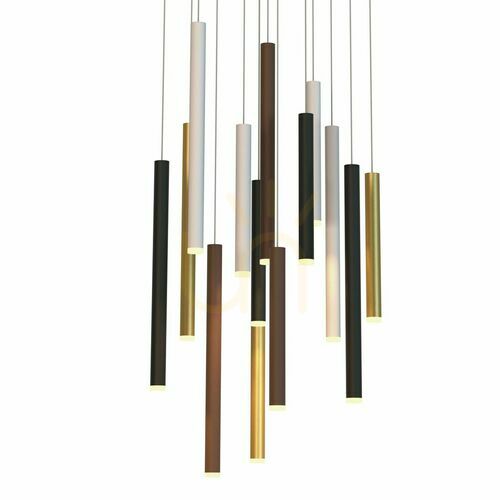
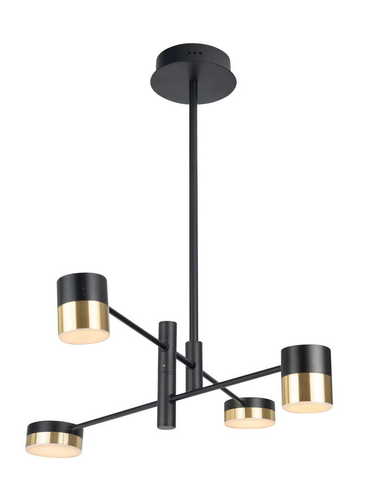
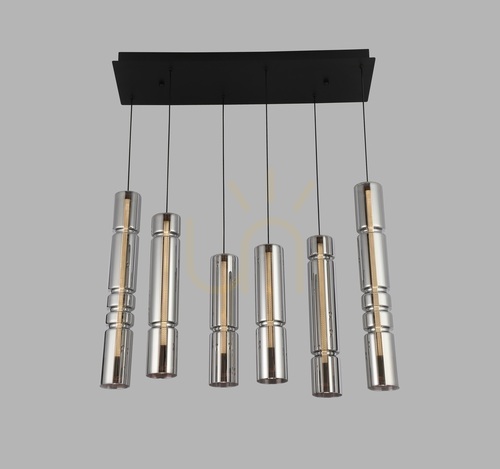
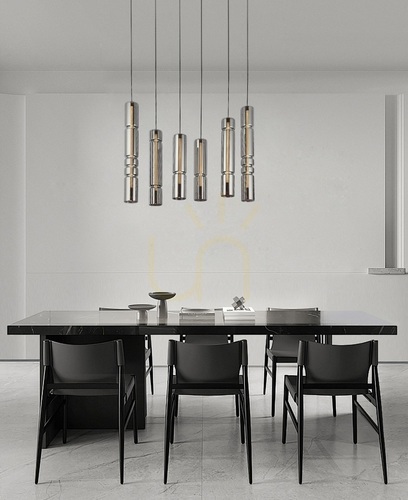
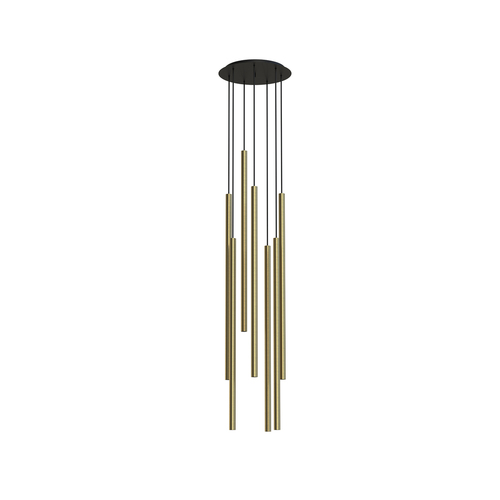
Tube chandeliers are what happens when the plainest possible fitting — a metal cylinder with a lamp inside — is multiplied. Several barrels are carried on one frame, bar or canopy, and the result takes the place a chandelier used to occupy without borrowing any of its ornament. There are no arms, no glass drops and no period reference; the composition is the decoration. That makes this a shape rather than a style, and the buying decisions are geometric: how many tubes, how they are arranged, how far apart, and at what heights.
Five arrangements, and what each is for
Multi-tube arrangements compared
| Arrangement |
Typical span |
Tubes |
Suits |
What goes wrong |
| Linear bar, tubes level |
60 to 120 cm |
3 to 6 |
Rectangular dining tables and kitchen islands |
Over a round table it lights the middle and leaves two sides dark |
| Staggered cluster on one canopy |
40 to 70 cm |
3 to 9 |
Square rooms, stairwell voids, above a coffee table |
Drops set at random rather than to a rhythm read as an accident |
| Ring or circular frame |
50 to 90 cm diameter |
6 to 12 |
Round tables, entrance halls, rooms with a central axis |
The frame casts its own shadow ring on a low ceiling |
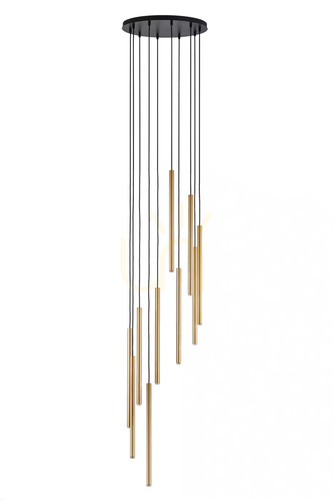
| Cascade down a void |
Narrow, 1.5 to 4 m tall |
5 to 15 |
Stairwells and double-height spaces seen from two floors |
Cleaning; every tube has to be reachable from somewhere |
| Grid on a plate |
40 to 80 cm square |
4 to 9 |
Low ceilings, where nothing may hang far |
Very little light reaches the walls, so the room edges go dark |
Set the rhythm before you set the height
A staggered cluster only works if the drops are related to each other. Three tubes at 60, 80 and 100 cm read as a designed sequence; three at 62, 74 and 91 cm read as an installation error. Pick an interval — 15 cm or 20 cm is the usual choice — and stick to it. The same discipline applies to a cascade, where the tubes want a consistent step down the void rather than a random scatter.
Over a table, all the tubes should sit at the same height and the lowest point should be 75 to 85 cm above the tabletop, exactly as for a single pendant. The exception is a table people also stand around at a party, where 85 cm gives sightlines across the surface and 70 cm does not.
How many tubes, and how bright each one should be
Multiplying fittings multiplies output, and this is where multi-tube designs are most often over-specified. Six barrels each holding a 400 lumen lamp is 2400 lumens landing on an area barely bigger than the table, which is roughly three times what a dining room wants in the evening. Two approaches work: fewer, longer tubes with a wider beam, or the full complement with a dimmer fitted from the start. The second is more flexible and costs almost nothing while the walls are open.
A useful sanity check is lumens per seat. Around 250 to 350 lumens per person at a dining table is comfortable for eating; 600 and above is homework light. If the arithmetic on a fitting you like comes out well above that, look for a lower-output lamp in the same socket rather than a different fitting.
The glare problem, and why barrel depth matters more in a cluster
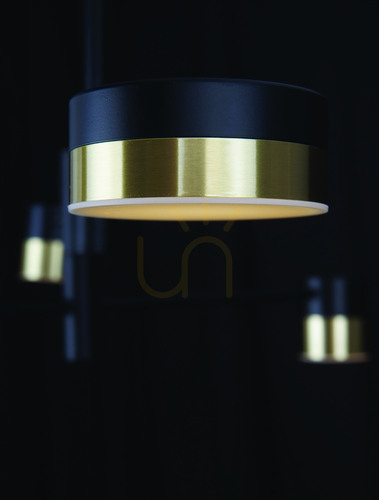
One shallow cylinder in a ceiling is a minor annoyance. Six of them at eye level over a table, seen from a sofa on the other side of the room, is a row of bright points that dominates everything. Depth is the fix: a barrel that hides the lamp above roughly 30 degrees from vertical disappears completely from a seated sightline while still lighting the table. When comparing two clusters, look at the section through the tube — how far the lamp sits up inside it — before comparing anything else.
The second fix is the beam. A narrow beam in a deep tube is almost invisible from the side and produces a crisp pool; a wide beam in a shallow tube spills onto everyone's face. Where the fitting takes a replaceable reflector lamp, this is a decision you make with a lamp purchase rather than a fitting purchase.
Frame, weight and fixing
A multi-tube fitting concentrates a fair amount of metal at one ceiling point, and the frame itself is often the heaviest part. Fix into structure — a joist, a noggin set between joists, or an anchor into a concrete slab — rather than into plasterboard alone. Two further points are specific to this form:
-
Cable dressing. On a cluster, every tube has its own cable running back to the canopy. Those cables are visible and part of the design, so they need to be cut cleanly to the intended drops rather than coiled inside the canopy.
-
Levelling. A linear bar shows every millimetre of slope against a ceiling line. Level the bar itself, not the ceiling, and check it along the length of the room rather than across it.
Common questions
Is a tube chandelier a chandelier at all?
Only in the sense that it occupies the same position and does the same job. It has no arms and no ornament, and it is bought by people who want the presence of a central fitting without the vocabulary of a traditional one. Calling it a cluster or a bar is more accurate; calling it a chandelier is how people search for it.
How many tubes for a table 180 cm long?
Three, spaced 60 to 70 cm apart, or two longer barrels if you prefer fewer objects. Five is too many at that length and produces overlapping pools with no shape.
Can I mix tube lengths in one cluster?
Yes, and on a staggered design it is usually better than mixing only the drops — a short barrel high up and a long barrel low down keeps the visual weight at the bottom of the composition, which is what makes a cluster look intentional.
What about a low ceiling?
Below about 250 cm, a hanging cluster is difficult anywhere except over a table. The grid-on-a-plate form or plain surface cylinders solve the same problem without the drop, and the spacing and beam-angle arithmetic for those is on tube ceiling lights.
Can I build the same effect from single pendants?
Often more successfully, because you control the spacing and the drops exactly and you can add one later. It needs several ceiling outlets or a track, which is the trade-off. The individual fitting choices are covered on tube pendant lights, and if what you actually want is a whole ceiling in one quiet language, minimalist ceiling lights is the broader comparison.