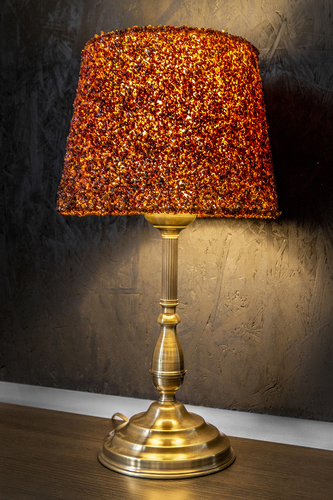
Colonial lighting is a furniture style that happens to hang from the ceiling. It came out of European households set up in warm climates, so it keeps the formality of a drawing room but swaps in materials that suited the tropics: brass instead of silver, cane and rattan instead of upholstery, amber and smoked glass instead of crystal. If you are furnishing around dark hardwood, leather or a woven rug, this is the filter that matches it.
The three tells
A fitting reads as colonial when it shows articulation, warm metal and a low centre of gravity. Articulation means a body you can count — rings, arms, turned uprights — rather than a smooth pressed shade. Warm metal means brass or brass-toned steel, never chrome. Low centre of gravity means the visual weight sits near the bottom, which is why multi-arm candle chandeliers and squat table lamps both belong here while a tall slim cylinder does not.
What the style does to each type of fitting
On a pendant or chandelier the style spends its budget on width. A twelve-arm candle frame in glass and brass wants clear air around it; over a dining table, plan the diameter at roughly a third of the table width and hang the lowest element 70–80 cm above the top. With candle arms, measure to the lowest arm, not to the body.
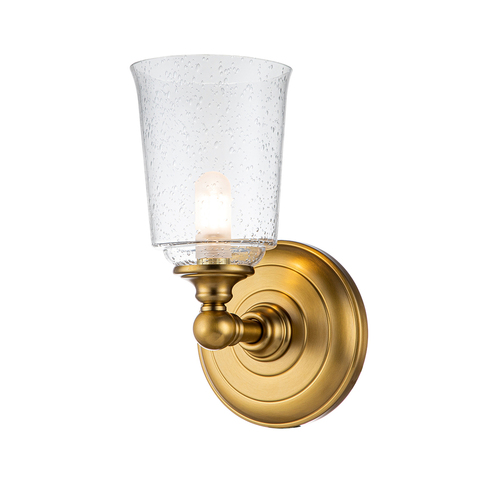
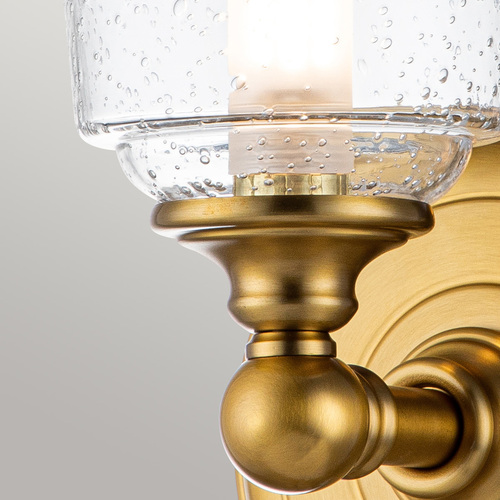
On a wall light the same vocabulary shrinks to something you look at closely. Every solder line and every edge on the brass is visible from a metre away, so finish quality matters more here than anywhere else — and a pair either side of a mirror does more work in a hallway than a single ceiling fitting.
On a table lamp the style is at its most forgiving. A natural amber body on a brass base changes the mood of a corner and nothing else, and you can move it. The practical constraint is the flex: a lamp supplied with a cable and plug needs a socket within reach, which quietly rules out the console table in the middle of the room.
Glass, amber and what they do to the light
Tinted glass is not a neutral cover. Amber shifts the apparent colour temperature several hundred kelvin below whatever the bulb box claims, and it absorbs a real share of the output, so a lamp under an amber shade needs more lumens than the same fitting under clear glass to look equally bright. Ribbed or reeded glass does something different again — it throws vertical stripes onto the nearest wall, which is handsome over a sideboard and distracting over a worktop.
Brass: lacquered or left bare
You only find out which you have when you clean it. Lacquered brass stays the same colour for years and wants nothing but a dry soft cloth; metal polish strips the lacquer and leaves dull streaks that cannot be buffed out. Bare brass darkens instead, which most people buying into this style actually want. If you would rather keep the shine, plan on polishing it, and expect it to tarnish faster in a kitchen or bathroom than in a bedroom.
Bulbs and dimming
Candle arms take E14 candle lamps, and a visible filament suits the style far better than a frosted golf ball. Stay between 2200 K and 2700 K; at 3000 K brass starts to read grey, and at 4000 K the effect is gone entirely. Where the bulb is replaceable, dimmability is a property of the bulb rather than the fitting — and a dozen 4 W LED candles together often fall below the minimum load a leading-edge dimmer needs to run without flicker.
Common questions
Does colonial style work in a modern flat?
Yes, one piece at a time. A single brass fitting in a plain room reads as a deliberate accent. Three in the same idiom turn the whole room into a theme.
How is it different from rustic or boho?
Degree of finish. Rustic rests on rough timber and dark ironwork; colonial uses polished wood, brass and neat cane work, and is noticeably more formal. For the looser, more textile take on natural materials, look at the boho fittings.
What wall colours suit it?
Off-white, sand, and deep green. Against a bright cool white, warm brass tends to look yellow rather than rich.