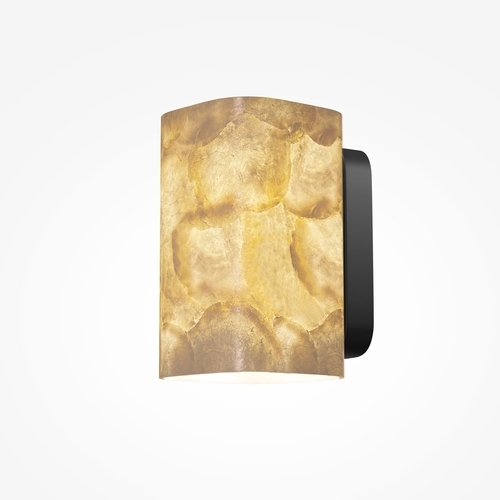
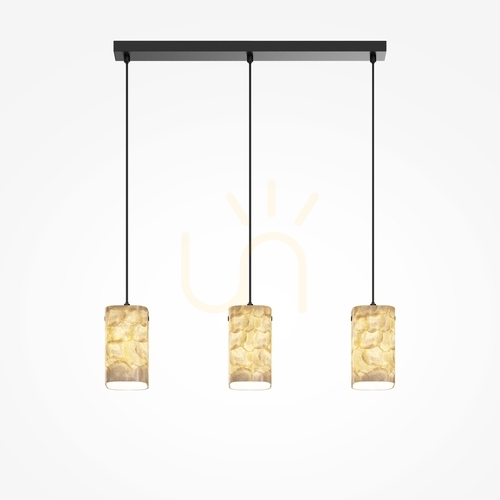
A shell lamp, in the true sense, is a light whose shade is built from real shell: translucent capiz discs, iridescent mother-of-pearl, or small whole shells wired to a frame. What the material changes is the light itself – instead of the crisp pool you get from glass or a fabric drum, shell breaks the beam into a soft, pearly glow and throws faint reflections across the walls.
It is worth being clear about the name, because plenty of lamps called “shell lamps” are only shaped like one. Sculpted table lamps in resin or ceramic, and little LED night lights with a pearl in an open clam, borrow the outline but not the material. They can look lovely; they just behave like any other opaque base or plastic diffuser. If the shell itself matters to you, check the materials listed for the shade rather than the product name.
Capiz, mother-of-pearl and whole shells
Capiz comes from the windowpane oyster, Placuna placenta, a flat bivalve gathered mainly around the Philippines, where its shells were once set into window frames in place of glass. Cut into thin discs or squares, it lets light through, so a capiz pendant glows across its whole surface.
Mother-of-pearl is the nacre lining the inside of certain shells. It is denser and barely translucent, so it filters some light and bounces the rest, creating a shifting pattern of light and shade. Lamps made from whole shells – cowries and small spirals on a wire globe or chandelier – sit at the decorative end: more shadow than light, very much a boho piece.
Because every disc is natural, expect variations in colour and markings, and the odd tiny chip along an edge. That is the material, not a fault.
Choosing the right one for a British home
A few practical details decide whether a shell light works in the room you have in mind.
| What to check |
Typical choice |
Why |
| Lampholder |
E27 or E14 on most shell fittings; B22 bayonet is the UK norm |
Match your bulbs, or buy the right cap before fitting day |
| Colour temperature |
2700–3000 K warm white |
Cooler light from 4000 K makes shell look grey |
| Bulb |
LED, 4–8 W, roughly 470–800 lumens, frosted or opal |
Runs cool; a clear filament bulb shows as a bright spot through capiz |
| Ceiling height |
around 2.4 m in many UK homes |
Choose a flush or semi-flush shell light for hallways and low rooms |
| Over a dining table |
bottom of shade 75–85 cm above the top |
Light on the table without blocking the view across it |
| Protection rating |
usually IP20 |
Dry rooms only; in a bathroom keep outside zones 0–2 |
Shades, table lamps and hanging lights
Shell lamp shades are often sold on their own, without flex or lampholder. They hang from a separate pendant set or ceiling rose, so check that the set takes the weight and that the shade’s top ring suits its fitting. A capiz shade over a bare bulb is one of the simplest ways to change the mood of a bedroom.
Hanging capiz lights come as layered rings of discs, tall cascades or round lanterns. The bigger ones are heavier than they look – hundreds of discs on a metal frame – so they belong on a hook fixed into a joist, not a plasterboard fixing alone. Connecting one to the lighting circuit is a job for a qualified electrician working to BS 7671, who will also know the extra rules for bathrooms.
Shell table lamps are the easiest entry point: plug in and go. On a bedside table or sideboard they give mood light rather than reading light, so pair one with a directional lamp if you read in bed.
Looking after shell
Capiz and mother-of-pearl are mostly calcium carbonate, which means vinegar, lemon cleaners and anything acidic will dull them. Dust with a soft paintbrush, a feather duster or a hairdryer on the cool setting. Water loosens the glue that holds many discs, so wipe mother-of-pearl, if you must, with a barely damp cloth and nothing else. Keep shell lights away from the hob, where grease settles on every disc, and away from strong south-facing sun if the shell is dyed, as colour can fade over time.
Frequently asked questions
What is a capiz shell lamp?
A lamp whose shade is made from thin, translucent discs of windowpane oyster shell, usually strung or glued onto a metal frame. The whole shade glows when the bulb is on.
Are vintage shell lamps worth buying?
Many are, especially well-kept mother-of-pearl and capiz pieces from the sixties and seventies. What matters more than age is condition: complete discs, a sound frame and wiring you trust. Have old flex and lampholders checked or replaced before use.
Can I put a shell lamp shade on my existing ceiling light?
Usually, if the shade’s fitting ring suits your lampholder and the pendant set can carry its weight. Heavier capiz cascades need their own hook rather than hanging from the flex.
Is a shell table lamp made of real shell?
Not always. Sculpted shell-shaped bases are often resin or ceramic. Real shell lamps show the layered texture and uneven sheen of capiz or nacre.
Where do capiz shells come from?
Mostly from the coastal waters of the Philippines, which is also where much of the craft of cutting and assembling the discs is based.
How do I clean a shell lamp?
Dry dusting only – brush, duster or cool air. Avoid sprays, water and acidic cleaners.
If you would rather have shell on the wall than overhead, read on about shell wall lights. For a comparison with glass, rattan or fabric, start from indoor lighting.