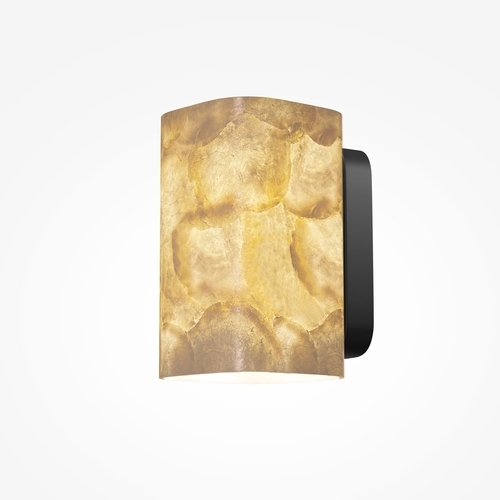
A scallop wall light is a wall fitting whose shade is shaped like a shell, usually a ribbed scallop opening upwards, sometimes a smoother, rounder clam. The shape is what you are really buying: rather than throwing light straight into the room, the shell spreads a soft fan across the wall above it, so the question is less ‘how bright?’ and more ‘what will the wall look like at night?’
The motif is old. It turns up in Roman decoration, in grottoes and Georgian plasterwork, and again in Art Deco interiors between the wars and in the cast plaster sconces of the post-war years, which is why a shell feels at home in a Victorian terrace with a picture rail as much as in a pared-back new-build bedroom.
Scallop, clam or real shell?
Search for shell wall lights and three quite different things come up:
-
Scallop – a fluted fan, nearly always open at the top. In plaster it works as an uplighter: light grazes the ribs and washes the wall and ceiling, and the shade itself stays matt.
-
Clam – a rounder, smoother bowl, often in glass or glazed ceramic. Glass versions glow through their whole surface; tinted amber glass gives a warm, honeyed light.
-
Made from real shell – mother-of-pearl discs or capiz panels rather than a shell silhouette. Here the material does the work, scattering small iridescent reflections. Those are a subject of their own: see shell lamps in mother-of-pearl and capiz.
Choosing a finish
| Finish |
Light effect |
Typical size |
Usual fitting |
Works well in |
| Raw or painted plaster |
uplight, soft wash on the wall |
30–35 cm tall, 16–19 cm deep |
E14 small Edison screw or E27 |
living rooms, period hallways, either side of a fireplace |
| Patinated cast composite |
uplight with an aged, stone-like look |
larger statement pieces, 50 cm wide or more |
E14 or E27 |
high-ceilinged rooms, stairwells |
| Glass (amber, clear, ribbed) |
whole shade glows |
around 20 × 22 cm, 11–13 cm deep |
G9 LED capsule |
bedrooms, narrow landings, bathrooms if rated |
| Painted metal or brass |
light escapes at the edges, crisp and graphic |
around 25 cm across, about 10 cm deep |
G9 or E14 |
accent lighting, dressing areas |
Whatever the finish, warm white at 2700–3000 K is what gives plaster that creamy glow. Cooler light around 4000 K turns white plaster flat and slightly grey, and the shadows between the ribs lose their depth.
Fitting one in a UK home
Most shell wall lights are hard-wired to a back box in the wall and switched from the room’s light switch, so new wiring or a new wall-light circuit falls under Part P of the Building Regulations in England and Wales and should be done by a qualified electrician. In a typical room with a 2.4 m ceiling, a centre height of roughly 1.6–1.8 m leaves an uplighter enough space to fan out before the light hits the ceiling. In a period room with taller ceilings you can go a little higher, often just below the picture rail.
Plaster is heavier than it looks, and a large shell can weigh several kilos. Use plugs suited to the wall: masonry fixings for brick, cavity fixings for plasterboard. Check for cables before drilling – the supply to a wall light usually runs vertically from the switch or the ceiling.
Painting and care
Raw plaster shells are often sold unpainted precisely so you can match them to the wall. Matt emulsion works well; a very porous cast may need a thinned mist coat first. Paint the shade off the wall, and keep to LED bulbs afterwards, as they run far cooler than halogen and are kinder to both plaster and paint. Dust plaster with a dry, soft brush and never wash it, because water leaves tide marks. Glass and glazed ceramic can take a damp cloth once the light is off and cool.
Frequently asked questions
What is the difference between a clam shell and a scallop wall light?
A scallop has the familiar ribbed fan and is usually an open-topped uplighter. A clam is a smoother, rounder bowl and more often comes in glass that lights up as a whole. In practice, retailers use the two names loosely, so look at the photos and the light direction rather than the name.
Will a plaster shell wall light work in a living room?
Yes, as mood lighting. A pair either side of a chimney breast, mirror or sideboard gives a calm, layered look, but in a larger room you will still want a ceiling light or floor lamp for general light.
Can I put a scallop wall light in the bathroom?
Only if it carries a suitable IP rating – usually at least IP44 – and sits in a zone permitted under BS 7671. Plaster shells are normally IP20 and belong in dry rooms; some glass shells are rated for bathrooms.
Are there rechargeable shell wall lights?
Some small decorative ones run on a battery or USB-C, which avoids wiring altogether. They are lighter and dimmer than mains fittings, so treat them as accent lights rather than room lighting.
Is an antique scallop wall light safe to use?
Often, once it has been checked. Old plaster sconces may have perished flex and brittle lampholders, so have an electrician inspect and, if needed, rewire them before fitting. Hairline cracks in the plaster are common and usually cosmetic.
Which bulb does a shell wall light take?
Plaster versions mostly use E14 or E27, glass and metal ones often a G9 capsule. Many UK homes standardise on B22 bayonet, so check the lampholder before buying spares, and make sure the bulb fits inside a shallow shade.
More on wall lights in other shapes, finishes and for every room: indoor wall lights.