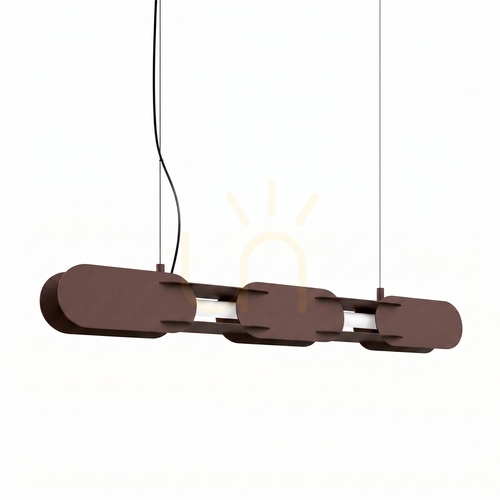
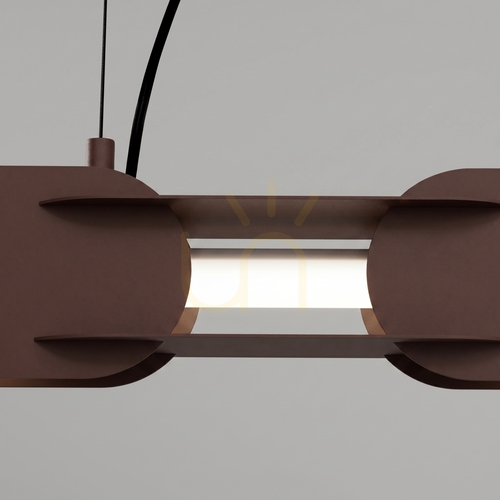
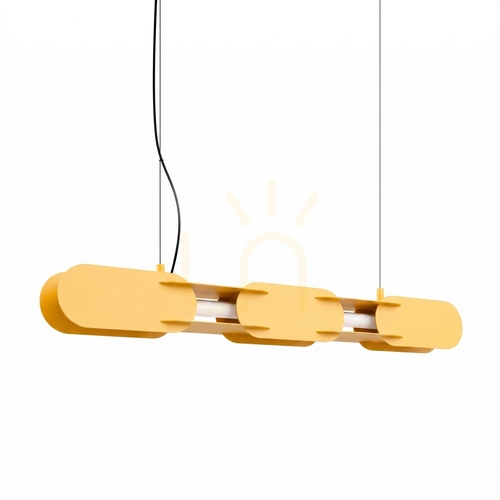
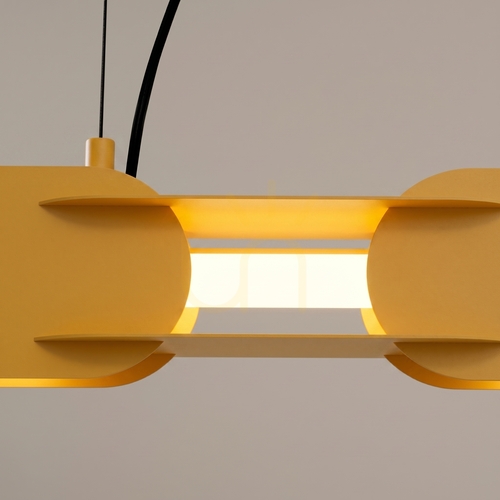
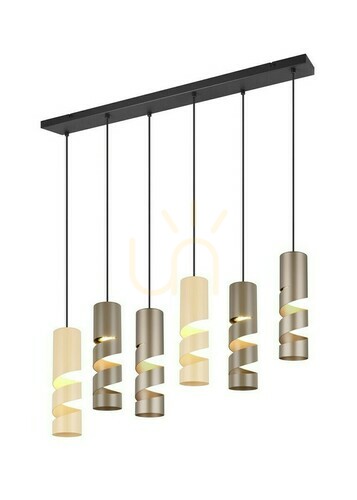
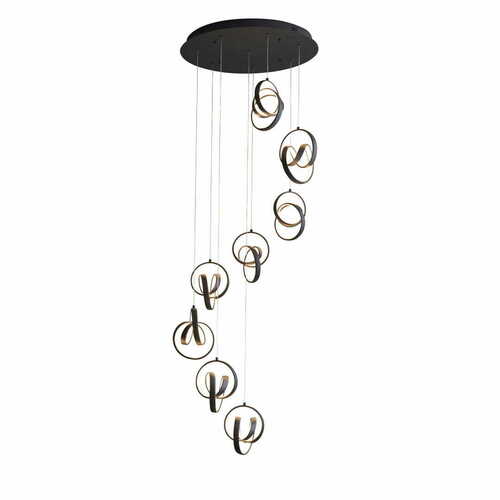
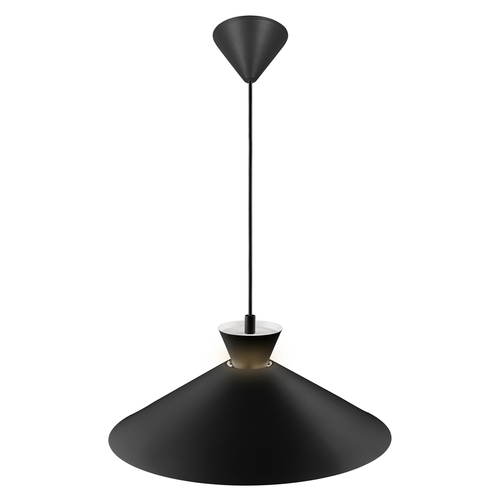
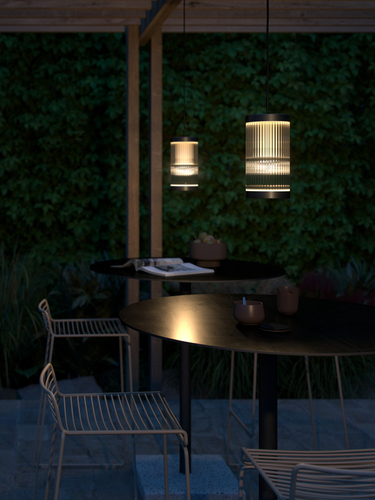
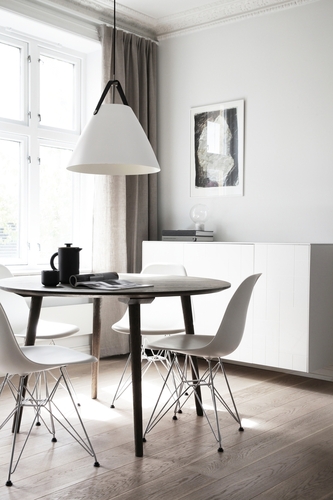
Design pendant lights is the category where authorship is most defensible, because a suspended shade hangs at head height and every mistake in its geometry lands directly in somebody's eyes. That is the problem the twentieth century's best-known lighting designers set out to solve, and the reason their pendants are still in production while thousands of anonymous shades from the same decades are not.
The shading problem, and the two answers to it
Hang a bare bulb over a table and you have a small, extremely bright object at exactly the height where people look at each other. There are only two honest ways out.
Layer the shades
Poul Henningsen began publishing his system in the mid-1920s: three concentric shades whose curves are set on a logarithmic spiral, arranged so that no direct ray leaves the fitting at a normal viewing angle and every ray is reflected at least once before it reaches the table. The visible result is a stack of tiers; the invisible result is that you can sit under it, look up, and see no source. Later fittings from the same workshop take the idea to dozens of overlapping leaves in tiered rows. This is the branch of the family where the design is genuinely an optical instrument.
Enclose or aim
The alternative is a solid shade with a deep enough cut-off that the source disappears above your sightline — Alvar Aalto's stepped brass bell of 1937 does it with a single rim; a plain metal cone does it by geometry. The rule of thumb is simple: stand where people will actually be and check whether you can see the lamp. If you can, either the shade is too shallow or it is hanging too high.
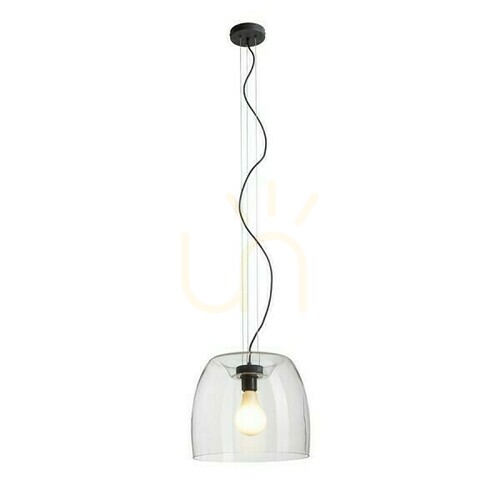
The third path — a bare filament bulb on a flex, made deliberate by designers from the late 1950s onward — is a legitimate design position rather than a failure, but it only works at low brightness. A visible source needs a lamp you can look at.
Hanging heights that hold up in a real room
Where the bottom of the shade should end up
| Position |
Bottom of shade |
Why |
| Over a dining table |
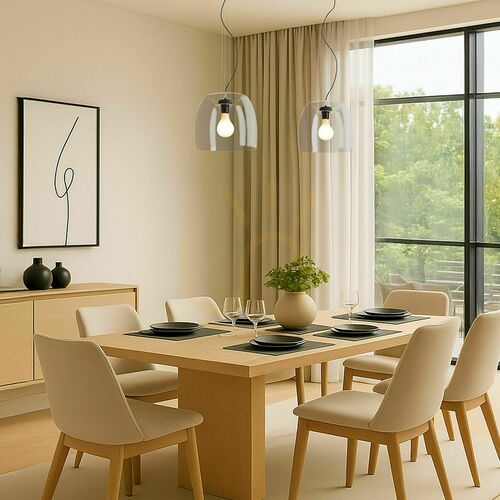
70 to 90 cm above the tabletop |
Below eye level of the person sitting opposite, above the eye level of the person standing to serve. Use 75 cm with a 2.5 m ceiling and go higher as the ceiling rises. |
| Over a kitchen island |
75 to 85 cm above the worktop |
High enough to clear a tall bottle and a raised arm, low enough to keep the light on the surface. |
| Beside a bed, in place of a table lamp |
1.3 to 1.5 m above the floor |
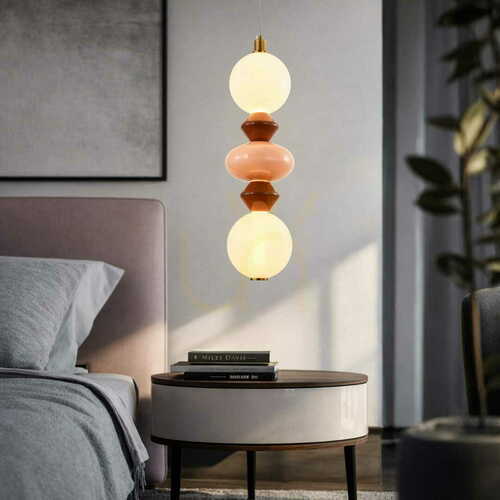
Shade at the eye level of somebody sitting up. Frees the whole bedside surface. |
| In a walking route |
2.1 m above the floor, minimum |
Head clearance. In a hallway or over a stair this overrides every aesthetic argument. |
| Over a stairwell |
2.1 m above the highest tread it passes |
Measure from the step below the fitting, not from the floor at the bottom. |
How wide, and how many
-
Single pendant over a rectangular table: shade width roughly one third to one half of the table width.
-
Round table: about one third of the table diameter.
-
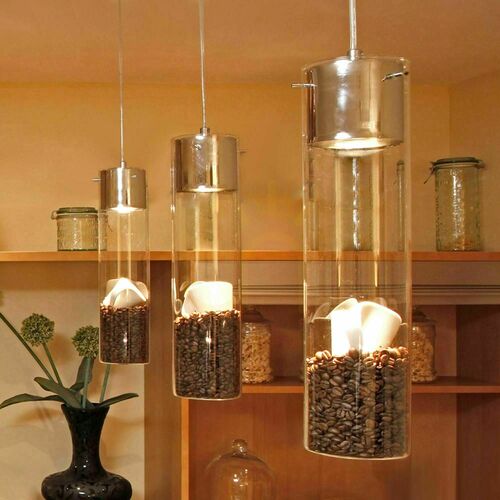
A row of three over a long table or an island: 60 to 75 cm between centres, and at least 30 cm in from each end. Three small shades read as a considered line; three large ones read as a barricade.
-
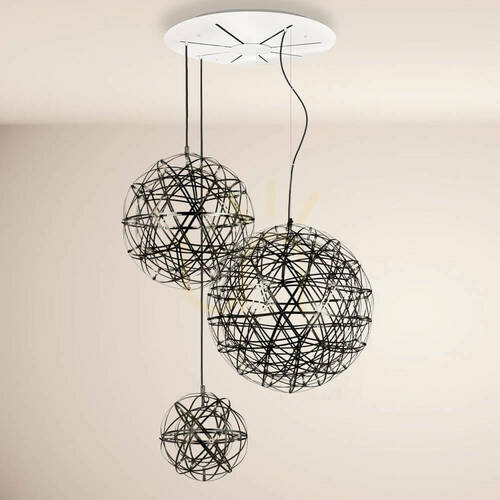
A cluster on one canopy: stagger the drops by at least 15 cm or the group flattens into a disc when seen from the side.
Length is the specification people forget to check. Rod-suspended fittings adjust in fixed steps, because you shorten them by removing a rod; cable- and cord-suspended fittings shorten anywhere, with the surplus either cut by an electrician or coiled inside the canopy. If the ceiling outlet is not directly over the table — and in older apartments it rarely is — you need either a hook to swag the flex sideways or a fitting supplied with extra cable. Ask before you buy, not after the electrician has left.
Original, licensed reissue, replica
Pendants are the most copied part of the design catalogue, and the copies are hardest to judge from a photograph because the geometry that matters is inside the shade. On a layered fitting, the spacing and the curve of each tier are the design; a copy that gets them approximately right is not glare-free, which is the entire point of the object. A licensed reissue carries the manufacturer's mark, a model reference, an EU energy label and a route to spare parts. The legal position in the EU is also worth knowing: registered designs run for up to twenty-five years, but the Court of Justice has confirmed that a work of applied art can carry copyright on its own account, and copyright lasts for the author's life plus seventy years. Several of these shapes remain protected on that basis, which is why the same copy is offered openly in one market and quietly withdrawn in another.
Source, fixing and service
-
Sockets. E27 and E14 at 230 V dominate, with GU10 in smaller directional shades and integrated LED modules in the newer designs. An integrated module is not a bulb — check what happens when it fails.
-
Visible bulbs. Frosted or long low-brightness filament lamps only. A compact high-output lamp in an open shade over a table ruins an otherwise good fitting.
-
Colour. 2700 K over a dining table; 3000 K over a kitchen island if the worktop is cool-toned stone. Above 3000 K, brass goes green and food looks wrong.
-
Dimming. A dining pendant is the strongest case for a dimmer in the whole house. Confirm the lamp is dimmable, use a trailing-edge dimmer with retrofit LEDs, and respect the dimmer's minimum load.
-
Fixing. The ceiling rose is a connection, not a structural anchor. Anything with mass needs a fixing into a joist or a bracket spanning between joists.
Questions people ask
My ceiling outlet is not over the table. What now?
Either move the outlet, or hang the fitting from a ceiling hook above the table and run the flex across to the rose. The second option is common, reversible and looks deliberate if the flex is taut and the hook is a proper one. Buy a fitting with generous cable if you plan it.
How low is too low over a table?
Below about 65 cm from the tabletop, people at either side start ducking to see each other, and the shade gets caught by serving dishes. Below 60 cm the fitting is in the way.
Can one pendant light a whole living room?
No, and neither can any other single fitting. A pendant is aimed light. Give it a table or a seating group to sit over, and light the rest of the room from the walls and from lamps.
Are the tiered fittings brighter than they look?
They are the opposite: they deliver less light downward than a plain cone with the same lamp, because much of the output is reflected between shades before it leaves. That is the trade for having no glare. Plan on the fitting being comfortable rather than powerful, and add a second light source if the table is also used for work.
What else should I compare?
If you have not settled on a suspended fitting, design ceiling lights compares pendants against flush mounts and multi-light fittings, and design chandeliers covers the multi-source end. By period rather than by author, see pendant lights art deco and mid century pendant lights.