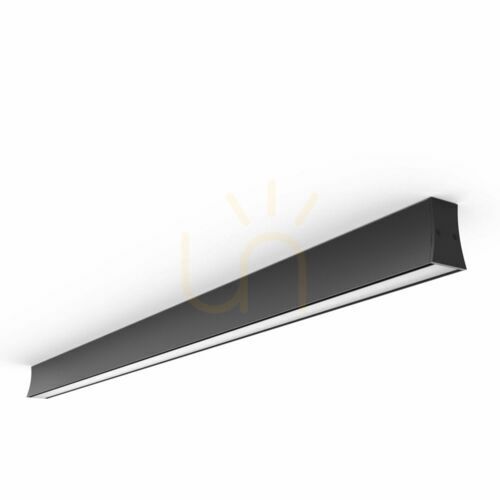
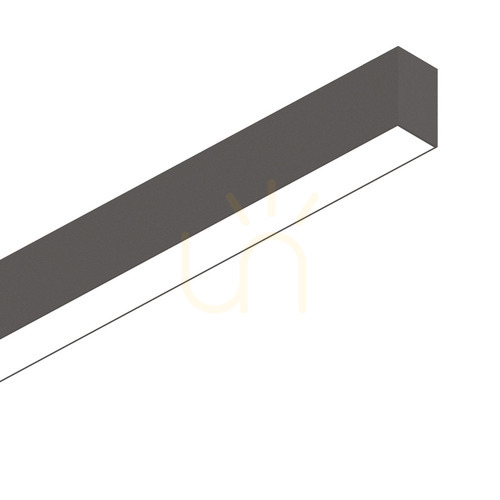
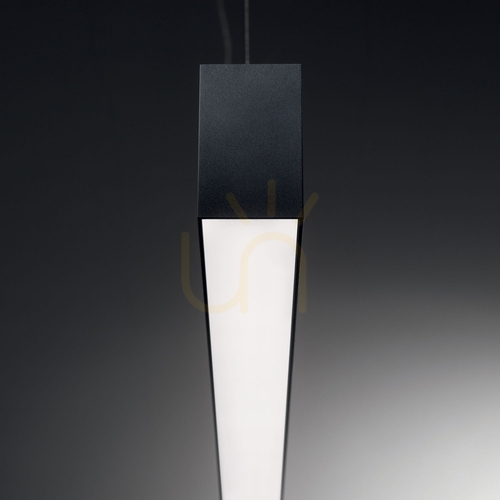
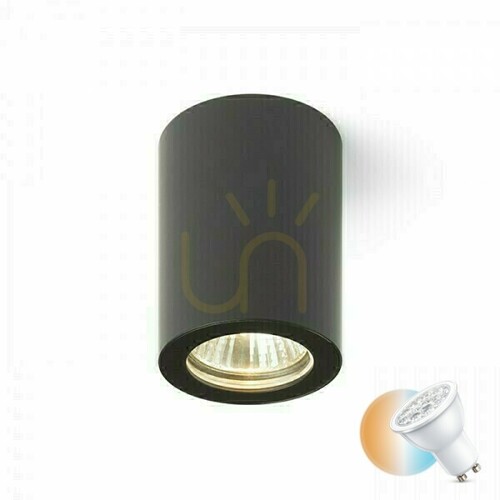
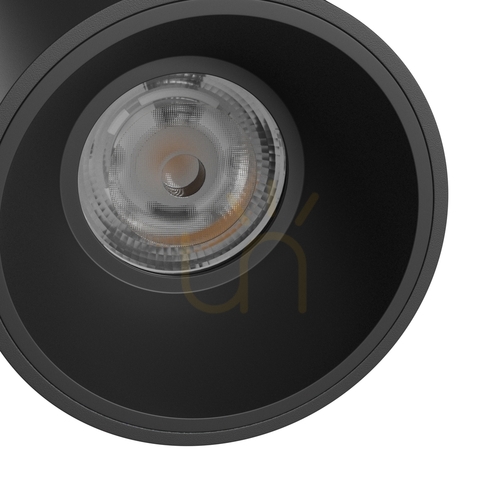
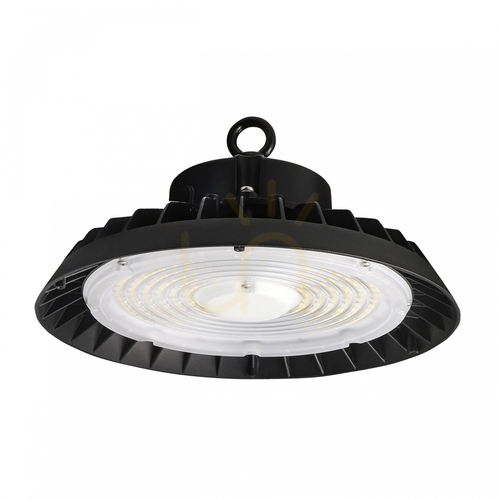
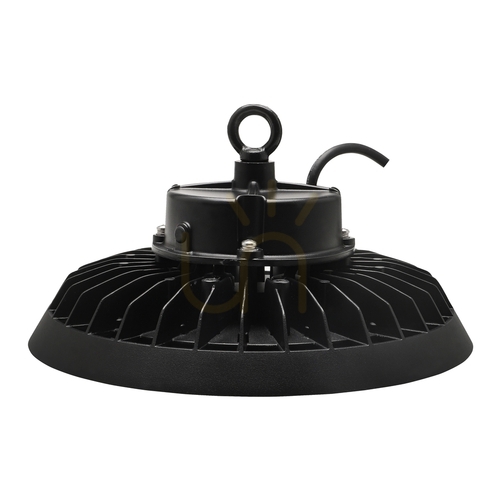
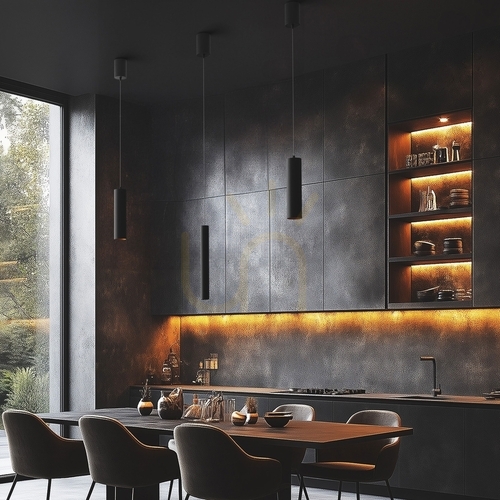
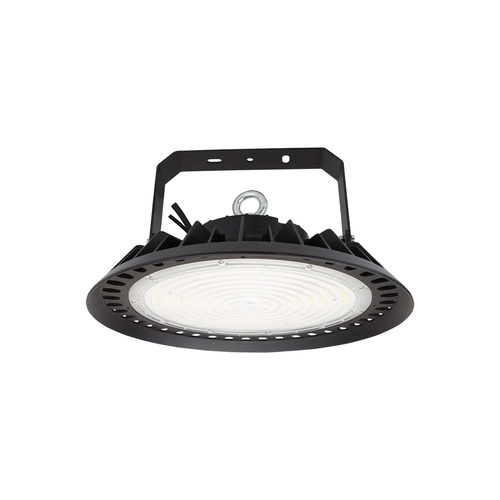
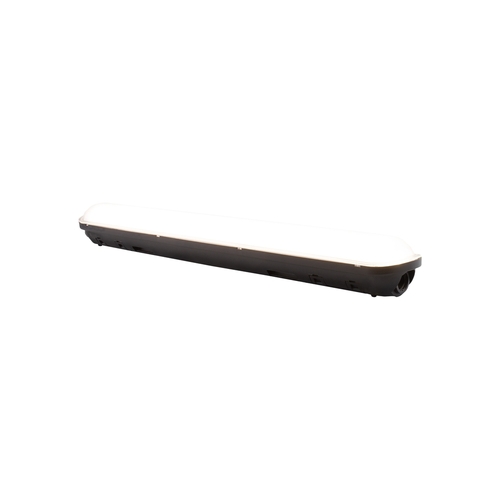
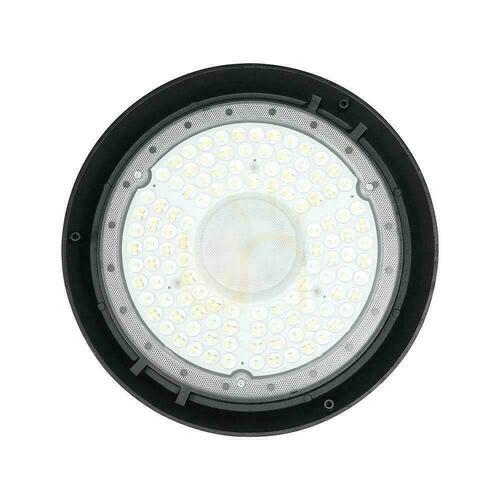
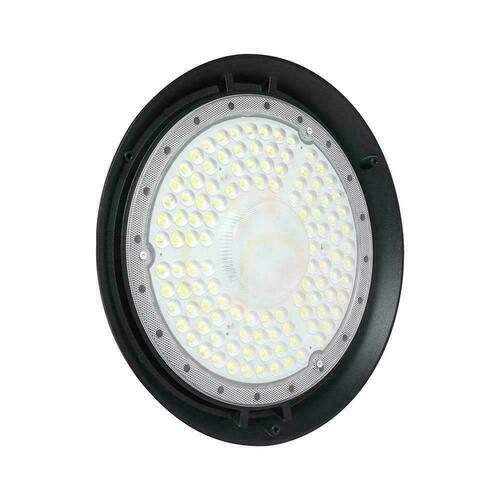
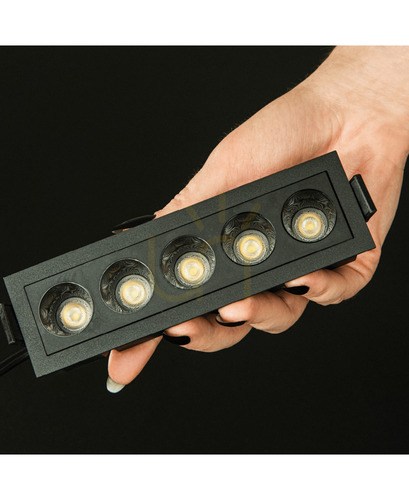
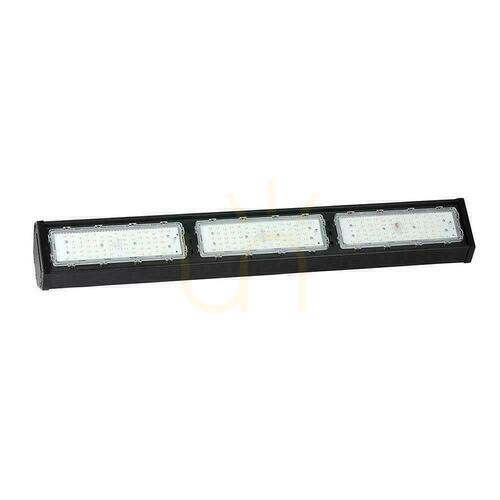
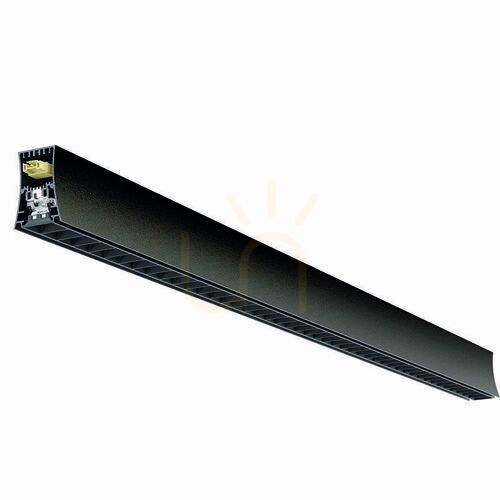
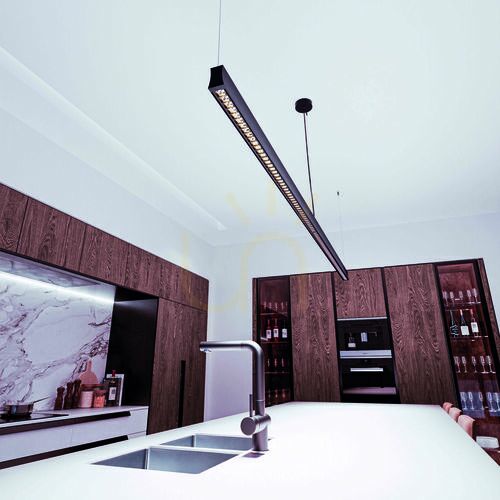
This is the black housing filter on the technical range — the fittings specified when the ceiling is dark, the services are exposed, or the shopfitter wants the hardware to disappear rather than announce itself. What sits behind it is a genuine working mix: three-phase track and track spots, GU10 and AR111 surface tubes, LED light bars and IP66 hermetic bars, UFO high bays, surface and pendant fittings, a few outdoor spike and wall spots, and the track connectors and adapters that hold a system together. SpectrumLED, V-TAC, Rendl, Ideallux, Zambelis, Mantra, Lumines and Stucchi all appear.
What a black housing changes, and what it doesn't
Finish has no effect on the light output printed on the box — a black fitting and a white one from the same family share their lumens, efficacy and colour temperature. What changes is the ceiling. A black body against a dark soffit reads as a shadow instead of a row of bright rectangles, and in a shop that keeps attention on the goods. The trade-off is reflectance: a dark housing bounces almost nothing back into the room, so the useful light is what comes out of the aperture. Plan lux on the task, not on the assumption that the ceiling will help.
Track, spots and pendants
Three-phase track is the backbone of most black retail schemes here, with adjustable reflectors at 24°, 26° and 38° for accenting, and GU10 or AR111 heads where the lamp is meant to be swapped. Because track separates the circuit from the fitting, a display can be relit without touching the ceiling. Pendants in black cover counters, bar tops and workbenches, and magnetic ultra-slim linear heads suit a recessed profile. Connectors, feed-ins and phase adapters are stocked alongside, which matters — a track system is only as good as its joints.
High bays and light bars
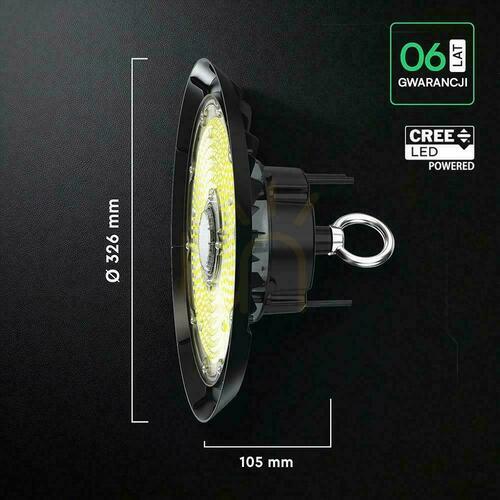
The heavier end of this filter is industrial. UFO high bays around 200 W deliver in the region of 27 000 to 37 000 lm and are meant for mounting from roughly 6 m up. Hermetic light bars at 1200 mm with IP66 and IK10 go into workshops, wash-down areas and loading bays, and some carry 1-10 V dimming so they can be tied into a control scheme. Aluminium bodies dominate here for a practical reason: they shed heat, and heat is what shortens an LED's life.
Where these fittings are rated to go
Ratings run right across the range. IP20 items belong in dry retail and office space; IP44 handles splashing; IP54, IP65 and IP66 pieces are built for halls, garages and outdoor use, and this filter does include spike and wall spots intended for outside. Read the rating on the individual product rather than assuming a black finish implies an exterior fitting. IK10 appears on the hermetic bars, meaning a housing tested to a 20 J impact — worth having where forklifts work.
Keeping a black scheme consistent
Two things give a mixed-supplier black scheme away. The first is colour temperature: hold the whole run to one figure, usually 3000 K in retail and hospitality, 4000 K in workshops and offices. The second is the black itself — matt, textured and semi-gloss blacks from different makers rarely match under a beam, so keep one manufacturer to a sightline where you can. If colour judgement matters on the shop floor, check Ra as well; Ra 90 fittings exist in this range, and Ra 80 is the common baseline.
Questions buyers ask
Does a black fitting run hotter than a white one?
Not meaningfully indoors. Thermal performance comes from the heatsink and the driver, not the paint. In direct sun outdoors the difference is measurable but still small next to the effect of the housing design.
Can I mix black track from different brands?
Three-phase track is broadly standardised, but adapter geometry and finish vary between makers. Confirm the adapter profile on the product card before mixing, and expect a visible difference in the shade of black.
Are these fittings dimmable?
Some are, some are not. Dimming is listed per product — look for 1-10 V or DALI, and remember an integrated-LED fitting cannot be made dimmable by changing the lamp.