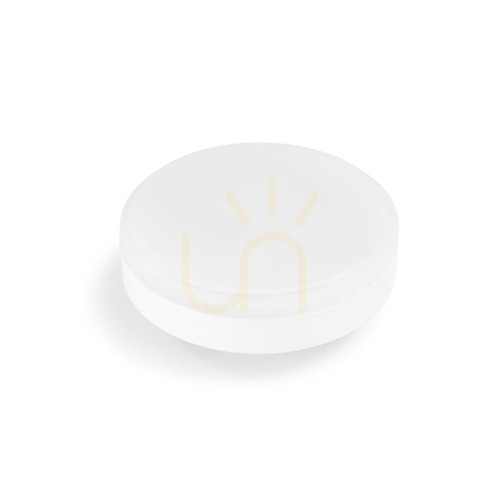
A GX53 bulb is a flat LED disc, roughly the size of a jam-jar lid, with two short pins on its back. You push it into the lampholder and give it a small clockwise turn to lock it. Because the whole lamp is only 2.5–3 cm deep, it fits slim downlights, kitchen under-cabinet lights and surface spots that a GU10 or an E27 bulb would never squeeze into.
Many older fittings with this cap were sold with compact fluorescent discs. Fluorescent versions have largely given way to LED, and an LED disc with the same cap is the straight swap: it runs on 230 V mains like the original, needs no transformer and keeps its driver inside the disc.
GX53, GU5.3, MR16 or G53?
These names cause more wrong orders than anything else on a lighting receipt. The letter G means the lamp has pins rather than a screw thread, the number gives the pin spacing in millimetres, and a second letter such as U or X marks the variant. So GX53 and GU5.3 share almost the same digits but have nothing else in common. Here's how the usual suspects compare:
| Cap |
What the lamp looks like |
Typical supply |
Where you usually meet it |
| GX53 |
flat disc, about 75 mm across and 2.5–3 cm deep |
230 V mains, no transformer |
slim downlights, under-cabinet lights, shallow surface spots |
| GU10 |
reflector spot about 50 mm wide with two chunky twist-lock pins |
230 V mains |
ceiling spots, track lights |
| GU5.3 (MR16) |
reflector spot about 50 mm wide with two thin pins 5.3 mm apart |
usually 12 V via a transformer or driver |
older low-voltage downlights, display lighting |
| G53 (AR111) |
large reflector about 111 mm across with flat lugs |
usually 12 V |
shop and accent lighting, large recessed spots |
If you're not sure what you've got, switch off, take the old lamp out and look. A GX53 is unmistakable once it's in your hand: a white or frosted puck with a pin on either side.
Replacing GX53 CFLs with LED
Old fluorescent discs were usually 7, 9, 11 or 13 W. An LED disc gives the same light for roughly half the power or less, so don't match the watts – match the lumens. As a rough guide, a 4–5 W LED disc gives about 400–470 lm, the brightness of a 40 W incandescent bulb; 6–7 W gives 550–650 lm; and 8–9 W reaches around 800 lm, close to an old 60 W bulb. Stronger 10–12 W discs, at around 900–1,100 lm, suit high ceilings or rooms where you want fewer light points.
As a starting point per downlight, 400–500 lm is plenty for a hallway or landing, 600–800 lm works in a kitchen or bathroom, and 300–450 lm is usually enough under wall cabinets, where the light only travels a short way to the worktop.
Check the depth as well. Discs vary by a few millimetres between makers, and in a tight cabinet light that can be the difference between a clean fit and a diffuser that won't close. Measure the lamp you're taking out before ordering its replacement.
Warm white or cool white?
Warm white (2700–3000 K) is the usual pick for living rooms, bedrooms and most hallways. Cool white (4000 K) is crisper and easier to work under, which is why people choose it for kitchens, bathrooms and home offices. Daylight (6000–6500 K) belongs in the garage or utility room. Whatever you choose, use the same colour temperature for every downlight in a room: a single 4000 K disc in a run of 3000 K ones stands out the moment you switch on.
A colour rendering index of Ra 80 is standard and fine for general lighting. Over a worktop or a bathroom mirror, Ra 90 or above makes food and skin tones look more natural. Most GX53 discs spread light over 110–120° through an opal diffuser, so you get an even wash rather than a hard-edged spotlight pool.
Dimming GX53 LEDs
Many GX53 discs aren't dimmable, so check the box before you buy if your downlights are on a dimmer. Older dimmer switches were designed for halogen and incandescent loads and can make LEDs flicker, hum or fail early. A trailing-edge dimmer rated for LED loads is the safer partner, and it's worth checking the switch's minimum load too – a few low-wattage discs may fall below it. Smart GX53 discs, controlled from an app or voice assistant, are another way round the problem where rewiring a switch isn't practical.
Fitting and safety
Swapping a lamp is a DIY job: isolate the circuit, turn the old disc anticlockwise, pull it out, line up the new one's pins and turn it clockwise until it clicks. Anything involving the fixed wiring – new lampholders, extra downlights, moving a switch – is work for a qualified electrician following BS 7671. The disc itself is usually only IP20, so in bathrooms it's the fitting's IP rating that decides how close to the shower it can go. Recycle spent LED lamps at a household waste recycling centre rather than the bin.
Frequently asked questions
What is a GX53 bulb?
A low-profile, mains-voltage lamp shaped like a puck, with two pins 53 mm apart. It twists into its holder rather than screwing in.
What is a 53 watt bulb equivalent to?
The 53 in GX53 has nothing to do with power – it's the pin spacing. A typical GX53 LED draws 4–9 W, and an 8–9 W disc gives about the same light as an old 60 W bulb.
Is GU5.3 the same as MR16?
Almost always in practice. MR16 describes the reflector shape and size, GU5.3 the cap it usually sits on. Neither fits a GX53 lampholder.
What does the G stand for in light bulbs?
It marks a lamp with pins instead of a screw thread, as in G4, G9, GU10 or GX53.
Can I get a dimmable GX53 bulb?
Yes, but only versions marked dimmable will work on a dimmer, and they behave best with a trailing-edge type rated for LEDs.
Are there smart GX53 bulbs?
Yes. Some discs connect over Wi-Fi or Zigbee and let you change brightness and colour temperature from your phone, without touching the wiring.
More on other caps and lamp types: light bulbs. If the lamp you took out turned out to be a small reflector spot, read up on MR16 bulbs.