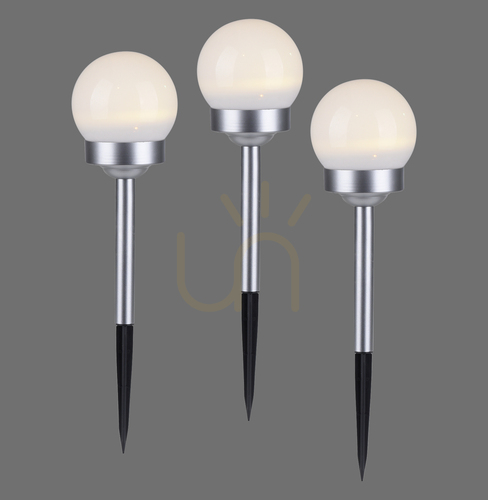
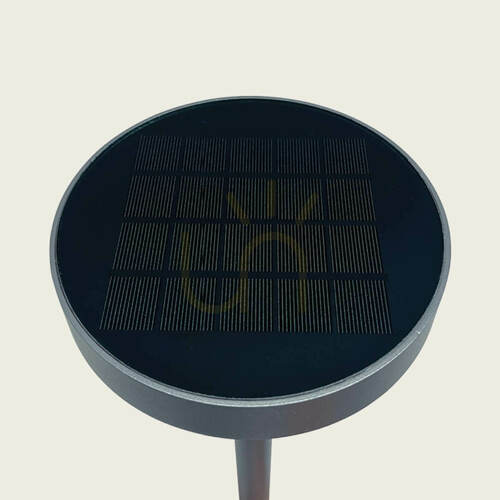
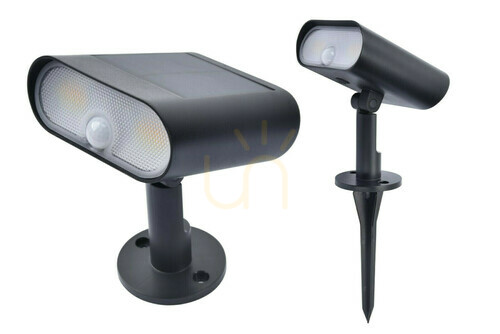
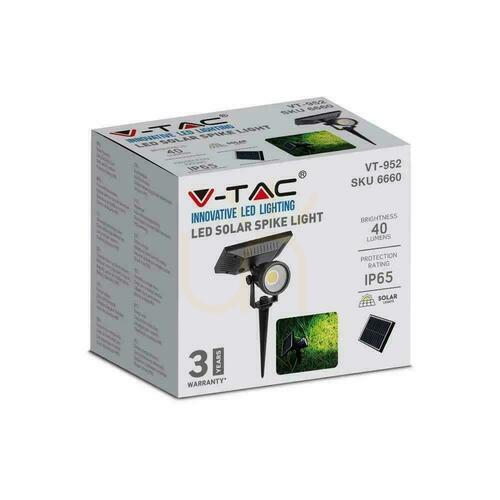
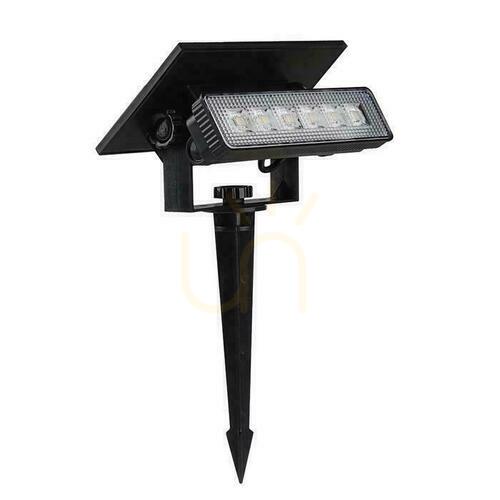
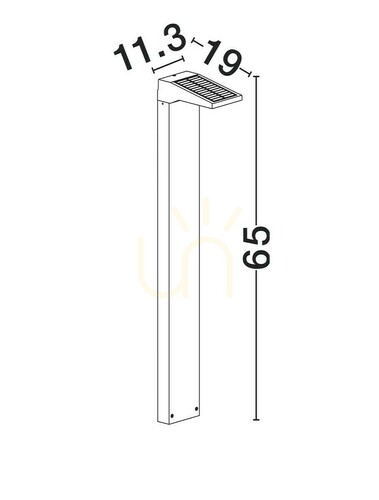
Solar ground lights are low lights on a spike that you push into a lawn or border, with no cable to bury and no electrician to book. A small panel on top charges a battery during the day, and a light sensor switches the LEDs on at dusk, so they suit the spots a mains cable would never reach: the far end of the garden, the edge of a pond, a stepping-stone path across the grass.
Compared with wired ground lights, the trade-off is simple. You lose the fixed brightness and the all-year reliability of a mains fitting; you gain freedom to move the light whenever the planting changes. Think of them as marker and accent lighting rather than something to light a whole patio.
What goes into a solar stake light
Every model has the same four parts: a mono- or polycrystalline solar cell, a rechargeable battery, LEDs and a dusk sensor. Small decorative stakes usually run on a 1.2 V NiMH cell in AA or AAA size; brighter spike spotlights use a 3.7 V lithium-ion cell, and premium lights sometimes use lithium iron phosphate (LiFePO4), which copes with far more charge cycles. Extras worth knowing about are a PIR motion sensor, a dimmed “all-night” mode and a switch between warm and cool white.
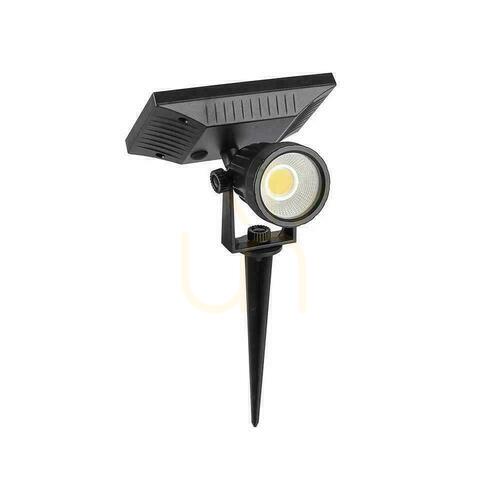
The classic shape is a post of about 30–50 cm on a spike, but the same idea covers flat lights that sit flush with the lawn, small spotlights on a stake for uplighting shrubs, and lights that come with both a ground spike and a wall bracket.
Choosing the right output for the job
Most disappointment with solar lights comes from expecting a marker light to behave like a floodlight. Match the output to the task first, then check that the spot gets enough sun to feed it.
| Job in the garden |
Typical output |
Spacing |
What to look for |
| Outlining a border or lawn edge |
2–20 lm |
every 0.5–1 m |
warm white, low profile |
| Lighting a path you actually walk |
20–100 lm |
every 1.5–2.5 m, staggered |
downward light, IP44 or better |
| Uplighting a tree or shrub |
100–400 lm |
1–2 per plant |
adjustable head, separate panel on a lead |
| Wet spots near a pond or sprinkler |
any |
as above |
IP65 |
For uplighting trees, a spotlight with its panel on a short cable is often the better buy: the light can sit in the shade under the canopy while the panel catches sun a metre or two away.
Getting them to last through a British winter
Short December days, a low sun and weeks of cloud are the real test for any solar light in the UK. A full summer charge can carry a good light through most of the night; in midwinter, expect a few hours. Cold also reduces battery capacity. A few habits make a noticeable difference:
- Pick the sunniest position you have, ideally south-facing, and check it at different times of day, as fences, hedges and the house cast long shadows in winter.
- Keep grass and perennials trimmed back from the panel, and wipe it with a damp cloth every few weeks. Pollen, dust and dried rain spots all cut charging.
- Keep lights away from street lamps and porch lights, or the dusk sensor may never decide it is dark.
- If you bring lights in for winter, store them dry and frost-free and top up the battery every few months.
Installing stake lights
Peel the protective film off the panel and slide the switch under the head to ON before anything else. Push the stake in by hand rather than hammering it, which cracks plastic spikes. In heavy clay or a dry summer lawn, water the ground first or open a pilot hole with a metal rod. Stakes need soft soil: on paving, concrete or decking, bolt-down bollards or flush-fitting lights are the answer. Give a new light a full sunny day to charge before judging how long it runs.
Questions people ask
Are there solar lights that stay on all night?
In summer, a light with a decent panel and battery will usually last until dawn. Through autumn and winter, the lights that come closest are those that dim themselves after a few hours or use a motion sensor, so the stored energy is spread across the night.
Do solar ground lights work in winter?
Yes, but with shorter run times. Clear snow off the panel, move lights out of winter shade and accept that a grey week will leave them dim.
How bright are the brightest solar lights for outside?
Spike spotlights can reach several hundred lumens, enough to pick out a small tree. Most path stakes sit between about 5 and 100 lm, which is plenty for guiding feet but not for security lighting.
Are solar ground lights waterproof?
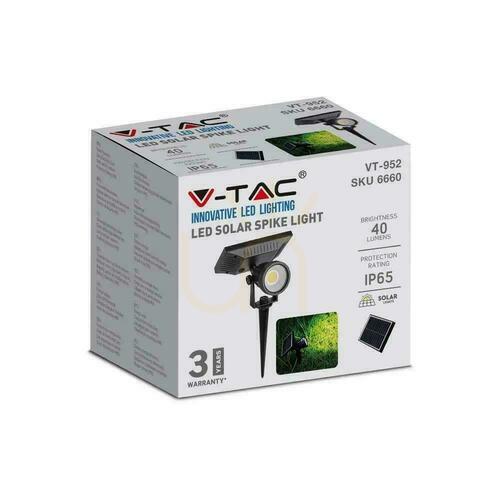
They are built to stand in the rain. IP44 protects against splashing from any direction; IP65 also resists jets of water, which matters next to a sprinkler. None of them should sit in standing water.
Can solar ground lights light up trees?
A small spike spotlight can, if you choose one with at least 100–200 lm and a panel that sits in sun. Aim it up the trunk from close to the base.
When should I replace the battery?
When a light fades within an hour after a sunny day, the battery is usually worn. Swap it for the same type and voltage – never a standard alkaline battery – and take the old one to a battery recycling point.
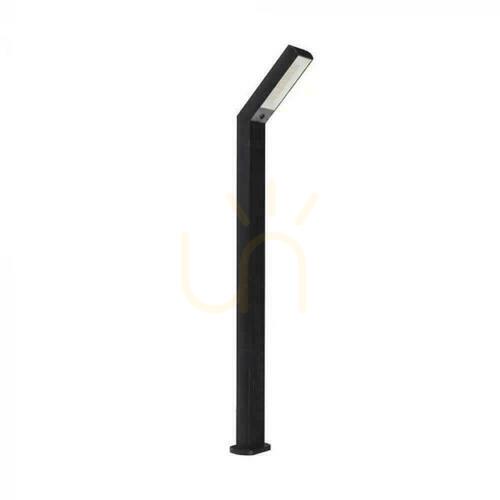
For light that behaves the same in January as in July, look at mains-powered ground recessed lights. For a taller light that grass cannot swallow, see solar bollard lights.