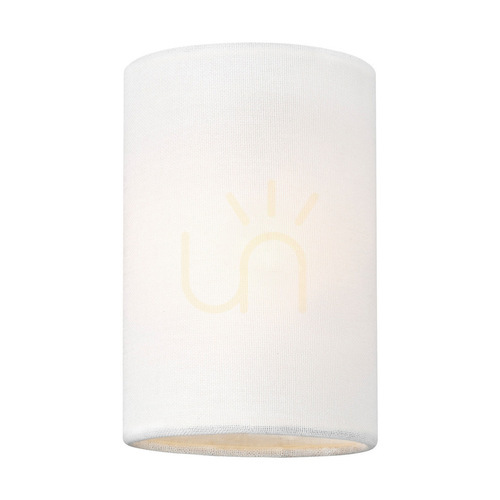
A linen lampshade takes the hard edge off a bulb and turns it into a soft, slightly warm glow with the weave showing through. Compared with smooth cotton or a plastic shade, linen looks far more alive once it is switched on: the little slubs in the yarn appear as gentle lines, rather like a sheet of handmade paper held up to a window.
That texture is why linen sits so comfortably with oak, stoneware, brass and painted wood, in a cottage sitting room as much as a pared-back flat. It also has a few habits worth knowing before you buy: it creases, its natural colour varies slightly from batch to batch, and strong sun will fade it.
Is linen a good fabric for lampshades?
For atmosphere, it is one of the best. Natural fibres scatter light without the glare of a thin synthetic, and linen keeps a matte, crumpled character that cotton lacks. The trade-offs are practical rather than aesthetic. A pure linen shade is harder to keep perfectly smooth, and pale natural linen picks up dust and marks more readily than a dark polyester.
Two constructions dominate:
-
Laminated (hard) shades: linen bonded to a white lampshade panel and fixed between two metal rings. They hold a crisp shape, and the white inner surface bounces light up and down.
-
Soft shades: fabric stretched, gathered or pleated over a wire frame, often lined. Cosier and more traditional, a touch dimmer.
Labels such as ‘linen look’ or ‘faux linen’ usually mean polyester woven to imitate the texture. Easy to wipe, but flatter when lit. Linen–cotton blends sit in between.
Choosing the shape and size
A reliable rule for table and floor lamps: the shade should be about two-thirds the height of the base and at least as wide as the base at its widest point. From the sofa or bed you should not be able to see the bulb holder. When a listing says 40 cm or 50 cm, it almost always means the bottom diameter.
| Shape |
Where it works |
Typical bottom diameter |
| Drum |
modern table lamps, floor lamps, ceiling pendants |
30–50 cm on lamps, 40–60 cm as a pendant |
| Tapered drum |
table lamps where you want more light thrown downwards |
25–40 cm |
| Empire |
classic and turned wooden bases |
25–40 cm |
| Coolie |
reading lamps, pendants over a kitchen table |
30–50 cm |
| Small candle or bedside shade |
chandeliers, wall lights, bedside lamps |
12–30 cm |
Over a dining table, hang a pendant shade so its lower edge sits roughly 60–80 cm above the tabletop. In a hallway or living room, keep enough headroom for the tallest person in the house to walk underneath.
Fittings and bulbs in UK homes
Most British lamps use a bayonet (BC, B22) or Edison screw (ES, E27) holder, while small lamps and chandeliers often take a small screw (SES, E14). Shades are usually made with a ring of about 40 mm for ES fittings and about 29 mm for BC and SES, and many come with a reducer ring so one shade fits both. Duplex fittings can be used either way up, on a lamp base or hanging from a ceiling rose. Tall floor-lamp shades sometimes sit on a harp with a finial instead.
Choose an LED bulb in warm white, around 2700 K. It runs cool, which keeps the fabric from browning over the years. With a traditional bulb, never exceed the maximum wattage marked on the lamp, often 40–60 W, and make sure the glass does not touch the fabric. If you rewire a ceiling point to hang a new pendant, that is a job for a qualified electrician.
Cleaning and care
- Dust weekly with a soft brush, a microfibre cloth, a lint roller or the upholstery tool of your vacuum.
- Spot-clean marks with lukewarm water and a little mild detergent, then blot with a dry towel. Do not rub.
- Never soak or machine-wash a laminated shade: the panel buckles and the fabric lifts from the rings.
- Keep linen out of bathrooms and away from the hob, as steam and grease work into the weave.
- Creases in a soft shade are part of the material. Hold a steamer well away if you want to relax them, never on a laminated shade.
Frequently asked questions
What is the best fabric for a lampshade?
It depends on the job. Linen gives the most textured, natural glow; cotton is smoother and more even; silk has a sheen and suits formal rooms; synthetic blends are the easiest to clean. For a calm living room or bedroom, pale linen is hard to beat.
What is the best linen lampshade for a table lamp?
A drum or tapered drum about two-thirds the height of the base, in a light colour if you read by it. Dark linen looks striking but sends most of the light up and down rather than into the room.
Which linen lampshade suits a floor lamp?
Usually a stiff drum or tapered drum of 40–50 cm. A soft shade on a tall stem can look lopsided, and a small one leaves the bulb visible from a chair.
Can a large linen lampshade be used on a ceiling light?
Yes, provided it has a pendant or duplex fitting. On wide shades a diffuser underneath hides the bulb when you look up, and the fabric absorbs a little sound in an echoey room.
Why does a vintage linen lampshade turn yellow?
Sunlight and heat. Years beside a sunny window or above a hot incandescent bulb slowly discolour natural linen. LED bulbs and a spot out of direct sun keep a new shade pale for much longer.
More on other materials and shapes: lampshades. If the shade is going on a bedside or desk base, read more about table lamp shades.