Choosing a lampshade for a table lamp comes down to two questions: will it physically fit the lamp, and will it look in proportion once it is on? Get the fitting wrong and the shade won't sit straight; get the size wrong and even a lovely base looks top-heavy or oddly bare.
Table lamps are also the lamps we live closest to. You sit beside them on the sofa, read under them in bed and work next to them at a desk, so you see the bulb holder from angles a ceiling pendant never shows. That makes the depth of the shade and the way its fabric handles light matter more here than anywhere else in the house.
Start with the fitting, not the fabric
Before falling for a colour, turn the lamp over in your mind and look at what holds the shade. In British homes you will usually meet one of these:
-
Ring fitting on the bulb holder – the shade has a metal ring that drops over the lamp holder and is locked in place by the shade ring that screws on top. Most modern table lamps work this way. Shades with a duplex (reversible) fitting have a ring you can turn over, so the same shade works on a table lamp or as a ceiling pendant.
-
Harp and finial – traditional lamps often have a U-shaped wire harp rising above the bulb. The shade has a small top washer (a spider fitter) that rests on the harp and is secured with a decorative finial. A harp lets you set the shade height precisely, and harps come in different heights if the shade sits too high or too low.
-
Bulb clip – small shades, usually under about 20 cm, clip straight onto a candle or golf-ball bulb. Handy for little lamps on shelves, but they only work with bulbs of the right shape.
Watch out for easy-fit shades. They are made for ceiling pendants and generally won't sit properly on a table lamp. Lamps bought abroad or second-hand may also use E27 or E14 screw holders rather than the B22 bayonet common in the UK. A reducer ring can let a larger ring fit a smaller holder, but only where the lamp's construction allows it.
What size lampshade do I need?
Interior designers lean on a few rules of thumb. They are not laws, but they keep you away from the classic mistakes: a tiny shade perched on a chunky base, or a vast drum swamping a slim stem.
| Measurement |
Rule of thumb |
Example: 40 cm base, 16 cm at its widest |
| Shade height |
about two thirds of the base height, measured to the bulb holder (anything from 60–80% works) |
roughly 25–28 cm |
| Bottom diameter |
around 1.5–2 times the widest point of the base |
roughly 24–32 cm |
| Bottom edge |
low enough to hide the holder when you are seated beside the lamp |
usually 2–3 cm below the holder |
| Typical table lamp shade |
small accent and desk lamps / most living-room table lamps |
about 14–20 cm / about 20–35 cm |
Go smaller on a narrow side table or windowsill, where a wide shade will catch curtains or knock the wall. Go larger when the lamp is meant to anchor a sideboard or console.
Shape and material: how the light behaves
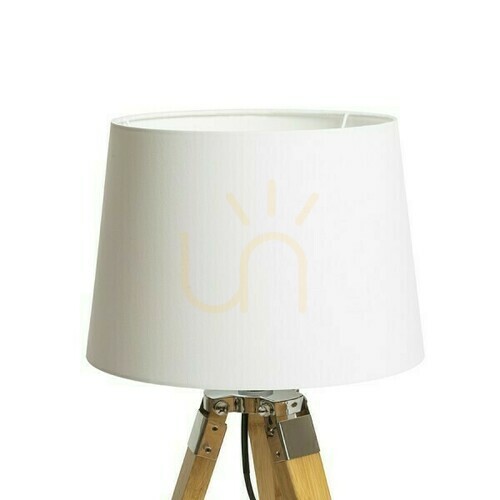
A drum (straight cylinder) sends a fairly even band of light down and up and suits clean-lined, modern bases. A tapered empire shade throws more light downward onto the table and flatters curved, traditional ceramic bases. Oval and rectangular shades are useful where depth is tight, such as a hall table pushed against the wall.
Pale linen and cotton let light through the sides, so the lamp also lifts the room. Dark, opaque fabrics, velvet and metal push light up and down, which gives a strong pool for reading and a cosy, low-lit room around it. Paper diffuses gently, rattan and jute cast patterned shadows, and a gold lining warms the light noticeably.
Bulbs, safety and care
LED bulbs run far cooler than the old incandescent and halogen types, which makes them the sensible choice inside fabric and paper shades. Even so, keep a few centimetres between bulb and fabric, and never exceed the maximum wattage printed on the lamp or the shade. Around 2700 K suits living rooms and bedrooms; 3000–4000 K is clearer for a desk. Fabric and paper shades are not rated for moisture, so keep them out of bathrooms.
Dust fabric shades with a soft brush or a lint roller and follow the care label for marks; only wash a shade if its maker says you can. Wipe glass with a soft cloth and treat acrylic gently, as it scratches easily.
Frequently asked questions
Can you put any lampshade on a table lamp?
No. The shade's fitting has to match the lamp – ring, harp or clip – and the size has to suit the base. A pendant shade with an easy-fit clip, for example, won't sit securely on most table lamps.
How do I find a lampshade that fits my lamp?
Check how the current shade attaches and measure the base height and its widest point. If the old shade is still around, measure its top diameter, bottom diameter and height, and note the inner diameter of the ring.
What size lampshade do I need for a table lamp?
Aim for a shade about two thirds as tall as the base and around one and a half to two times as wide as its widest point. Most table lamps end up somewhere between 20 and 35 cm across at the bottom.
Is a drum shade a good choice for a table lamp?
Yes, especially on straight or geometric bases. On rounded, bulbous bases a tapered shade often looks better balanced.
Can I replace the shade on an old lamp?
Usually. Charity-shop and inherited bases are often perfectly sound; just check the flex and plug, and have a qualified electrician look at anything with damaged wiring before you fit a new shade.
Which bulb is best under a fabric shade?
A warm-white LED. Around 450–800 lm suits reading, while 200–400 lm is plenty for a mood lamp.
Other shapes, materials and fittings are covered under lampshades; if the lamp in question lives on a bedside table, carry on with bedside lamp shades.