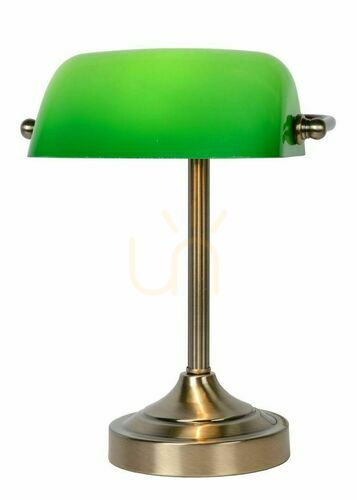
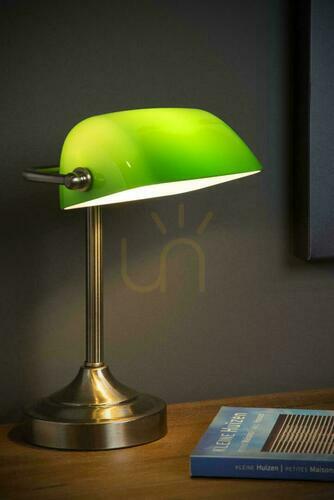
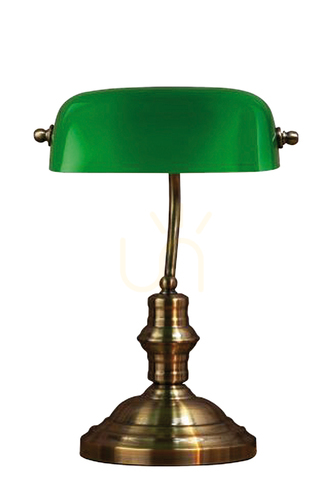
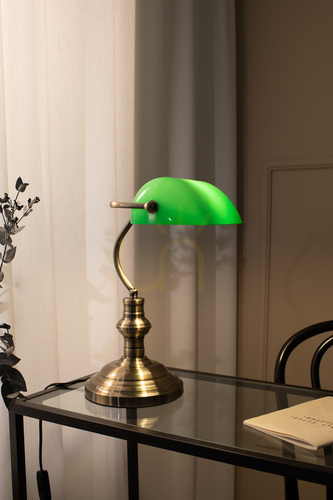
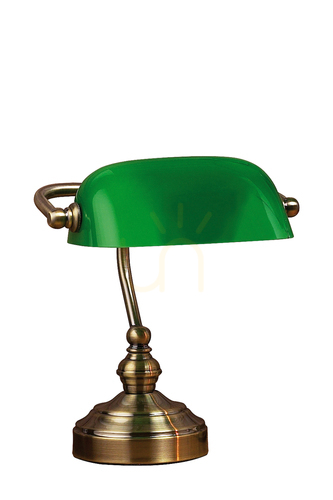
A bankers lamp is a table lamp with a long, horizontal glass shade – traditionally emerald green – set low over a weighted base so that it lights the desk rather than your face. Among table lamps it is the specialist: where most send light out into the room, this one concentrates it on paperwork, a keyboard or an open book and leaves the rest of the room softly lit. The design goes back to an American patent application of 1909, and more than a century on it still reads instantly as “study”, “library” or “chambers”.
What makes a table lamp a bankers lamp?
It comes down to the shade. On a classic example it is made of cased glass: a dark green outer layer fused over a white or opal inner one. The pale lining bounces light down onto the desk, while the dark outside keeps the bulb from glaring at anyone sitting nearby. The shape helps too – flattened at the back, sloping towards the front, with softened edges – and the shade usually tilts on its bracket so you can aim the pool of light nearer or further away.
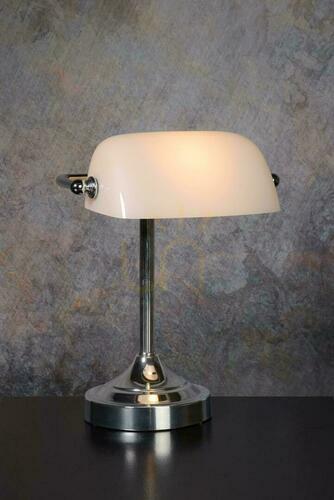
Underneath sits a heavy base, originally solid brass and often weighted so the lamp doesn't topple when you adjust the shade. The traditional switch is a pull chain hanging from the shade, frequently finished with a small brass bead. Plenty of designs move on from there: white opal, cream, blue, burgundy or smoked glass shades, Tiffany-style leaded glass, bases in chrome, nickel, black or antiqued brass, wooden or marble details, adjustable stems, and twin “library” versions with two bulbs for a wide desk or reading table.
What light bulb does a bankers lamp take?
Most take either an ES (E27) or a smaller SES (E14) screw bulb; some UK-made lamps use a B22 bayonet cap instead, so check the fitting before you buy replacements. The bulb has to fit under a fairly shallow shade, so length matters as much as the cap. A long decorative filament bulb can poke out below the rim and shine straight into your eyes.
| What to check |
Typical for a bankers lamp |
Why it matters |
| Bulb cap |
ES (E27), SES (E14), occasionally B22 |
must match the lampholder |
| Brightness |
around 470–806 lm per bulb (a 40–60 W equivalent LED) |
enough for reading and writing without hot spots |
| Colour temperature |
2700–3000 K warm white |
keeps green glass looking rich rather than grey-blue |
| Bulb finish and size |
frosted or opal, standard or compact |
hides the filament and stays inside the shade |
| Lamp height |
roughly 35–45 cm; small versions about 30 cm |
shade edge at or below seated eye level |
| Shade width |
roughly 25–30 cm |
one shade suits a 120–140 cm desk; go twin on wider desks |
| Rating |
IP20 |
dry indoor rooms only |
LED is the sensible choice. It draws a fraction of the power, and it runs far cooler than an old incandescent bulb – worth having when there is a glass shade a few centimetres above your hands. If your lamp has a dimmer, buy bulbs marked as dimmable.
Where to put it
On a desk, stand it on the side opposite your writing hand – left for right-handers – so your hand doesn't cast a shadow across the page. With a laptop or monitor, keep it to one side of the screen, not behind it: the low shade lights the keyboard and notes without reflecting in the display. It is task lighting, though. For a full working day add general light in the room, or your eyes will tire from the contrast between a bright desk and a dark background.
Away from the desk, a bankers lamp looks at home on a bureau, a hall console, a sideboard in a panelled sitting room or a bedside table in a traditional bedroom. By the bed, pick a smaller lamp with a shade that tilts towards your book.
Vintage, original or new?
Early twentieth-century lamps are collectable, and the second-hand market has plenty of later copies described as “original”. Hold the shade up to the light: genuine cased glass shows a clearly pale inner layer. Look at the cable and lampholder too. Old wiring is often perished, so have a qualified electrician check and, if needed, rewire a vintage lamp before you plug it in. A modern reproduction gives you the look with fresh wiring and no surprises.
Care is simple. Unplug first. Lift off the glass shade and wash it in lukewarm water with a little washing-up liquid, then dry it completely. Lacquered brass only needs a dry or barely damp cloth – metal polish will strip the lacquer. Unlacquered brass darkens with time; leave the patina or bring back the shine with a brass cleaner.
Bankers lamp questions
Why are banker desk lamps green?
The usual story links the colour to the green eyeshades worn by clerks, bookkeepers and telegraphists to cut harsh light. Whether green itself rests the eyes is debatable; what genuinely helps is the dark outer layer, which stops the bulb glaring while the pale lining throws light downwards.
What light bulb for a bankers lamp?
A frosted warm white LED with the right cap – usually ES or SES – at around 470–806 lumens. Check the maximum wattage on the lamp and make sure the bulb isn't long enough to show below the shade.
How can you tell an original vintage bankers lamp?
Older lamps tend to have a two-layer glass shade, a heavy brass base and honest wear on the metal. A light base, glossy lacquer and single-colour glass usually point to a recent reproduction.
Are bankers lamps good for reading?
Yes – the focused, downward light suits reading at a desk or in bed. For an armchair you need light from above and behind your shoulder, which is a job for a floor lamp; some bankers designs come in floor-standing versions for exactly that.
Do bankers lamps only come in green?
No. Green is the classic, but white opal, cream, blue, burgundy and smoked glass shades are common, as are bases in chrome, nickel and black.
Can I use one next to a computer?
As a desk light beside the screen, yes. It lights the keyboard and papers without throwing reflections onto the monitor.
If you'd like to compare other desk and bedside designs, start with table lamps. And for a desk light that also charges your phone, have a look at table lamps with a USB port.