
Neon sign for bedroom: wall sign or Neon Flex
A neon sign for a bedroom is usually a ready-made USB-powered LED wall sign; choose Neon Flex by the metre for a line of light or large lettering. With a ready-made sign, three things are easy to miss on the product page. Is a plug adapter in the box, does the sign dim, and how do you screw it to the wall above a bed? With Neon Flex you also need the right voltage (12 or 24 V), bend radius and direction, and power supply rating.

Contents
- Which neon sign for a bedroom or other room?
- LED neon versus classic glass neon
- A ready-made neon sign or Neon Flex by the metre?
- LED neon wall sign: word or shape, size and brightness
- Power: USB, batteries or mains
- Switch, dimmer, remote and timer
- How and where to hang a neon sign
- A neon sign above the bed and in a child’s room – safety
- Neon Flex: how to make your own neon from a strip
- Ideas room by room
- Neon colour and colour temperature
- How much electricity does an LED neon sign use?
- The most common mistakes
- Frequently asked questions
- What to choose
Which neon sign for a bedroom or other room?
For your first neon sign for a bedroom, choose a ready-made LED wall sign: a short word or a shape 30–70 cm wide. Power it by USB through a separate plug adapter, with a dimmer and switch within reach. Neon Flex by the metre suits a line of light, an outline or lettering larger than the ready-made sizes.
Ready-made neon signs sit within our wider wall lights range (selected models are shown below), and neon by the metre is in the Neon Flex category. Room by room it looks like this:
- Teenager’s room – a word or shape neon sign on USB, above the desk or bed.
- Gaming setup – RGB Neon Flex behind the desk or under its edge, plus one sign on the wall in the camera frame, but not right next to the monitor.
- Bedroom – warm-white Neon Flex behind the headboard as indirect light, with a dimmer; a neon sign above the bed screwed to the wall, not stuck on.
- Living room and home bar – a larger word above the sofa, or a line of Neon Flex along a bottle shelf or under the bar counter.
- Child’s room – a small battery or USB shape, hung out of reach and switched off for sleep.
Two rules apply everywhere. A decorative neon sign glows but does not light the room, so for homework, reading and tidying up you need an ordinary lamp. And the closer to the bed the sign hangs, the fewer loose cables and the firmer the fixing should be.
LED neon versus classic glass neon
A classic neon is a glass tube bent by hand and filled with a noble gas at low pressure. Pure neon glows red-orange. Other colours come from argon with a trace of mercury, other noble gases, a phosphor coating inside the tube and coloured glass, among others. To make the gas glow, a transformer raises the voltage to several thousand volts, and in larger advertising signs to over ten thousand. That is why glass neon rarely ends up in a home. It runs on high voltage, so only a specialist firm installs and services it. The glass cracks when hit by a ball, and some colours contain mercury.
An LED neon imitates the effect differently. Closely spaced LEDs, usually 100–160 per metre, sit on a flexible strip embedded in milky silicone, which diffuses their light into a continuous line with no visible dots. It runs on safe low voltage: 5 V from USB in small decorative signs, 12 or 24 V DC in Neon Flex. It is light, does not break and warms up only slightly. Ready-made decorative signs draw 1–10 W, Neon Flex 9–14 W per metre. You only see the difference up close: a glass tube glows all the way round, while most LED neons glow from the front (round 360° models such as Bergmen Multi One are the exception). From the sofa you cannot tell, which is why almost every neon sign for a bedroom today is LED.
A ready-made neon sign or Neon Flex by the metre?
Choose a ready-made neon sign when you want to hang a motif on the wall: a word or a shape that goes up in a quarter of an hour. It runs on USB, batteries or a plug-in adapter. Choose Neon Flex when you want to draw with light: a line, an outline around furniture, or lettering larger than the ready-made sizes.
A ready-made decorative sign is a design created by the manufacturer: a thin LED tube fixed to a clear acrylic panel, or a free-standing plastic outline. It needs no DIY, runs on safe low voltage and is usually 30–70 cm wide. The design and colour are fixed, though, and the brightness is enough to decorate, not to light a room.
Neon Flex is bought by the metre, cut, bent, closed with end caps and connected to a power supply, sometimes through a controller. In return you get a line of any length, an RGB version and outdoor use (IP65 or IP67). It is also many times brighter: white versions give from 225 to over 1,100 lm per metre. You will need to buy a power supply, end caps and clips, and set aside an hour or two for fitting. A power supply without a plug has to be wired into the mains by an electrician.
The two often share a room: at a gaming setup, RGB Neon Flex glows behind the monitor while a ready-made On Air sign hangs on the wall in the camera frame.
LED neon wall sign: word or shape, size and brightness
Neon word sign or shape?
Choose a word sign when you have one or two words that will still fit in a year: a name, a nickname, “on air”. A shape – a heart, rainbow, game controller, planet – does not depend on language and takes longer to get boring, so for a teenager it is a safer pick than a trendy slogan.
A word can only be read from the front; in a mirror it appears reversed. One or two words are legible from the other side of the room, while a quote needs a large format. Handwritten letters, as on the Neon-Love model, are more decorative but less legible than print. A childish motif such as a unicorn will soon be “outgrown” along with the child.
Size
The rule known from pictures applies: above a piece of furniture, the sign should take up roughly half to two thirds of its width. Small signs (about 30 cm, e.g. the 29 × 38 cm heart or the 34 × 12.5 cm Neon-Love word) suit a spot above a bedside table, a shelf or a narrow desk. Formats of 60–70 cm, such as the 60 × 40 cm Neon-Gamer panel or the 71 × 17 cm On Air sign, look better above a sofa, a bed or a wide desk. Read the dimensions on the product page carefully: for words, the stated length is usually the width on the wall, not the height.
Brightness
Do not compare the lumens on product pages of ready-made signs. Some of them state a token 1 lm, which is a placeholder, not a measurement. A neon sign looks bright because you are looking straight at a coloured outline. With the ceiling light on it fades, and after dark it floods the surrounding wall with colour. The background matters too. A white wall creates a coloured glow around the sign and a dark one emphasises the outline, while a coloured wall shifts the hue (a pink sign on a green wall turns greyish).
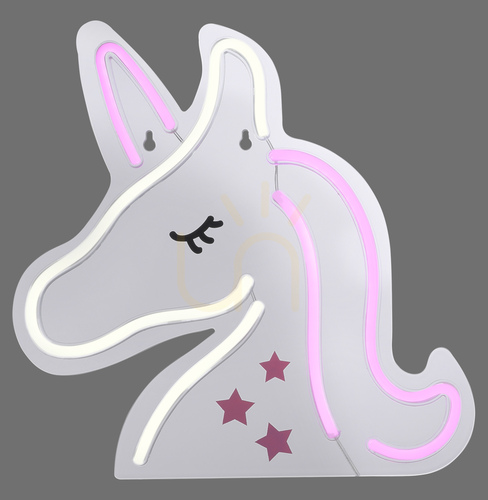
Some neon wall signs from our range:




Power: USB, batteries or mains
USB 5 V is the most popular option. The sign has a cable with a USB-A plug, usually about 2 m long, and often comes without a plug adapter – as with the Neon-Gamer and Neon Flamingo models. Check the power draw: a standard USB 2.0 port delivers 0.5 A (2.5 W), USB 3.x 0.9 A (4.5 W), while an 8.5 W sign needs about 1.7 A. From a computer port such a sign may glow dimly, flicker or not light at all. Only ports that the computer maker describes as charging ports deliver more. A USB port on a TV or monitor often switches off with the screen, and it usually supplies only 0.5 A too. The safe choice is a 5 V USB plug adapter rated at least 2 A (10 W), CE-marked, from a reputable manufacturer.
USB-powered signs are usually protection class III (safety extra-low voltage); you can confirm this on the product page, as with the Neon-Love model. Check there what is in the box as well: adapter, fixings, cable length.
A battery sign (usually 3 × AA) needs no cable: you can stand it on a shelf or windowsill or hang it where there is no socket. Three alkaline AA cells hold about 7–10 Wh in total. At a stated draw of 1 W they last roughly 6–10 hours, depending on the batteries and the sign’s electronics. That is a few evenings, not a month, so the battery version suits occasional use.
A mains adapter suits signs meant to glow for many hours every day. Examples are the Zuma Line On Air and Smile models, rated 3.44–4.14 W: no batteries to replace, a cable to the socket, and dry interiors only (IP20).
A neon sign for a bedroom that glows every evening belongs on USB or a mains adapter. Leave batteries for places without a socket and for a small child’s room, where every cable within reach is a problem.
Switch, dimmer, remote and timer
- An in-line switch on the cable is standard (the Neon-Love has one, for example). Plan the cable route so that the switch ends up by the bed or desk, not behind the wardrobe.
- Not every sign has a dimmer (the Neon-Unicorn is not dimmable). In a bedroom it is worth paying extra for one, because a fraction of full brightness is enough in the evening.
- A remote is useful when the sign hangs high above the bed. It often adds flashing and pulsing modes too; in a room where someone falls asleep, switch them off.
- A smart plug with a schedule will switch the sign off at a set time if the sign has its own USB or mains adapter rather than a computer port. The sign also has to light up by itself when power returns. A model with a mechanical switch left on comes back on, while one with an electronic button or remote often starts up switched off.
- Neon Flex is controlled with a dimmer or controller connected between the power supply and the neon – see the controller section.
How and where to hang a neon sign
- On a bare wall, place the centre of the sign at eye level, 150–160 cm from the floor. Above furniture, the bottom edge should sit 20–30 cm above the desktop, the back of the sofa or the headboard.
- Acrylic panels have mounting holes: use two screws with wall plugs in masonry, or plasterboard fixings in drywall. Lighter outlines can hang on hooks or a chain. Signs 30–70 cm wide usually weigh under a kilogram (Zuma Line models: 0.5–0.7 kg). Double-sided tape only holds the lightest models, and never use it above a bed.
- Before drilling, check where the cables run in the wall with a detector. Wiring usually runs vertically and horizontally from sockets and switches, but not always; if in doubt, ask an electrician.
- With a typical 2 m cable, plan where the socket will be. Run the cable in cable trunking painted to match the wall, not under a rug or mattress, without tension or sharp bends.
- Decorative signs are usually IP20, which means dry interiors only. Do not hang them in a bathroom or directly above a radiator.
- The sign should not shine straight into your eyes from the pillow or the desk chair. It is better seen from the side or above you.
A neon sign above the bed and in a child’s room – safety
An LED sign of a few watts usually gets no more than slightly warm. The plug adapter needs more care: do not cover it with bedding, wedge it between the mattress and the wall or leave it on the bed, because it needs airflow.
Above the headboard a sign must be screwed on, not stuck on, and hang higher than the spot where you rest your head while reading. The plug, adapter and spare cable stay off the bed.
In a child’s room, remember that a neon sign is not a toy. Hang it out of reach, including from the cot, and run cables at least a metre from the cot, with no loose loops. Baby monitor manufacturers give the same distance for their cables, because a cable loop in a cot is an entanglement hazard. In battery models, replace the whole set of batteries at once and take them out when the sign is not used for a long time, as spent cells can leak.
A 12/24 V Neon Flex circuit poses no shock risk, but low voltage does not rule out a short circuit or overheating, because fairly high currents flow in it. Make connections with accessories from the same series, close the ends with end caps, and place the power supply somewhere ventilated and accessible, as the manufacturer’s instructions say.
Can a neon sign stay on all night?
Technically yes: a few-watt LED runs for hours without overheating, but for sleep it is better switched off or put on a timer. Sleep hygiene advice, for example from the American Academy of Sleep Medicine, calls for a dark bedroom, and evening light with a high share of blue has the strongest effect on melatonin release.
If the sign is to act as a night light, choose a warm colour (red, orange, amber or warm white), the lowest brightness and no flashing.
Neon Flex: how to make your own neon from a strip
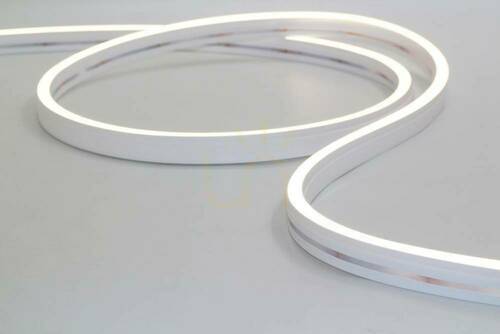
Neon Flex is an LED strip embedded in a silicone housing, usually sold by the metre from reels 5–50 m long. Unlike an ordinary strip it needs no diffuser, because the silicone itself spreads the light into an even line. Before you buy the first metre, settle the voltage, the cutting and bending plan, the IP rating, the mounting method, the power supply and the controller.




12 V or 24 V
Most Neon Flex runs on 24 V. At the same power it draws half the current of a 12 V strip, so the voltage drop is smaller and a longer section glows evenly from one feed point. For example, the Bergmen HS series can run up to 5 m when fed from one end, and VR up to 10 m when fed from both ends. A 12 V neon (e.g. HR Eco, 12 W/m) makes sense for short, fine lettering indoors: it cuts every 1 cm and bends to a radius of just 1.5 cm. The power supply must have the same voltage as the neon. A 12 V neon connected to 24 V will overheat and fail, while a 24 V neon on a 12 V supply will barely glow or not light at all.
Cutting
Neon Flex is cut at the marked points or, only where the manufacturer clearly allows it, anywhere. The cutting section ranges from 6.25 mm to 1 cm on finely cut models (Multi One, HR Eco) and 5–10 cm on others (HXS, HS, some coloured VR, RGB versions). The manufacturer allows cutting anywhere on HXR One, HXS Nano and warm-white VR, for example. Cut with a sharp knife, square and in one stroke. Plan lengths around the cutting section: with a 5 cm section, every stretch of lettering must be a multiple of it. First lay out the route with string on a template, then measure it and add extra for curves. Every cut end breaks the seal and has to be closed with an end cap.
Bending
Bend radius and bend direction decide what you can draw with the neon.
- The bend radius ranges from 1.5 cm (HR Eco) and 3 cm (HXR One) through 8 cm (HS) to 20 cm (VR). The smaller it is, the finer the lettering: with a 3 cm radius the tightest curve is about 6 cm across, so letters such as “o” or “e” cannot be smaller. The neon cannot make a sharp right angle; you make a corner with a curve or from two pieces.
- A horizontally bending neon bends in the mounting plane with its glowing face towards you. That is how words, logos and hearts are made on a wall or panel (Bergmen HXS, HS, HXR One). A vertically bending neon bends “up and down” relative to its glowing face. That is how a line follows the curve of a vault, the edge of a round table top or a column (VR, LED Labs 3Y VERTICAL). The round Multi One glows through 360° and bends in any direction, and HXR One can also be twisted by up to 360° every 30 cm. Check the direction on the drawing on the product page, because a neon will not bend the wrong way.
Do not bend the neon right next to the power connection or the end cap, where the joint is most fragile.
IP65, IP67 and outdoor Neon Flex
The IP rating under EN 60529 tells you what the housing protects against:
- IP44 – splashing water;
- IP54 – also partly against dust;
- IP65 – dust-tight and resistant to water jets;
- IP67 – dust-tight and resistant to temporary immersion under test conditions (up to 1 m for 30 minutes).
IP67 does not automatically mean resistance to high-pressure water jets. In our range, HR Eco is IP44 (IP65 with its matching end fittings), HXS Nano IP54, VR IP65, and HXR One, HXS and HS IP67. The stated IP67 only applies with compatible end caps and silicone adhesive, as the manufacturer of the Bergmen series puts it. Moisture gets in through a cut end without a cap.
For outdoor Neon Flex on a terrace, balustrade or façade, choose from models that the manufacturer intends for outdoor use (in our range IP65 or IP67), in UV-resistant silicone. The manufacturer describes HXR One as resistant to UV and salt. Check the operating temperature: HXR One and VR are rated from −20 to +45 °C, HXS and HS from −25 to +60 °C. An outdoor power supply must have an IP67 housing or sit in a dry place. The outdoor supply circuit should be protected by a 30 mA RCD, and the mains side should be connected by an electrician. In a bathroom, the zones in the wiring regulations (IEC 60364-7-701) decide where the neon may go: agree them with an electrician and keep the power supply outside the zones.
Mounting: profile or clips
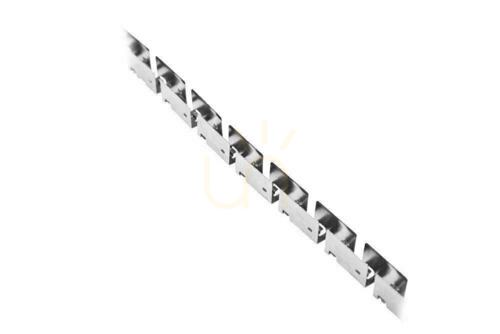
- An aluminium profile made for the series gives a straight, even line, hides the base of the neon, protects it mechanically and helps it shed heat. Our range includes profiles for HXR One (970 mm), HS (1 and 2 m), HXS (1 m), HXS Nano (1000 mm) and VR (965 mm). For curves there are flexible profiles: for HXR One on a reel of up to 20 m and for HS in 1 m lengths.
- Clips and brackets, small aluminium holders screwed to the surface, work well for lettering and curves. Space them closer on curves and further apart on straight runs.
- You can also make lettering on acrylic, plywood or MDF: run the neon in clips or in a routed groove. The manufacturer also designs HXS Nano for shallow grooves with adhesive.
- Accessories must come from the same series. Cross-sections differ (7 × 15, 6 × 12, 10 × 18, 16 × 15 mm), so a clip or end cap from another series will not fit.
- Power connection caps have a straight, side or bottom cable exit. A bottom exit lets you take the cable through a hole in the wall or panel, so it disappears behind the neon.
You will find profiles in the Neon Flex Profiles category. Choose clips, connectors and end caps from the same series as the neon.




Power supply: how to calculate the wattage
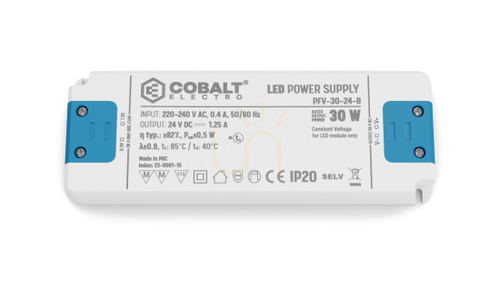
The formula is simple: neon power (W/m) × length (m) + at least 20% headroom, then the next larger constant-voltage power supply at the neon’s voltage.
- 3 m of HXR One at 9 W/m = 27 W; with 20% headroom that is 32.4 W → a 24 V, 36 W power supply.
- 4 m of HS at 14 W/m = 56 W; with headroom about 67 W → a 24 V, 75 W power supply.
- For RGB, count the full power from the product page, because white lights all channels at once.
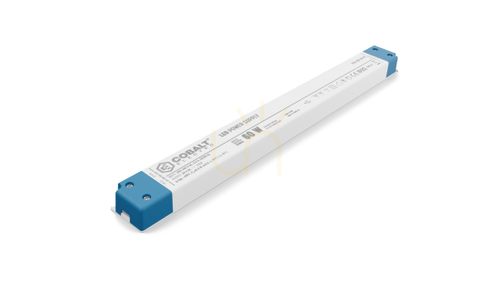
Install an IP20 power supply somewhere dry, ventilated and accessible: not plastered into a wall and not under a mattress. Outdoors and in damp places choose IP67. Do not exceed the length allowed for the feed method. Feed a longer run from both ends if the manufacturer provides for it, or split it into separately fed sections. A modular power supply without a plug is wired into the mains by an electrician. On the 24 V side, connections are made with connectors and joiners from the same series, observing polarity and the cable cross-section the manufacturer specifies. If you have no practice at this, leave it to an electrician too. You will find power supplies in the LED power supplies category.






Controller: single colour, RGB or digital neon
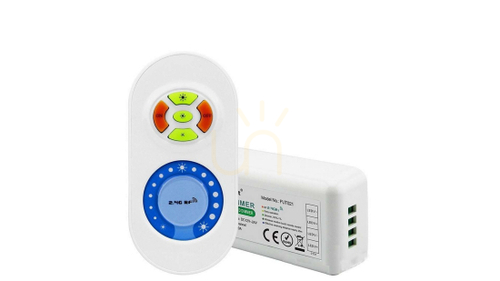
- A single-colour neon (white or one colour) can be dimmed with a PWM controller and remote, connected between the power supply and the neon.
- RGB needs an RGB controller plus a remote or app; the neon connects with four wires (R, G, B and a common positive). RGBW adds a pure white channel.
- A digital neon (addressable, with an IC in every segment, e.g. Bergmen HS IC) can show flowing waves and effects, because each section lights independently. It needs a pixel (SPI) controller compatible with the chip named on the product page; an ordinary RGB controller cannot drive it.
- The controller’s current rating must exceed the neon’s current: current = power ÷ voltage, e.g. 56 W ÷ 24 V ≈ 2.3 A.
White mixed from RGB tends to be bluish and uneven, and the output is noticeably lower: VR RGB gives 320 lm/m, warm-white VR 880 lm/m. If you want a calm white line, choose a white neon (2700–4000 K). The purest, most saturated colour comes from a single-colour neon. RGB makes sense when the colour should change with the mood, at a gaming setup or in a teenager’s room. We have grouped controllers and remotes in the LED controllers category.



Ideas room by room
Neon sign for a teenager’s bedroom
For a teenager’s bedroom, pick a name, a nickname or a single word, or a motif tied to a hobby (a game controller, an On Air sign for a streamer or podcaster). Hang it above the desk or bed. For studying, though, a desk lamp is needed: in offices the EN 12464-1 standard requires 500 lx at a workstation for writing and reading, and a neon sign gives a fraction of that. Neon Flex can be added as a line under a shelf or along a bed alcove. Lamps chosen for this kind of room are collected in our teen bedroom lighting selection. If your teenager would rather have a coloured pool of light on the wall than a word, a sunset lamp or a projector will do that better.
Gaming setup
- Neon Flex or a strip stuck to the back of the desk or on the wall behind the screen lights the wall, not your eyes. It softens the contrast between a bright screen and a dark room, which many people find more comfortable than gaming in total darkness. In studios where picture colour is judged, the wall behind the monitor is lit with neutral white (about 6500 K) at low brightness; for gaming the colour is a matter of taste.
- A slim neon (HXS, HXR One) in a profile along the front edge of the desk makes it look as if it is “floating”.
- A bright neon right next to the monitor distracts and reflects in a glossy screen. Hang it higher or behind you.
- A streamer needs one sign behind them (On Air, the Neon-Gamer panel). It should not be so bright that the camera overexposes it, and its colour should contrast with the light on the face. Check a dimmed sign on the preview at your final camera settings, because some dimming frequencies show up as bands in the picture.
- Hide the power supply and controller in a cable tray under the desk, with one switch for everything.





Bedroom
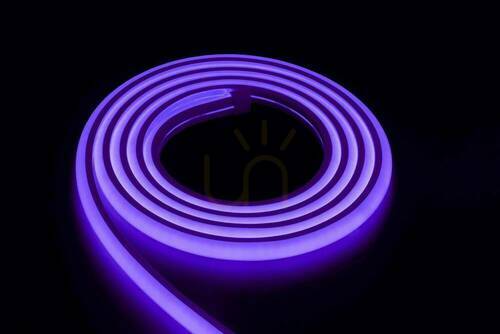
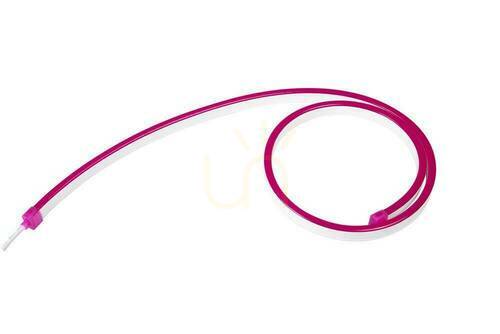
Behind the headboard, Neon Flex in 2700 K warm white works best, aimed at the wall as indirect light. A model giving about 225 lm/m (HXR One) creates a soft glow, while 880 lm/m (VR) gives strong light that is worth dimming. Choose a decorative neon sign above the bed in a warm colour, with a switch or remote within reach. Screw it clear of your head and the bedding, with fixings suited to the wall.
Living room and home bar
Above a sofa, a 60–70 cm word looks good. So does a line of Neon Flex in 2700–3000 K warm white in a TV-wall alcove, matching the rest of the living-room lighting. In a home bar, run the neon under the counter overhang, along bottle shelves or behind an open shelving unit. Near a bar sink choose IP65 or higher. Amber and warm white flatter glass and wood; keep a brand or club colour for a single accent.
Child’s room
Hang a small battery or USB shape (heart, rainbow, unicorn) high up, and route the cables as described in the safety section. Switch the sign off for sleep or set a timer.
Neon colour and colour temperature
- 2700 K white is warm and blends with bulb light in a bedroom or living room. 3000 K is also warm, slightly crisper. 4000 K is neutral and works well by a desk. Cool white at 6000–6500 K rarely makes sense at home.
- Warm colours – red, pink, orange, amber – suit evenings and bedrooms. Cool ones – blue, purple, green – give a “gaming” look and work best in the dark. The wavelength in a product name (e.g. 620 nm red, 590 nm orange, 520 nm green, 460 nm blue) tells you the exact shade.
- A coloured neon has fewer lumens: pink HXR One gives 37 lm/m, while the same model in warm white gives 225 lm/m. That is not a flaw. Lumens weigh brightness by the eye’s sensitivity, and a saturated colour looks brighter than the figure suggests. If the neon should also add light, though, choose white.
- In some series (e.g. HXR One) the silicone is the colour of the light even in daytime. In others (e.g. VR) the housing is white and the colour only appears when switched on. Decide what you want to see during the day.
How much electricity does an LED neon sign use?
An 8.5 W decorative sign that glows 4 hours a day uses about 12 kWh a year, and 3 m of Neon Flex about 44 kWh. An old 60 W bulb would use about 88 kWh over the same time, so an LED neon sign is a small item on the electricity bill.
Use is calculated with this formula: kWh = power (W) × hours ÷ 1000.
- 8.5 W × 4 h = 0.034 kWh a day. A 1 W battery model draws nothing from the mains, but it uses up batteries.
- 3 m of Neon Flex at 9 W/m is 27 W, and about 30 W with roughly 10% power supply losses. At 4 hours a day that is 0.12 kWh a day.
An F or G energy class on Neon Flex does not mean the neon “eats electricity”. The light-source label under Regulation (EU) 2019/2015 rates lumens per watt, and coloured and decorative sources naturally have few of them. Your bill depends on watts and hours of use. A power supply left with no load draws a fraction of a watt; a switched or scheduled socket removes even that.
The most common mistakes
- A neon sign instead of a lamp – the sign decorates, and studying and reading need a lamp.
- Powering it from a laptop port – an 8.5 W sign needs its own USB plug adapter.
- A power supply with a different voltage from the neon.
- Cutting between the marks – the last segment stops glowing, unless the model may be cut anywhere.
- Bending tighter than the radius or in the wrong direction – tracks crack and dark spots appear.
- A cut end without an end cap and adhesive – moisture gets inside.
- A power supply with no headroom, or shut in without ventilation – it overheats and shortens the life of the whole set.
- Feeding a long run from one end – the far end glows more dimly.
- Double-sided tape above a bed – sooner or later the sign falls.
- RGB where a calm white line was wanted – the white comes out bluish and dimmer.
Frequently asked questions
Does an LED neon sign get hot?
Only slightly. A decorative sign of a few watts is at most lukewarm, and Neon Flex can feel distinctly warm to the touch. The power supply warms up more, so it needs access to air. Install Neon Flex where the ambient temperature stays within the range on the product page, which rules out the spot above a radiator.
Battery or USB neon sign – which is better for a teenager’s room?
For everyday use, a USB sign with its own plug adapter is better: there are no batteries to change, and the brightness does not drop towards the end of the evening. Batteries last a few evenings, so they suit places without a socket or occasional use.
Can Neon Flex be installed outdoors?
Yes, if the manufacturer intends the model for outdoor use, you seal the ends with end caps and adhesive, and the power supply is IP67 or kept somewhere dry. The outdoor mains circuit is protected and connected by an electrician. The requirements for outdoor models are in the outdoor Neon Flex section above.
Can I make my own lettering from Neon Flex?
Yes. It is easiest with slim series that have a small bend radius (HR Eco, HXR One) and a 1 cm or free cutting section. Draw the lettering at 1:1 scale on a panel, plan one continuous route with as few cuts as possible, and fix the neon in clips or a groove. Letters smaller than twice the bend radius will not work.
Can Neon Flex be joined and extended?
Yes, with connectors from the same series (e.g. the straight connector for VR, which needs no soldering) or with a cable between two power connections. The extended run still has to stay within the length limit per feed point, and the power supply needs headroom for the whole length.
How long does an LED neon sign last?
Neon Flex manufacturers declare a life of around 30,000–50,000 hours, measured under specific conditions and by their own criteria (e.g. L70/B50, a drop to 70% of the luminous flux). That is not a guarantee for the whole set: the power supply, temperature and quality of the connections matter too.
Can an LED neon sign be dimmed?
A ready-made sign only if the manufacturer provides for it (an in-line dimmer or remote). Single-colour and RGB Neon Flex can be dimmed with a PWM or RGB controller connected between the power supply and the neon, and a digital neon with a pixel controller. The product page states which type of controller is needed.
What to choose
If you are buying your first neon sign for a bedroom, take a ready-made USB model sized to the piece of furniture it will hang above. Check on the product page whether a plug adapter is included. If it is not, buy one before the sign goes on the wall.
When no ready-made size fits, start from the Neon Flex product page: voltage, cutting section, bend radius and direction. Work out and buy the power supply last.
Bartosz Dziedzic


Maybe you will be interested in products from these categories?
Neon Flex, Wall Lights, LED power supplies
Tags & Blog Categories