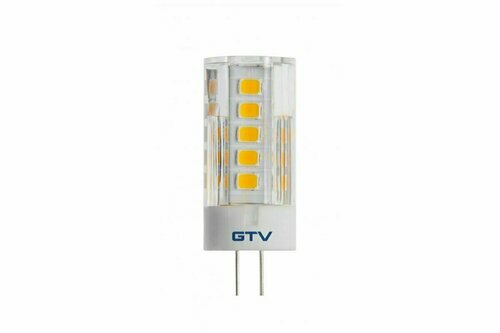
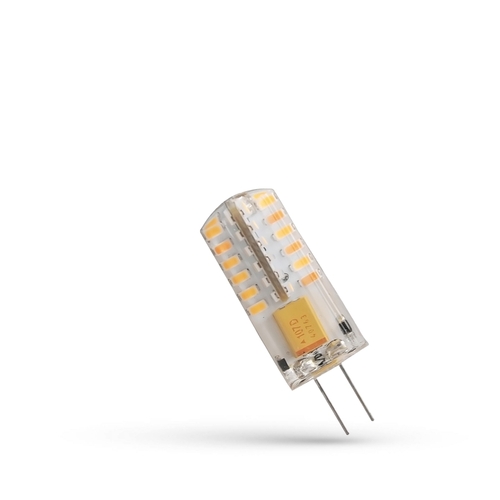
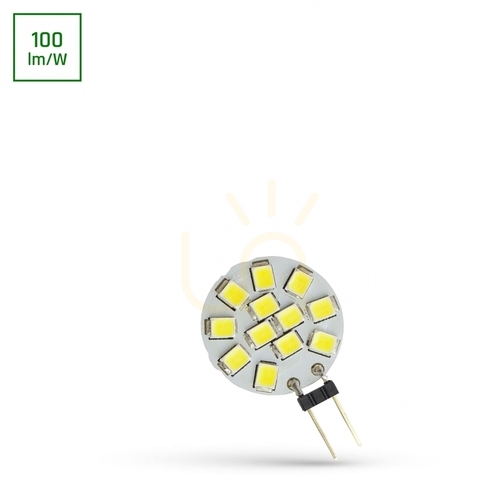
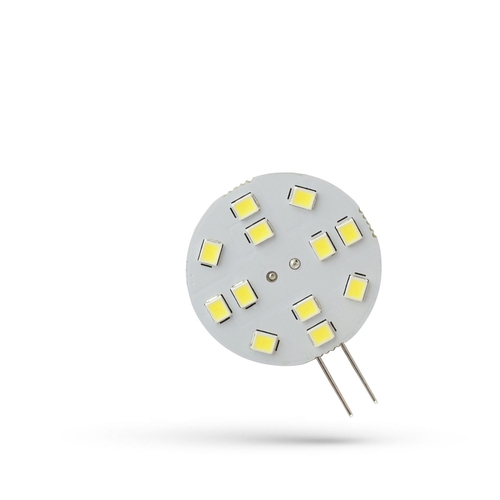
A G4 LED bulb is a small bi-pin capsule that plugs into the same 4 mm socket as the old halogen G4 and uses roughly a tenth of the power. Swapping one in is usually simple, but whether it works first time depends on the fitting around it: the voltage it runs on, the space inside the shade and the transformer feeding it.
You'll meet G4 capsules in cooker hoods, under-cabinet kitchen lights, display cabinets, reading and bedside lamps, bathroom mirror lights and crystal chandeliers where a dozen tiny bulbs sit on slim arms. Low-voltage cable and rail systems use them too, as do caravans and boats running on 12 V.
Are all G4 bulbs the same?
The base is standardised – two straight, smooth pins 4 mm apart – but the bulbs on it are not. Three things vary:
-
Voltage. Most G4 bulbs are 12 V and need a transformer or driver. Mains-voltage G4 bulbs (230 V, sometimes listed as 220 V or 240 V) also exist for fittings without one. They look identical and must never be mixed up: a 12 V capsule in a mains fitting fails instantly, and a 230 V one on 12 V barely glows.
-
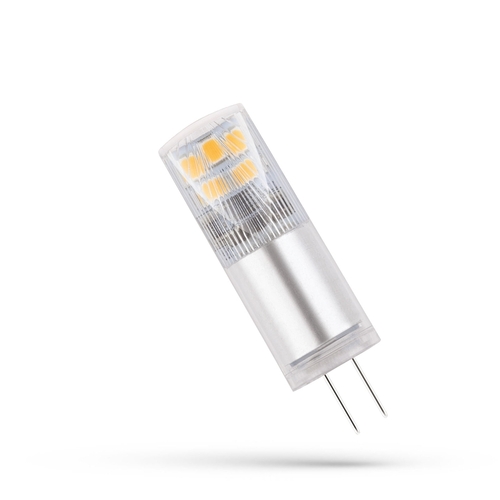
Size. A halogen G4 is around 10 mm across and 30 mm long. LED versions are often 15–19 mm wide and 35–45 mm long, which matters inside a glass shade or a hood cover.
-
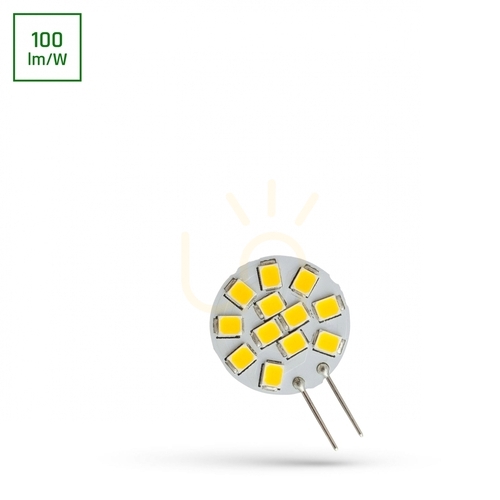
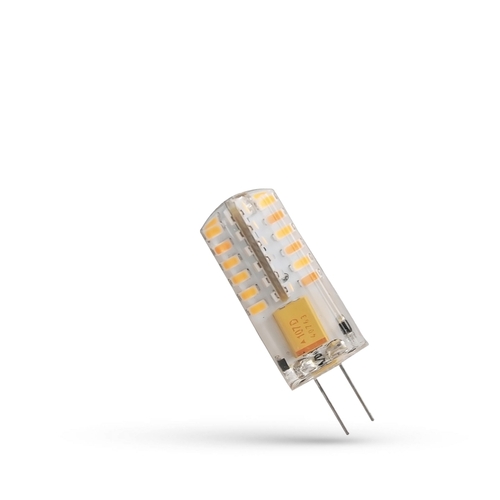
Shape. Flat discs light mainly forward, cylinders with LEDs all round give a halogen-like spread, and silicone-coated capsules look closest to the original.
Watch out for look-alikes. GU4 has the same pin spacing but thickened pin tips and is mostly used on MR11 reflectors. GY6.35 has thicker pins 6.35 mm apart, and G9 has looped pins and usually runs on mains voltage.
Matching brightness and colour
Ignore the "equivalent to" claim on the box and compare lumens. These are the figures a like-for-like swap is usually built on:
| Old halogen capsule |
Approx. output |
LED to look for |
| 10 W |
130–150 lm |
1–1.5 W, 100–150 lm |
| 20 W |
about 300 lm |
2–3 W, 200–300 lm |
| 35 W |
500–600 lm |
4–5 W, 400–500 lm |
| Colour, living spaces |
2700–3000 K |
codes 827 or 830 |
| Colour, worktops and displays |
4000 K |
CRI 80 or higher |
Warm white at 2700–3000 K is what most people expect when replacing halogen, especially in a chandelier. Cooler 4000 K light reads well over a hob or in a cabinet full of glassware.
The transformer problem
This is where most G4 swaps go wrong. Many halogen fittings use an electronic transformer that needs a minimum load – often 10–20 W – before it switches on properly. A 2 W LED is well below that, so the bulb flickers, blinks every few seconds or stays dark. Older wire-wound (toroidal) transformers tend to cope better with AC/DC LEDs.
Your options, in order of effort:
- choose bulbs marked as compatible with electronic transformers;
- where one transformer runs many capsules, check that the combined LED wattage clears its minimum;
- replace the transformer with a 12 V constant-voltage LED driver rated 20–30% above the total load.
Bulbs marked "DC only" need a DC driver or battery, not an AC transformer. If the transformer is wired into the mains, have a qualified electrician change it; fixed wiring work in the UK falls under BS 7671.
Lifespan and damp rooms
G4 LEDs are usually rated for 15,000–25,000 hours, against roughly 2,000–4,000 hours for a halogen capsule. In a bathroom, protection from moisture comes from the fitting's IP rating and seals, not from the bulb.
Fitting, heat and dimming
Switch off and let a halogen cool before you pull it. Some integrated fittings, cooker hoods especially, need a cover or diffuser removing first. Push the new capsule straight in without twisting until the pins are fully seated. LEDs dislike heat more than halogens: most G4 LEDs are designed for surrounding temperatures up to about 40 °C, so in a hood above a hob or a tightly enclosed fitting, a lower-wattage bulb lasts longer than the brightest one you can find. Dim only bulbs labelled dimmable, and check that the dimmer and transformer are LED-friendly – a trailing-edge type is the usual choice for electronic transformers.
G4 LED questions
Can you replace G4 bulbs with LED?
Yes, in most fittings. Match the voltage, check the LED fits the space and make sure the transformer will run such a small load.
Are G4 halogen bulbs being phased out?
Yes. Ecodesign rules in the UK and the EU have phased out new halogen G4 capsules for general lighting, so LED is the practical replacement.
What is the brightest G4 LED bulb?
G4 LEDs typically top out at around 400–500 lm at 4–5 W. Brighter capsules run hotter and are larger, so check the fitting's space and ventilation before going for maximum output.
Is there a 230 V G4 LED bulb?
Yes, for fittings wired straight to the mains without a transformer. Only use one where the old bulb or the fitting's label says 230 V.
Why does my new G4 LED flicker?
Usually because the electronic transformer isn't seeing its minimum load, or because the dimmer isn't designed for LEDs.
Can I use a G4 LED in an oven?
No. Oven lamps are special heat-resistant types; a standard G4 LED isn't built for those temperatures.
More socket types and light colours are explained under light bulbs. If the same room has 12 V spotlights on a transformer, the same applies to MR16 bulbs.