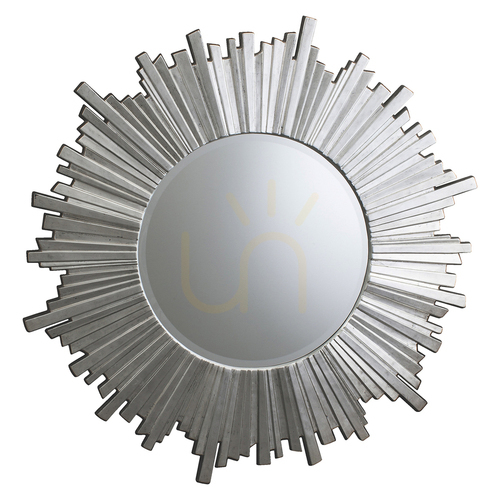
Retro mirrors are new mirrors made in the shapes and frames of past decades – a stepped Art Deco outline, a gilt fifties sunburst, a rattan or smoked-glass piece straight out of the seventies. What sets them apart from a plain wall mirror is that the frame, silhouette and edge do the talking: they decide whether a room reads as an inter-war flat, a mid-century lounge or a seventies bedroom.
If you have been searching for a vintage-style mirror, this is usually what you mean: period looks with modern, clear silvered glass. A genuinely vintage mirror is either decades old or has deliberately aged, foxed glass – a different thing, with different care needs.
Picking a decade
“Retro” covers several eras, and each has its own proportions and materials:
-
Art Deco (twenties and thirties) – fan and stepped tops, arches, wide bevelled edges, brass, frames built from mirrored panels. Lovely above a fireplace in an Edwardian or inter-war house.
-
Hollywood – a dressing-table mirror ringed with exposed bulbs, borrowed from theatre dressing rooms.
-
Mid-century (fifties and sixties) – metal sunbursts and starbursts, round and oval mirrors in teak or walnut, slim hall mirrors with a small shelf, a little chrome.
-
Seventies – rattan and wicker, wavy or organic outlines, smoked or bronze-tinted glass, glossy coloured plastic.
-
Industrial – thin black steel, arched “window” shapes, ship’s porthole mirrors.
So retro is not always round and gold. A black steel arch is just as much a period piece as a pastel plastic oval.
Size, height and fixing in a British home
| Where |
Typical size or rule |
Worth knowing |
| Overmantel, above a chimney breast |
about two-thirds of the mantel width |
bottom edge 15–25 cm above the shelf |
| Above a sideboard or console |
roughly two-thirds of the furniture width |
centre at about 150–160 cm from the floor |
| Full length in a hall |
at least 120–160 cm tall |
in a narrow terrace hallway, a tall arched mirror beats a wide round one |
| Dressing table |
small to medium, often 40–60 cm |
side lighting at face height matters more than size |
| Sunburst |
usually 60–100 cm overall |
the glass centre is far smaller – decorative rather than practical |
Glass weighs about 2.5 kg per m² for every millimetre of thickness, so a 4 mm plate is around 10 kg per m² before the frame. The frame changes the total more than the glass does: rattan, MDF and resin mouldings are light, solid wood and cast metal can double it. Hang heavier mirrors from two points or a French cleat. Brick and block take ordinary wall plugs; plasterboard on studs needs cavity fixings rated for the load, or a screw into the stud itself. Frameless glass goes up with mirror adhesive – acetic silicone eats into the silvering.
Bathrooms and dressing rooms
Steam attacks silvering from the edges, which is where those black borders on old bathroom mirrors come from. A retro mirror in a bathroom wants a working extractor fan and a frame that copes with damp: lacquered brass, chrome or coated metal. Keep rattan and raw wood for the hallway or bedroom. Illuminated mirrors near a basin usually need at least IP44, and anything wired into the mains in a bathroom is work for a qualified electrician under BS 7671. A heated demister pad keeps the glass clear after a shower.
For ambience, warm white bulbs at 2700–3000 K and visible-filament lamps flatter brass and wood. For make-up or shaving, light from both sides at face height works better – around 4000 K with a high colour rendering index (Ra 90 or above).
Looking after it
Spray glass cleaner onto a microfibre cloth rather than the mirror, so nothing runs under the frame. Lacquered brass only needs a damp cloth; unlacquered brass darkens naturally, so polish it only if you dislike the patina. Teak appreciates an occasional wipe of teak oil, rattan a soft brush and a spot away from radiators and strong sun.
Frequently asked questions
Do vintage mirrors have any value?
Genuine old pieces can, depending on age, maker, frame quality and condition – original glass and gilding count for a lot. A new retro mirror is bought for the look and for clear, reliable glass rather than as an investment.
How can you tell if a mirror is vintage?
Look at the back and the edges. Old mirrors often have a wooden or hardboard backing, hand-cut fixings and cloudy spots where the silvering has oxidised. Perfectly even silvering and a modern backing board point to a newer or reproduction piece.
Which retro mirror suits a dressing table?
Usually a small to medium one, around 40–60 cm across, so you can sit close without leaning in. An oval or arched Art Deco frame suits a slim dressing table; a Hollywood mirror ringed with bulbs brings its own light. Otherwise, place a lamp on each side at face height – light from the sides shows skin tones more truly than a single bulb overhead.
Is a wooden retro mirror suitable for a bathroom?
Only in a well-ventilated room and away from splashes. Teak copes better than softwood, but metal frames are the safer choice in a small shower room.
How do I secure a full-length mirror leaning against the wall?
Fix it at the top with a small bracket or safety cord, especially with children or pets around. Leaners look relaxed, but a 20 kg mirror sliding down is no joke.
Can a small retro mirror work on its own?
Yes, though small mirrors often look better in pairs or as a group of three to five with gaps of about 5–8 cm, mixing shapes from the same era.
More on mirrors in general: mirrors; for aged glass with real patina, read on at vintage mirrors.