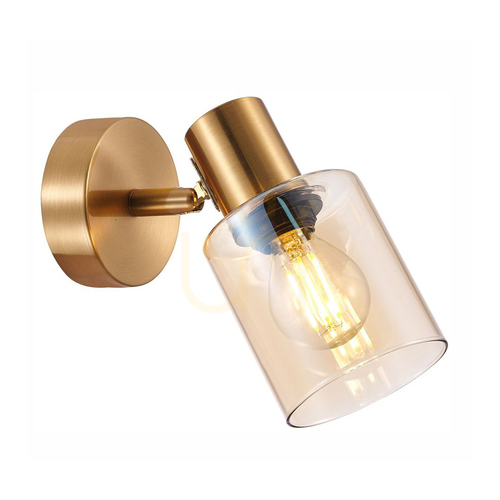
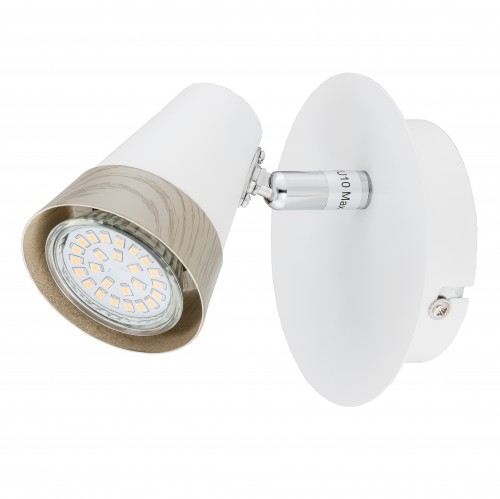
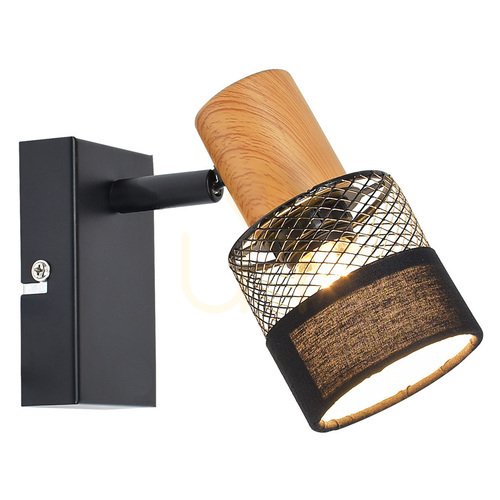
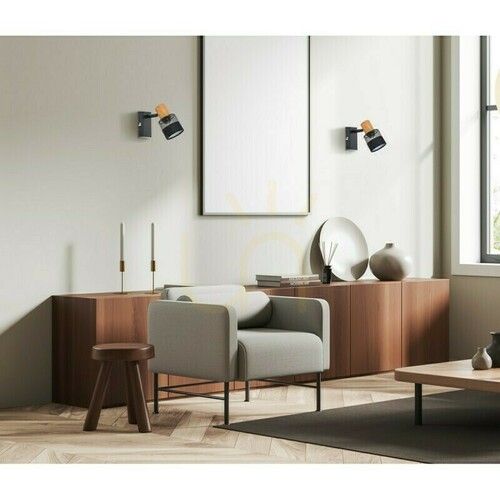
Wall spotlights are wall-mounted fittings with a head you can tilt or swivel, so the beam goes exactly where you want it – onto a painting, a bookcase, a worktop or the pillow side of the bed. Where an ordinary wall light glows in every direction, a spotlight throws a defined cone of light, which means placement, aim and beam angle matter far more than the wattage printed on the box.
How a wall spotlight differs from other wall lights
Decorative wall lights and sconces with shades are there for atmosphere. A spotlight is a working light that happens to sit on the wall. Point the head down and it lights the sideboard beneath; point it up and the beam bounces off the ceiling to give soft, indirect light across the room. The common formats are:
-
Single spot on a backplate – the simplest option, neat above a picture or beside a bed.
-
Twin and triple spots – each head aims independently, one at the shelves and one at the armchair, for instance.
-
Spotlight bars – three or four heads on a bar, useful along a hallway or kitchen run.
-
Arm and gooseneck spots – the head stands proud of the wall, which suits reading.
-
Wall-and-ceiling spots – the same fitting can be mounted on either surface.
Many come switched, with a toggle or rocker on the backplate, and some are plug-in with a flex and in-line switch, so they need no wiring in the wall at all.
Choosing the right spotlight for the job
With LED, wattage tells you little. A GU10 LED lamp of 5–7 W typically gives 400–600 lm, roughly what a 35–50 W halogen used to. Focus on lumens, beam angle and colour temperature instead.
| Task |
Beam angle |
Lumens per head |
Colour temperature |
Typical position |
| Artwork and photographs |
15–36° |
250–400 lm |
2700–3000 K, CRI 90+ |
above the piece, aimed about 30° from vertical |
| Bedside reading |
36–60° |
300–450 lm |
2700–3000 K |
60–80 cm above the mattress |
| Shelving and alcoves |
36–60° |
400–600 lm |
3000 K |
30–50 cm above the shelf |
| Kitchen worktop |
40–60° |
500–700 lm |
3000–4000 K |
clear of wall cupboards, aimed at the front edge |
| Bathroom mirror |
36–60° |
400–600 lm |
3000–4000 K, CRI 90+ |
either side of the mirror, IP44 or better |
| Bounce light off the ceiling |
60° or wider |
600 lm or more |
2700–3000 K |
head up, at least 40–50 cm below the ceiling |
Then decide on the light source. GU10 is the usual replaceable cap: swapping a lamp takes seconds and lets you change the beam or the colour later. You will also meet G9, E14 and E27 holders. Integrated LED allows a slimmer head, but when the LED reaches the end of its life the whole fitting is usually replaced. For dimming, the lamp has to be marked dimmable and the dimmer has to suit LED loads, which usually means a trailing-edge dimmer.
Fitting and placement
Most living-room accent spots go in at 1.8–2.2 m. Lower than that and they dazzle people sitting down; higher and it gets hard to land the beam on anything. For a row of pictures, allow one spot per piece or one every 1–1.5 m. Before buying, check where the cable comes out of the wall: the backplate has to cover the back box, and the head must clear curtain poles, door frames and wardrobe doors when it swivels.
In bathrooms, fittings follow the zones in BS 7671. Zones 1 and 2, around the bath and shower, need at least IPX4, so look for IP44 or better there; zone 0, inside the bath or shower tray itself, is no place for a wall spotlight. Hard-wired lights on 230 V should be connected by a registered electrician, and bathroom work is best left to one entirely.
Common mistakes and care
Glare is the big one: if you can see the bulb from the sofa or the bed, re-aim the head or choose a fitting with a deeply recessed lamp or a honeycomb louvre. Pictures behind glass need light from a steeper angle or from the side, otherwise you see the fitting reflected. Joints have end stops, and forcing a head past them can pinch the cable inside. Old halogen lamps run very hot, so keep them away from curtains and timber. To clean, switch off, let the fitting cool, and wipe with a dry or slightly damp cloth; never spray cleaner straight onto the head.
FAQs
What are the lights that go on the wall called?
Wall lights in general, or sconces when they are decorative. A wall light with an adjustable head that directs a beam is a wall spotlight, or simply a wall spot.
Do they still make spotlights?
Yes. Halogen lamps have largely been phased out, but the spotlight itself has not: LED replacements with a GU10 cap fit the same holders, and many new spots have the LED built in.
Can I get plug-in wall spotlights?
Yes, some come with a flex, a UK plug and an in-line switch. They are handy in rented homes or where there is no wiring in the wall, and the cable can run in trunking.
Are outdoor wall spotlights different?
They have to be built for it. Under a porch IP44 is often enough; on an exposed wall look for IP54 to IP65 and corrosion-resistant housings.
What makes the best wall spotlight for reading?
A head on an arm or with a wide tilt range, a switch you can reach from the bed, around 300–450 lm and warm light at 2700–3000 K.
Can wall spotlights replace a ceiling light?
In a small room they can, if the heads bounce at least 600 lm off a pale ceiling. In a large living room they work better as a second layer.
If you would rather the beam came from the ceiling or a track, start with adjustable spotlights. For a softer wash of light on the wall instead of a beam, compare flush wall and ceiling lights.