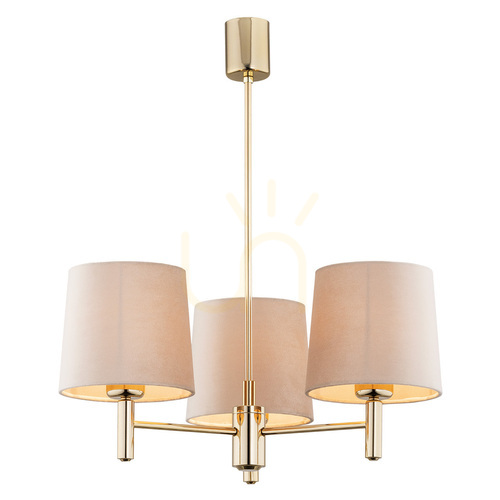
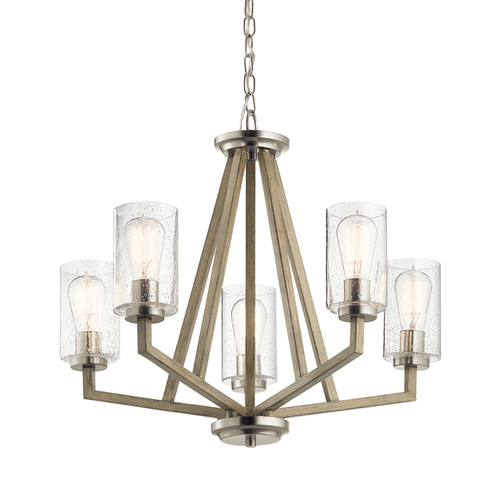
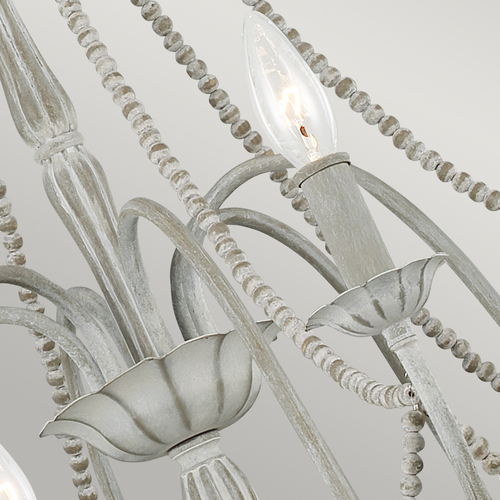
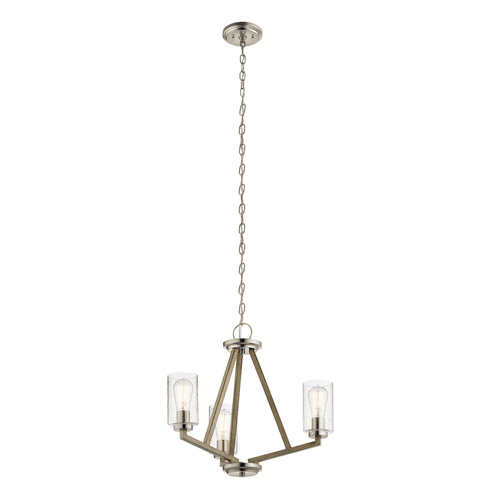
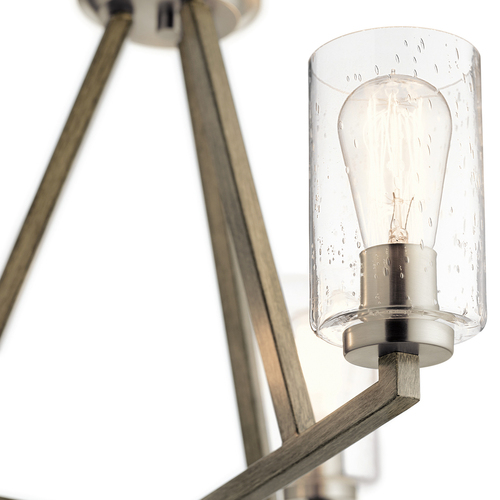
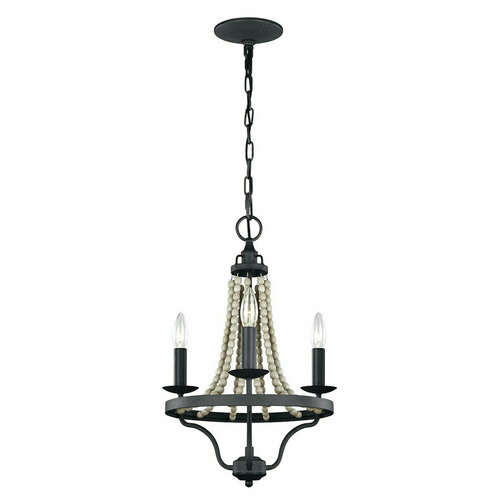
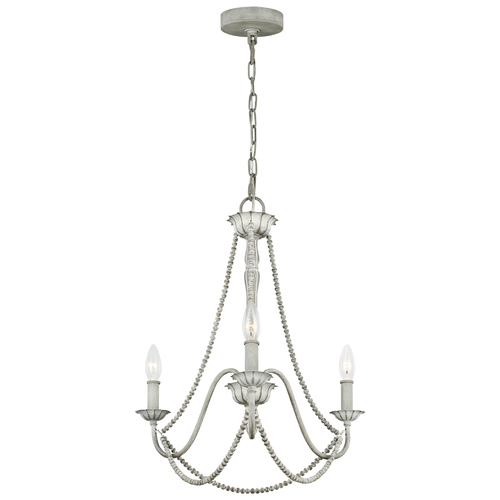
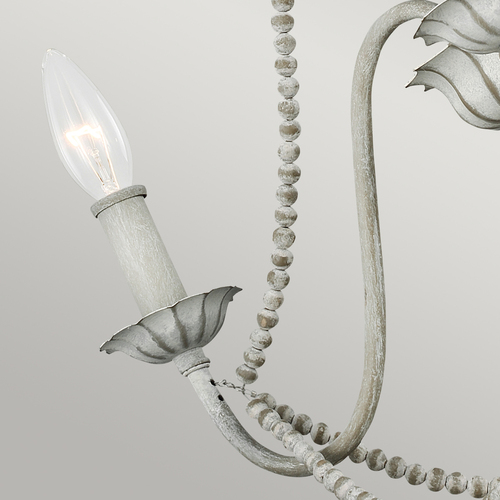
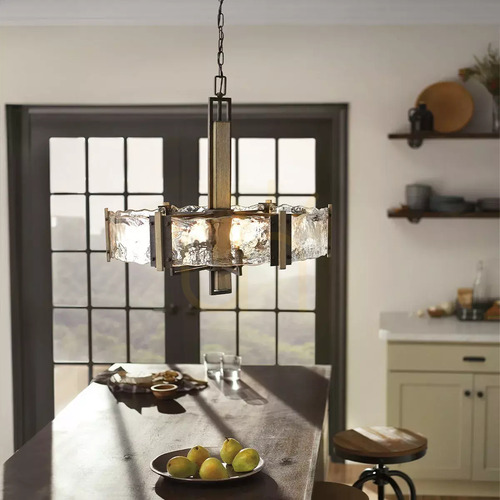
Rustic chandeliers are the country-house branch of the multi-arm ceiling light: a wrought iron or timber frame, arms that still read as candle arms, and not a single crystal drop anywhere on them. The look comes from the hand of the smith rather than from the glass cutter — hammered bar, forged scrolls, visible rivets and welds, a wax or matt black finish that absorbs light instead of throwing it back. Where a classical chandelier tries to sparkle, a rustic one tries to look as though it has been hanging in the same hall for eighty years.
What separates rustic from the styles it gets confused with
Three neighbouring styles use candle arms, and the differences are easy to see once you know where to look. Rustic keeps the arm honest: a plain forged tube, a simple drip cup, a shade of parchment, linen or none at all. Classical adds cut glass, polished brass and a symmetry that has been drawn rather than hammered. Vintage is about surface age — chipped enamel, aged brass, smoked glass — and can be applied to any silhouette, including an industrial one. If the frame is dark, matt and slightly irregular, and the arms carry candle tubes with no glass hanging off them, it is rustic.
Materials do most of the work. Forged and blackened steel is the backbone; oak, pine and reclaimed beam timber appear as a central spar or as a wheel; rope, leather straps and unglazed ceramic show up as details. Colour stays inside a short range of black, graphite, rust brown, waxed bronze and raw wood, with off-white or natural linen on any fabric shade. Nothing is chromed and nothing is high gloss.
The decision a rustic chandelier really forces: weight and the ceiling
Forged iron and solid timber are heavy, and a six or eight arm rustic frame can weigh several times what a modern steel-and-glass pendant of the same diameter weighs. That makes the ceiling fixing the first question, not the last. A hook screwed into a plasterboard ceiling with a plastic anchor is not a mounting for this kind of fitting. Work out what is above the ceiling before you choose a size.
Ceiling construction and what it can carry
| Ceiling |
What actually takes the load |
What to check before ordering |
| Timber joists |
A coach screw or hook driven at least 50 mm into the side or underside of a joist |
Find the joist, not the noggin. If the fitting lands between joists, a timber batten screwed across two joists solves it. |
| Concrete slab |
A through-bolt or a steel expansion anchor set in solid concrete |
The depth of any screed or insulation layer below the slab; the anchor has to reach the concrete itself. |
| Plasterboard on a metal frame |
The metal channel, or a timber noggin added inside the void |
Spring toggles are rated for a few kilograms at best. Anything heavier needs a real backing. |
| Lath and plaster |
The joist above, never the plaster |
Old plaster crumbles around a load. Expect to cut a small access hole and fix a plate. |
| Exposed beam |
The beam, which is usually the strongest point in the room |
Whether the beam is structural or decorative cladding over a steel section or a void. |
Sizing one for the room
The old rule still works: add the room dimensions in metres and read the answer in centimetres. A room 4 m by 5 m suggests a frame around 90 cm across. Over a dining table the table governs instead — the frame should be roughly half to two thirds of the table width, and never so wide that less than 30 cm of table is left clear on each side, or people knock their heads standing up.
Drop height is where rustic differs from a slim modern pendant. A heavy frame at eye level dominates a room, so hang it higher than you would a light one: about 75 to 85 cm above a dining table top, and with at least 210 cm of clear headroom underneath in a hall or over a circulation route. In a room with a 240 cm ceiling, a tall two-tier rustic frame is usually the wrong buy — that form wants 280 cm or more before it stops feeling like a hat rack.
Bulbs, and why they matter more here than usual
Rustic frames almost always leave the lamp visible in a candle tube, which means the bulb is part of the design. A clear candle lamp with a visible filament reads correctly; a frosted golf-ball lamp reads like a builder's fitting. Warm colour temperature is not a preference on this style, it is a requirement: 2200 K to 2700 K keeps blackened iron looking waxed and timber looking oiled, while anything at 4000 K turns the same frame flat grey and makes oak look like MDF.
-
Socket: E14 candle lamps on slim arms, E27 where the arm carries an open shade or a cage.
-
Output: six arms at 470 lm each is roughly 2800 lm, which is enough as the main light for a room up to about 20 m2.
-
Dimming: worth wiring in. A rustic frame at full output looks like a showroom; at 40 per cent it looks like a room someone lives in.
-
Direction: arms that point upward throw light at the ceiling and are gentler; arms that point down put the lamp in your eyeline and need shades or dimming.
What it sits well beside
Rustic lighting works with anything that shows its own material: exposed brick, lime plaster, quarry tile, oak boards, a stone fireplace, an untreated timber table. It fails against high-gloss lacquer and mirrored surfaces, because those want a light source with sparkle and a forged frame has none. In a kitchen, a chandelier over the table and plain metal rustic wall lights along the run of units is a reliable pairing — the wall fittings carry the low light and the chandelier carries the room. If the ceiling is low, or the space is a landing rather than a room, look at the flatter forms among rustic ceiling lights instead, where a close-fitting design gives the same material language without the headroom problem.
Common questions
Is a rustic chandelier only for a country house?
No. It behaves well in a city flat as the single dark object in an otherwise pale room, which is how most designers use one now. What it cannot do is share a room with a second ornate fitting; one forged frame per space is the limit.
Can I put one on a sloping ceiling?
Only if the fitting comes with a swivel canopy or an adjustable ceiling plate. A fixed round canopy on a slope leaves a gap on the high side and hangs the frame off vertical. Chain suspension solves this naturally, since a chain always hangs plumb whatever the ceiling does.
Are the candle tubes replaceable?
On most designs the sleeve slides off the lampholder and can be swapped, which is worth knowing because cream plastic tubes yellow with heat over several years while the frame does not age at all. Check the sleeve diameter before ordering replacements.
How does rustic differ from a vintage fitting?
Rustic is about material and craft, vintage is about age and patina, and they overlap without being the same request. A comparison against vintage chandeliers makes the difference obvious: the vintage piece leans on aged brass and smoked glass, the rustic one on forged iron and bare timber.
What about cleaning?
A dry brush and a vacuum with a soft head. Waxed and blackened iron finishes dislike detergent, which strips the wax and leaves the steel to bloom with rust in a humid kitchen. Timber elements want nothing wetter than a barely damp cloth.