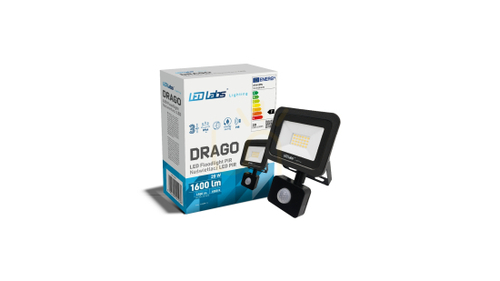
Ask about outside lighting on any UK DIY forum and the first question back is usually “PIR or dusk till dawn?” A PIR floodlight with a dusk sensor sits between the two. Set up in the usual way, it ignores movement during the day and, after dark, switches on when someone walks into range. That is what most people picture when they say security light: enough output to flood a drive or back yard, yet on for a few minutes a night rather than until morning. Most of the grumbles about these lights – on at teatime in November, dark when you are fumbling with the key, flashing on for every cat – come down to two small dials and where the fitting is mounted.
PIR, dusk till dawn or both?
“Dusk sensor” on a box can mean several different behaviours, and the label alone does not tell you which one a fitting has.
| Mode |
What happens after dark |
Best suited to |
Trade-off |
| PIR with dusk lock |
off until movement, then full output for the set time |
drives, side returns, back doors |
dark between triggers |
| Dusk-to-dawn photocell |
on all night, off at first light |
areas that need steady light, such as shared paths |
burns roughly 7–16 hours a night, depending on the season |
| Two-stage (Hi-Lo) |
dim glow all night, full output on movement |
front gardens, entrances you want to look lived in |
less common on mains floodlights |
| Manual override |
stays on until switched back or until dawn |
parties, unloading the car |
easy to forget it is on |
If you want the two-stage effect but cannot find it in the fitting you like, a common workaround is two lights: a low-output dusk-to-dawn lantern by the door and a PIR floodlight covering the drive.
How the two sensors share the work
The photocell is the light’s sense of time of day: a small window, often next to or below the PIR lens, that answers a single question – is it dark enough yet? Until it is, nothing the PIR notices will switch the lamp on. The LUX dial, normally marked with a sun at one end and a moon at the other, moves that point, on most fittings from around 5 lux, when it is nearly dark, up to roughly 2000 lux, close to daylight. It follows the seasons without a timer: dusk falls mid-afternoon in December and after 9 pm around midsummer. A short built-in delay stops passing headlights or a dark cloud flicking it on and off.
The PIR does not see movement as such. It reacts to a change in heat across its zones, which is why it picks you up, along with the dog and a car that has just pulled in, and why it copes with wind and rain far better than the microwave sensors some fittings use, which can also fire through glass and thin walls. The TIME dial sets how long the lamp stays on after the last detection, usually from about 10 seconds to several minutes, and every fresh movement restarts the count. Simpler heads see about 8 m; larger ones reach further, typically over a 110–180° arc. With anything from around 800 lm to several thousand behind the lens, a badly set dial shows up straight away.
Where to put it
- Down a side return the walls keep the passage dim long before the street goes dark, so a photocell mounted there reads dusk early. Set LUX lower than you would on an open drive.
- By the wheelie bins or the back gate, point the sensor so people cross its view. A PIR is far better at spotting someone walking across it than someone heading straight towards it.
- On a terraced front, where the pavement is a few steps from the door, narrow the field with SENS, tilt the head down or fit the masking strips, so passers-by do not trigger it. Keep the street lamp out of the photocell’s view too: lit all night, it never sees dark and the PIR never arms.
- Two floodlights facing each other can lock one another out, because the first to switch on puts the second’s photocell back into daylight.
- About 1.8–3 m up, angled down, suits most houses. Mount it higher and the blind spot beneath grows while the beam spreads thinner.
Setting it up
Start in daylight with LUX on the sun symbol (test mode) and TIME at minimum. Walk the area, then adjust SENS and the angle of the sensor head until it picks you up where you want and ignores the pavement. At dusk, turn LUX towards the moon until it stops responding, back it off slightly and set TIME to suit: around a minute for a path, 2–5 minutes for a drive where you need to get the car in and the door locked.
Mains floodlights run on 230–240 V. Have a qualified electrician install them, with the work done to BS 7671, the cable entering from below and connections in an outdoor junction box with a matching IP rating. Where there is no supply, battery and solar units are an option, though with far less output.
When it misbehaves
On for the fox at 3 am: lower SENS and angle the head so its reach ends at your boundary. On every time the boiler fires: a flue or heat-pump fan in view puffs warm air across the zones, so mask that segment of the lens. Off while you stand at the door: you are in the blind spot or too still, so lengthen TIME. On at teatime under a grey sky: the photocell is in shade, so turn LUX towards the moon. Allow a week of evenings for tuning.
Damp winters leave a film on the lens and cobwebs gather round the sensor head, so wipe the PIR lens and the photocell window in autumn, before the long nights start, and again in spring. Keep the beam pointing down and away from next door’s windows: in the UK, intrusive artificial light can be treated as a statutory nuisance.
PIR floodlight questions
What is a PIR floodlight?
A floodlight with a passive infrared sensor that detects a warm body moving across its view and switches the light on. With a dusk sensor added, it normally does so only after dark.
Why does my PIR light come on in daylight?
Most often the LUX dial is still on the sun (test) setting, or the photocell sits in deep shade and reads dusk too early. Turn the dial towards the moon; if nothing changes, the sensor may be faulty.
Are dusk to dawn lights good for security?
They make an area permanently visible, which helps on shared paths. For a private drive, a light that snaps on when someone arrives is usually more noticeable to the household and to anyone approaching.
What’s the difference between a floodlight and a security light?
A floodlight is defined by its wide, powerful beam. A security light is defined by its job; it is often a floodlight with a PIR and dusk sensor, though smaller lanterns are sold as security lights too.
Do floodlights deter burglars?
Lighting removes cover and draws attention, which is why a sensor-triggered light is a common part of home security advice. It works best alongside locks and, where fitted, a camera covering the same area.
Can I get a battery PIR floodlight?
Yes, along with solar versions. They suit sheds and fences far from a socket, but deliver less light and shorter run times than a mains fitting.
For brightness, colour and beam angle on floodlights with or without sensors, see LED floodlights. If the wall you have in mind has no supply, compare them with solar floodlights.