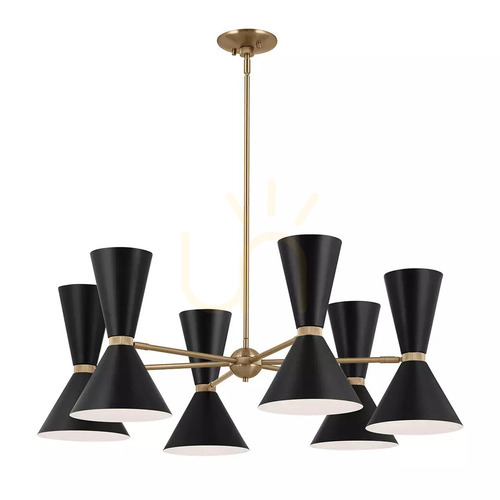
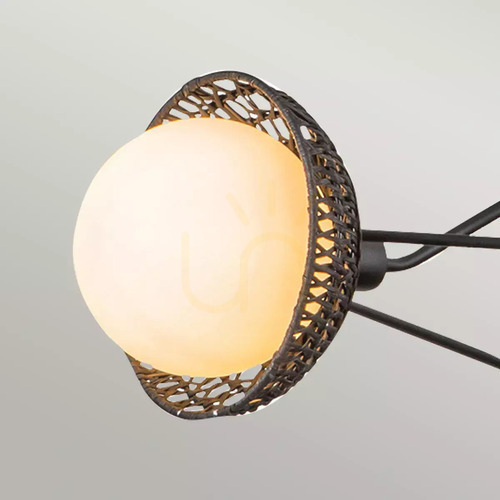
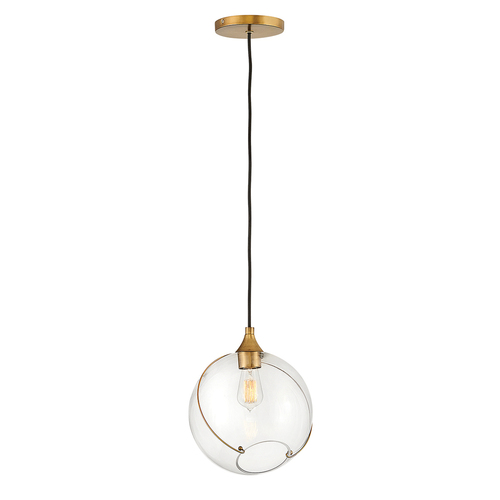
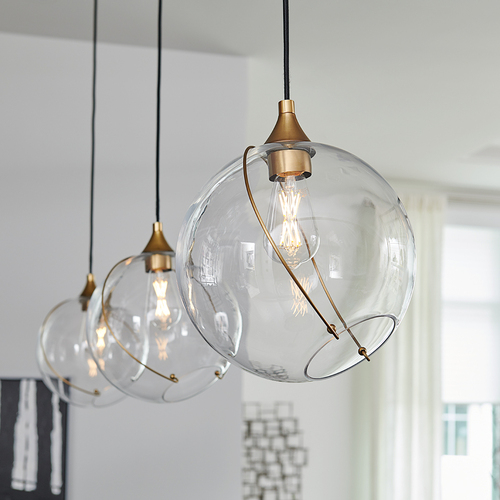
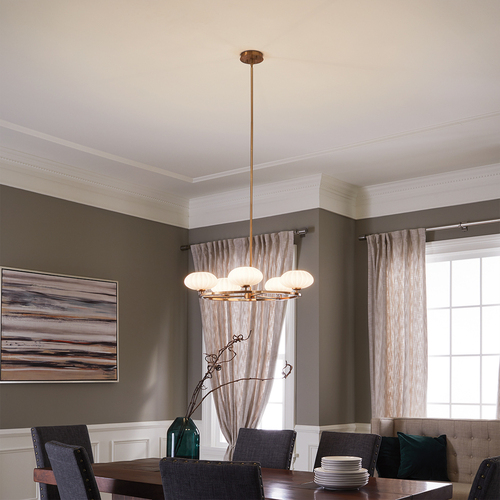
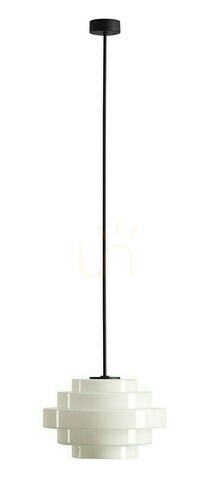
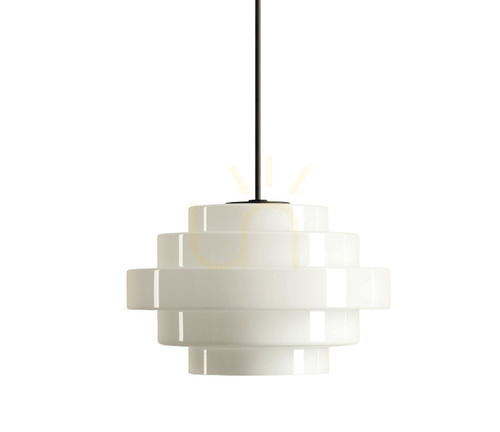
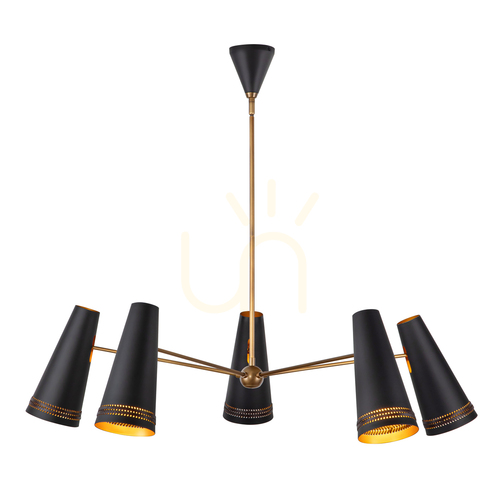
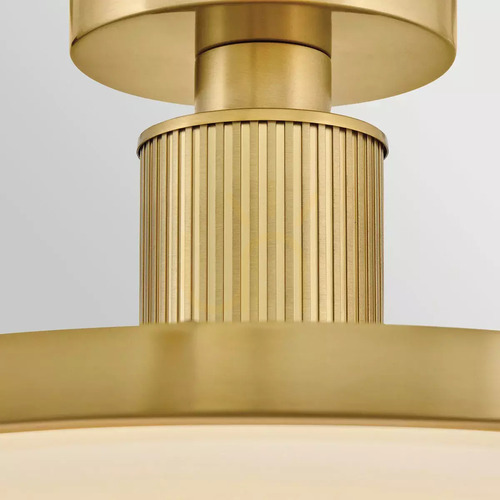
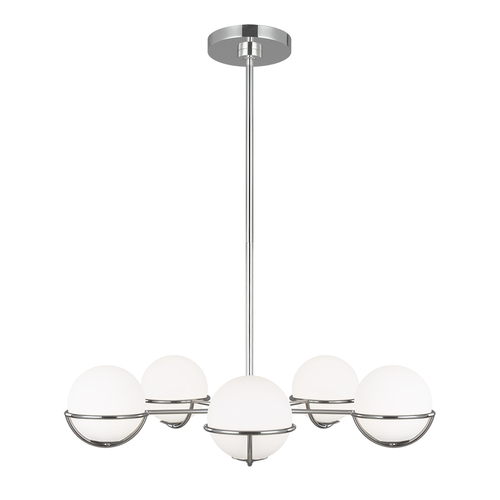
Mid century ceiling lights cover four quite different fittings that happen to share a period: the pendant on a flex, the flush or semi-flush disc, the multi-arm sputnik, and the ceiling spot on a rotating ball joint. They came out of the same twenty years and the same design language — opal glass, spun metal cones, thin brass, splayed geometry — but they solve different problems, and the ceiling in front of you decides which one you can actually use.
Start with the height of the ceiling
This is the decision that comes first, before shape, finish or price. Every other choice follows from it, and getting it wrong is the single most common reason a fitting has to go back.
Which mid-century ceiling fitting a room can take
| Ceiling height |
Over a table or island |
Over open floor |
Avoid |
| Under 2.4 m |
A shallow cone or a small opal globe, hung so the bottom sits 70 cm above the tabletop |
Flush or semi-flush disc only |
Sputnik forms, long stems, anything with a visible drop over walking space |
| 2.4 to 2.7 m |
Cone, globe or a row of three small pendants |
Semi-flush on a short stem, or a compact multi-arm fitting |
Deep enclosed shades that sit below 2.05 m at their lowest point |
| 2.7 to 3.2 m |
Anything, including a large single opal globe or a cluster at staggered heights |
A sputnik reads properly here for the first time |
A small flush disc, which disappears into the plaster |
| Over 3.2 m |
A long-drop pendant or a rise-and-fall on a counterweight |
A wide sputnik or a tiered arrangement |
Anything under about 40 cm across, which looks like an afterthought |
The universal floor is 2.05 m of clear headroom under any fitting people walk beneath. Over a table nobody walks on, that rule stops applying and the tabletop becomes the reference instead.
The four fittings, and what each one is for
Pendant on a flex or stem
The workhorse of the period, and the form most people picture. A cone, a globe or an elongated dome hanging from a short brass or fabric flex. It lights a defined area under it and very little else, which makes it right over a table and wrong as the only light in a living room. If this is the one you need, mid century pendant lights covers drop heights, diameters and how many to hang in a row.
Flush and semi-flush
An opal disc, a shallow bowl or a small globe fixed close to the plaster. The period produced a great many of these because post-war flats had low ceilings, and the flattened shapes are not a compromise — they are the original solution. They light a whole room evenly and cast almost no shadow, which is exactly what a corridor or a small bedroom wants and exactly what a dining table does not.
Sputnik and multi-arm
Arms radiating from a central sphere, each ending in a small lamp. Bought as a sculpture rather than as a light source: it throws light in every direction at once, including at your eyes, so it works best on a dimmer and alongside other fittings. It needs height above it and clear space around it. Mid century chandeliers goes into diameter against room size and how many arms a space can carry.
Directional ceiling spots
The least-remembered of the four and the most useful. A ball-jointed metal cylinder on a plate, single or in a row of three or four, aimed at a wall or a picture. The period drew them for shops and galleries and they moved into homes with the open-plan layout. In a room where you cannot drop anything, this is how you get light onto something rather than merely into the space.
How much light the room actually needs
Mid-century interiors were lit at a lower level than a modern specification assumes, from several points rather than one. If you fit a single bright ceiling light and nothing else, the room will look flat no matter how good the fitting is.
- A living room of around 20 m² wants roughly 2,000 to 3,000 lumens in total, split across a ceiling fitting, a floor lamp and a table lamp — not delivered by the ceiling alone.
- Over a dining table, 400 to 800 lumens is enough if the pendant hangs low, because the distance to the table is short. A high-mounted fitting needs considerably more.
- A hallway or a small bedroom is served by a single flush fitting at 800 to 1,200 lumens.
- 2700 K throughout. The wood, brass and opal glass of the style were all chosen under warm incandescent light, and a cooler source drains them.
Fitting it to a real ceiling
-
Check what is above the plaster. A sputnik or a wide multi-arm fitting is heavy and needs to reach a joist or a proper cavity fixing, not a plasterboard anchor chosen at the last minute.
-
Measure the ceiling rose. Period-style canopies are often small, and a narrow brass rose will not cover a large modern box. Check the canopy diameter against the hole you already have.
-
Sloped ceilings. A pendant hangs vertically regardless of the slope, but the canopy has to sit flat on it. Fittings that allow the flex to pivot inside the rose are the ones to look for.
-
Bulb access. A closed opal globe usually opens by unscrewing the lower half. If it is glass and heavy, that is a two-hand job at the top of a ladder, which is worth knowing before you buy rather than after.
Questions people ask
Can I hang a pendant in a room with a 2.3 m ceiling?
Over a table, yes — the tabletop is the reference and a shallow shade at 70 cm above it clears everything. Over open floor, no. A semi-flush fitting is the honest answer there, and the period made plenty of them.
One large fitting or three small ones over a table?
A single shade needs to be about a third of the table width to look deliberate. Three small pendants in a row need the table to be at least 160 cm long, spaced evenly with the outer two set in about 30 cm from the ends. Below that length a row looks crowded and a single fitting is better.
What is the difference between this and flush ceiling lights generally?
This page is the whole ceiling category filtered to one period, so it holds pendants, flush fittings and multi-arm designs together. If you already know the ceiling is too low for anything to hang, go straight to the flush and semi-flush shapes instead of choosing between forms you cannot use.
Does a sputnik work in a normal-height room?
Only a small one, and only where nothing passes underneath. The form was drawn for entrance halls and double-height spaces. In a 2.5 m room a six-arm version at 50 cm across can work over a stairwell or in a corner of an open-plan space; a 90 cm one cannot.
Where do I look if the room is not mid-century?
Two neighbours sit close enough to swap in. Vintage ceiling lights shares the warm metals but adds visible age and darker glass, and industrial ceiling lights takes the same simple geometry into black steel and mesh. If the room is period rather than modern, retro lamps sets out how the whole style holds together before you commit the ceiling.