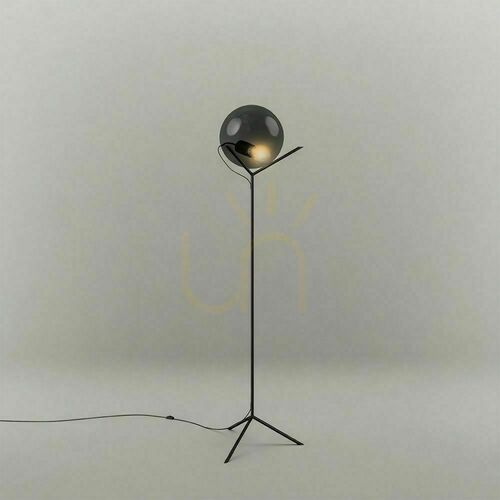
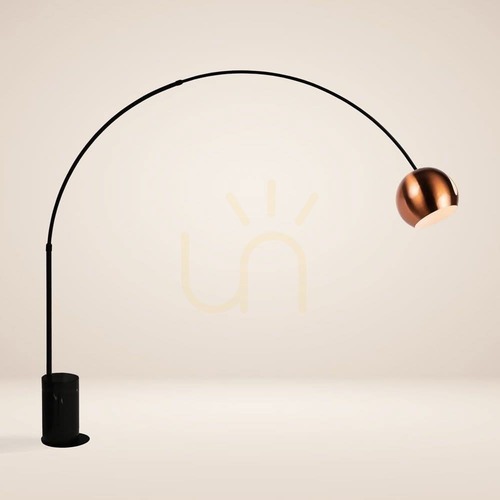
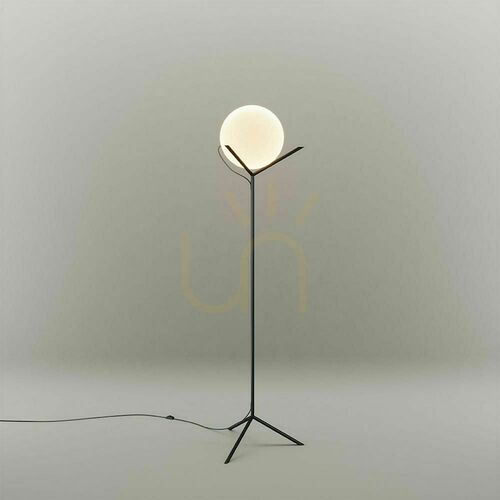
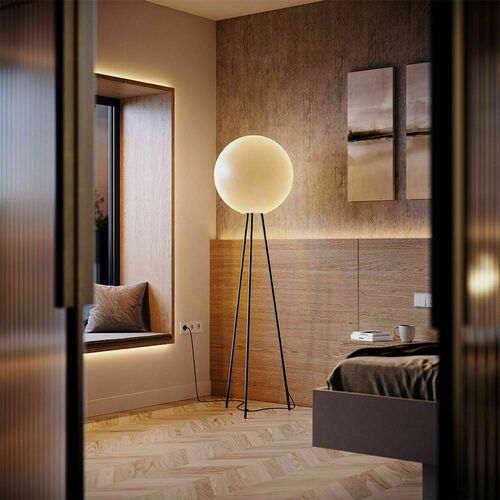
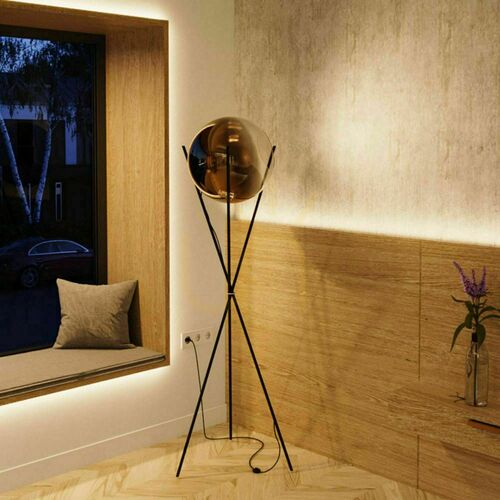
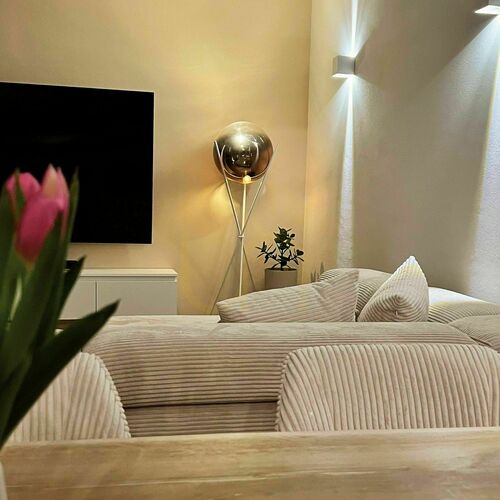
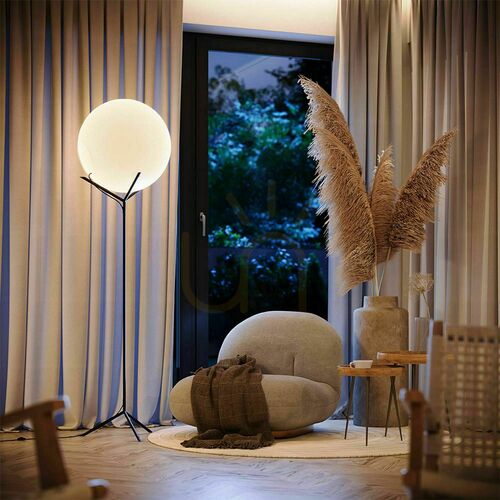
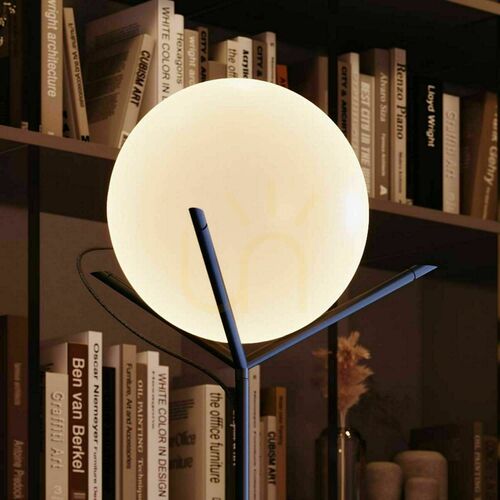
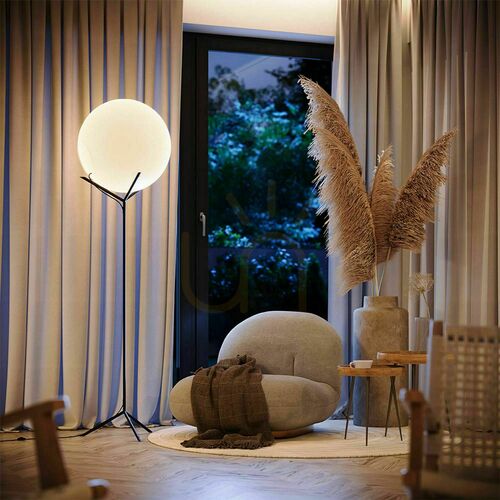
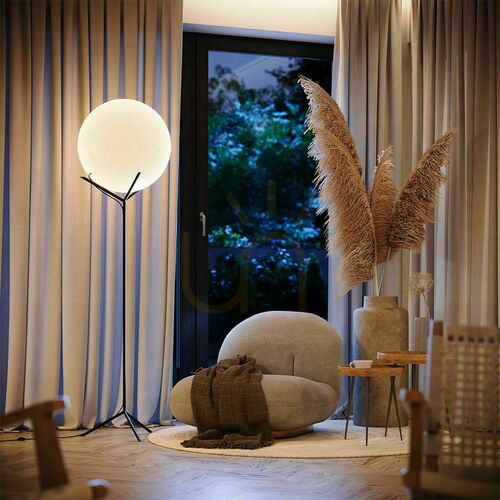
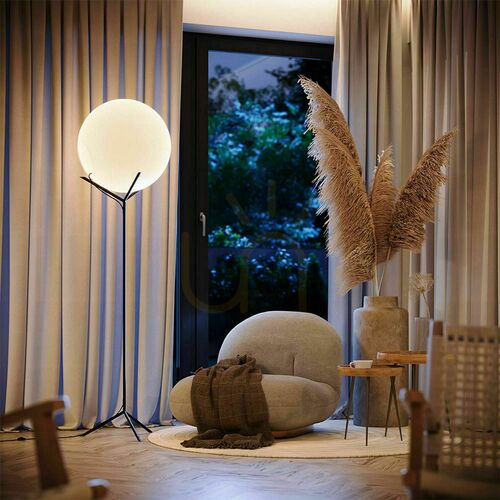
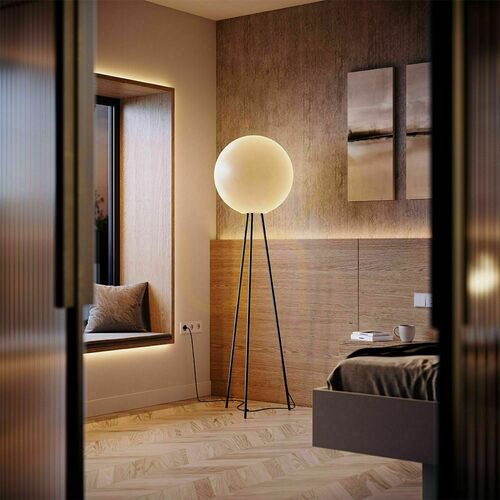
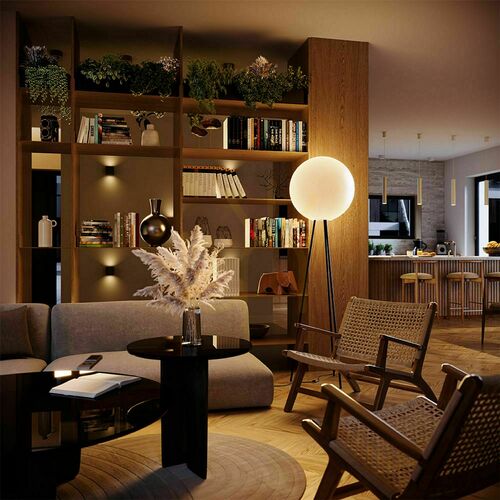
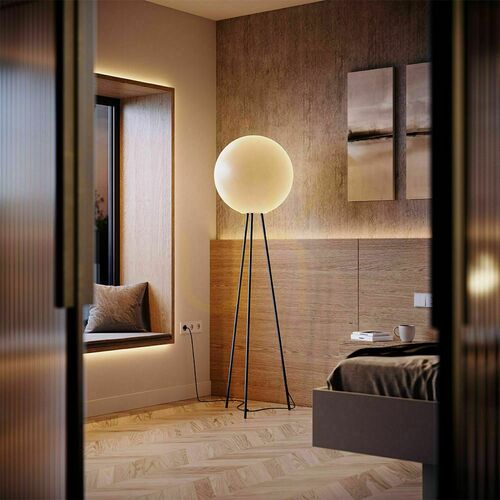
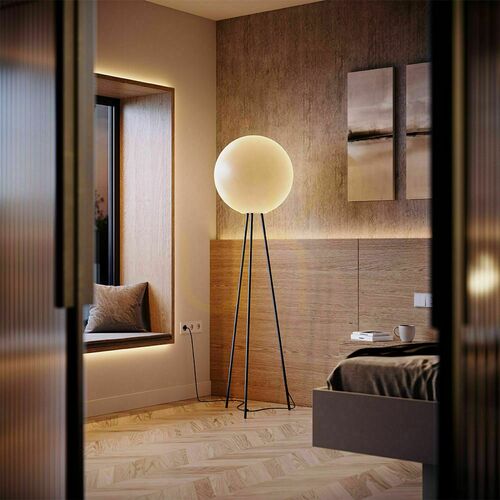
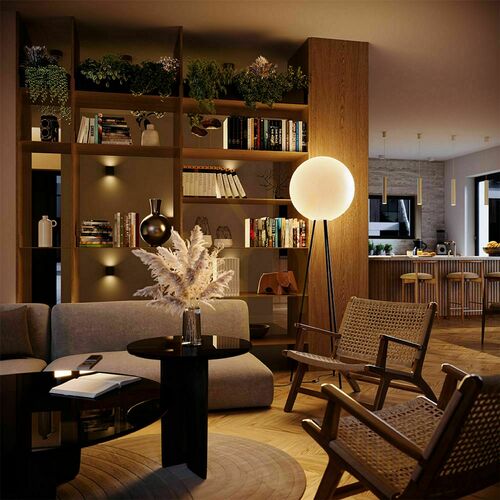
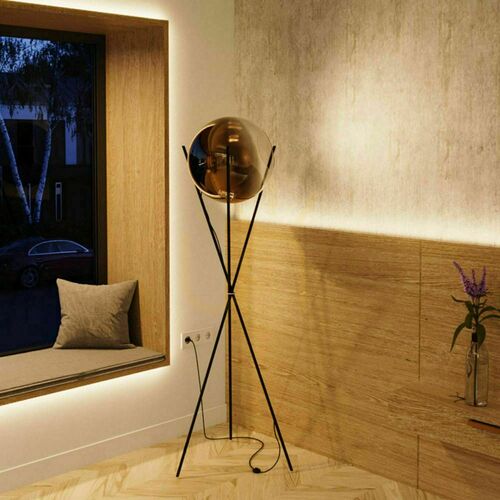
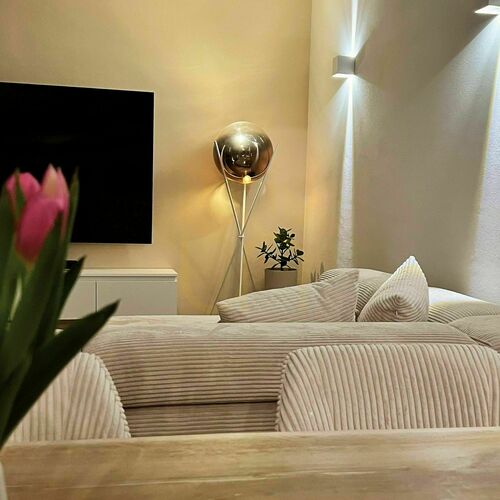
A globe floor lamp is a floor-standing lamp whose light comes from a spherical shade, usually glass, set on a stem, an arc or a cluster of arms. Because a sphere glows in every direction, it washes the walls, the ceiling and the corner around it with soft light instead of throwing a bright pool onto the floor the way a fabric-shaded standard lamp does.
On most globe floor lamps that glow sits at about face height, which is where the trade-off lies. With a globe pendant you look up at the glass; with a globe floor lamp you look straight into it, so the type of glass, the height and the bulb matter far more than they do overhead.
Where to put a globe floor lamp
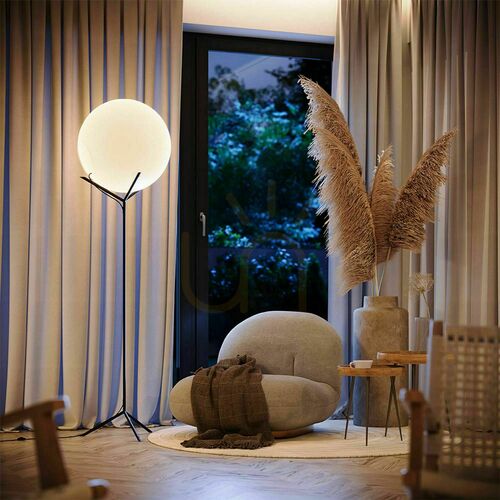
Start with the corner. Two walls bounce the light back into the room, which makes a small sitting room feel bigger and gets rid of the dark patch that a single ceiling light leaves behind. Beside the sofa or an armchair is the next natural spot, ideally slightly behind the seat so the globe is not right in your peripheral vision. Next to the television, a gentle glow cuts the harsh contrast between a bright screen and a dark room, which is easier on the eyes in the evening.
An arc lamp with a globe on its end solves a common problem in British living rooms: there is a single ceiling rose in the middle and nothing over the coffee table. The arc reaches across, no rewiring needed. Keep any floor lamp clear of curtains and off the main walkway, and run the flex along the skirting rather than across the rug.
Sizing it up: globe, height and bulb
| Spot |
Globe size |
Overall height |
Typical bulb |
| Beside a sofa or armchair |
25–35 cm, opal |
usually 130–160 cm |
ES (E27) or BC (B22), 600–800 lm, 2700 K |
| Empty corner |
35–50 cm, or a large floor-standing globe |
120–170 cm |
800–1000 lm, 2700–3000 K |
| Over a coffee table |
30–40 cm on an arc |
up to around 200 cm |
ES, 800 lm, dimmable |
| Feature piece, several globes |
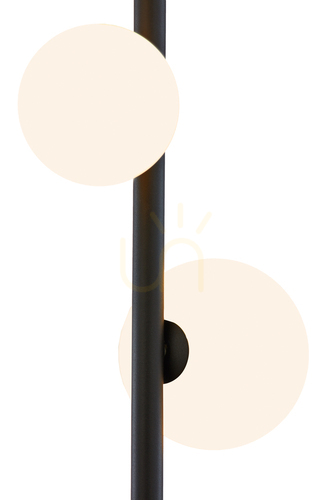
10–15 cm each |
140–180 cm |
G9 capsules, roughly 300 lm each |
Under a typical 2.4 m ceiling in a modern home, a lamp that nearly touches the top looks crammed; in a Victorian terrace at around 2.7 m and above, a short globe can look lost, and a taller stem or an arc fills the height better. The maximum wattage on the label, for example 25 W per G9 or 60 W for an ES holder, refers to old incandescent bulbs. An LED of the same brightness uses a few watts and leaves the glass barely warm.
Opal, clear or smoked glass
-
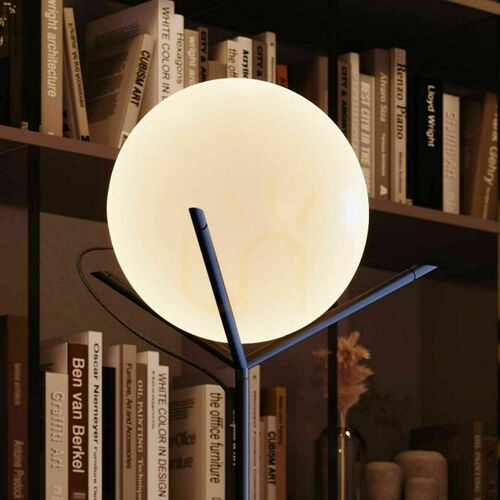
Opal (frosted white) spreads light evenly and hides the bulb, so it does not dazzle even at eye level. The safest choice next to seating.
-
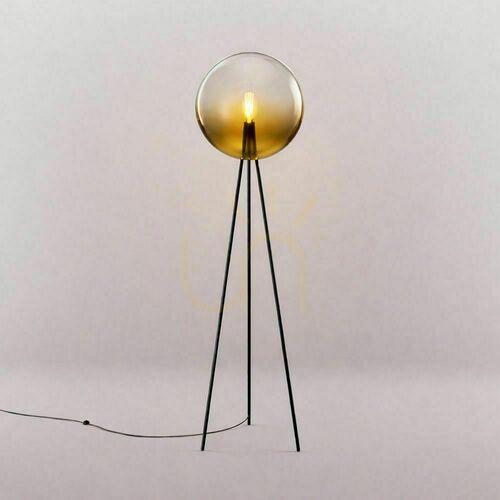
Clear glass turns the bulb into the decoration. Use a filament LED or a crown-silvered bulb, or the bare point of light will glare.
-
Smoked, amber or tinted glass dims and warms the light. Lovely in the evening, but it will not light the room on its own.
-
Acrylic, polyethylene or paper globes are lighter and unbreakable – worth considering with children or a lively dog.
Plugs, switches and stability
A floor lamp plugs into an ordinary socket, so no electrician is needed. Lamps sold for the UK come with a BS 1363 plug, normally fitted with a 3 A fuse. Some older or refurbished homes have 5 A round-pin sockets wired to the wall switch, which lets the lamp come on as you walk in; to use one, the lamp needs a matching round-pin plug. Any change to the wiring itself is a job for a qualified electrician. A foot switch is the most convenient control on a floor lamp, and many offer stepped dimming by tapping it. A separate dimmer only works with a dimmable bulb.
Glass at the top makes a globe lamp top-heavy, so look for a weighty base in marble, cast iron or thick steel. A tripod stands firm but takes up roughly half a metre of floor.
Care and common mistakes
- Cool white 4000 K light makes a living room feel like an office after dark.
- Dust and insects collect inside an opal globe and show as shadows, so empty it out now and then.
- Unplug and let it cool before cleaning. Wash glass in lukewarm water with a drop of washing-up liquid and dry it fully before refitting.
- Wipe brass, gold and chrome dry, with nothing abrasive. Hand-blown glass may show tiny bubbles – a mark of the process, not a fault.
Frequently asked questions
Where should lamps go in a living room?
Spread them out: a globe floor lamp in a corner or by the sofa, a table lamp at the other side of the room and a reading light at the favourite chair. Several sources at different heights look far softer than one bright ceiling light.
What is the lampshade rule, and does it apply to globes?
The usual rule puts the bottom of a shade at roughly seated eye level so you never see the bulb. An opal globe can sit at that height without glare; a clear globe should sit well above your head.
Can you put a globe floor lamp in a bedroom?
Yes, especially a dimmable one with warm 2200–2700 K light. Place it so the globe is not in your eyeline from the pillow.
Is a large globe floor lamp right for a small room?
It can be, if it stands in a corner and the globe is opal. A big glowing sphere reads as one calm shape; a cluster of small globes looks busier.
Chrome, brass or black – which finish?
Chrome and black suit modern rooms, brass and gold lean towards art deco. Matching the finish to door handles, frames or table legs matters more than the colour itself.
For a wider look at lighting the main room, see globe lights for the living room; for globe lighting in general, see globe lights.