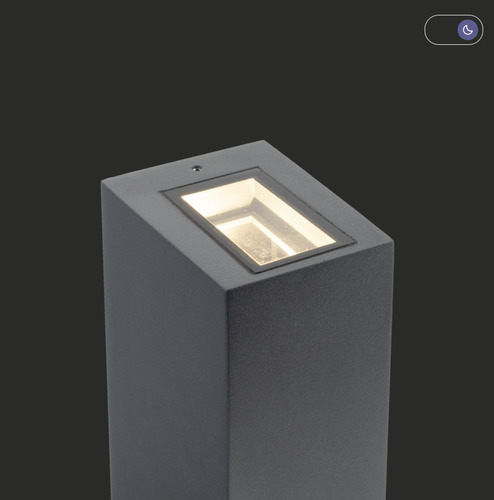
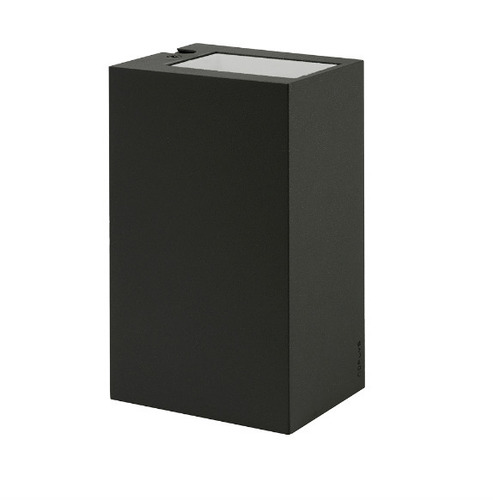
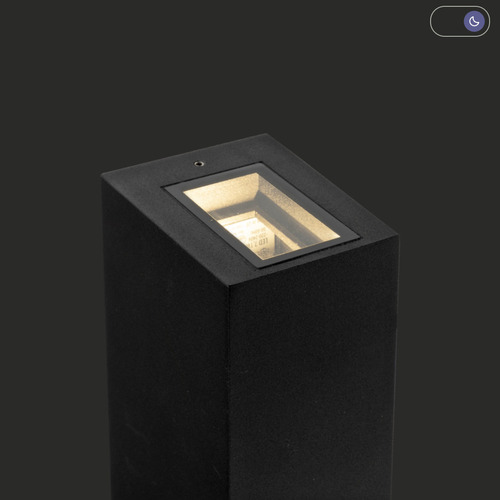
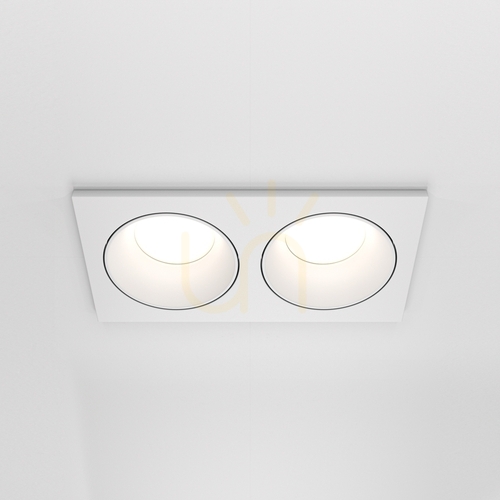
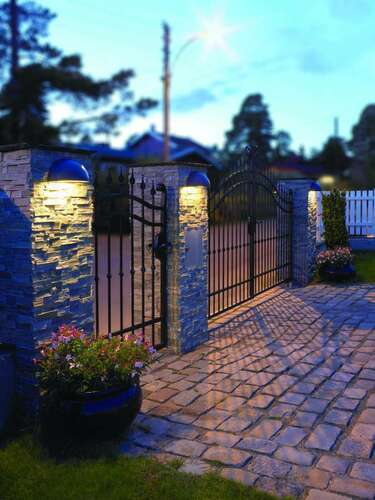
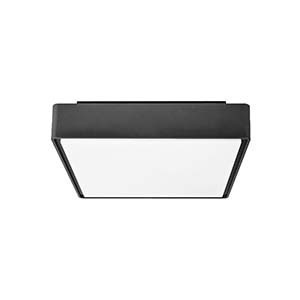
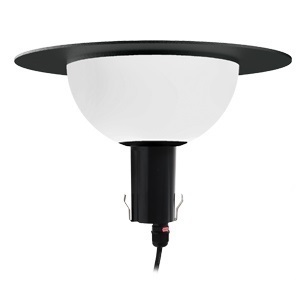
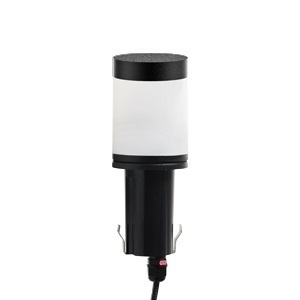
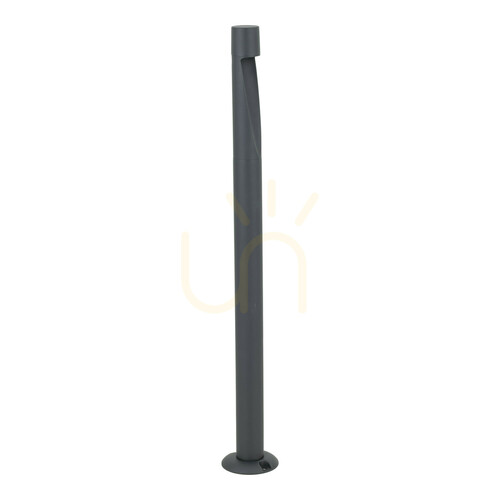
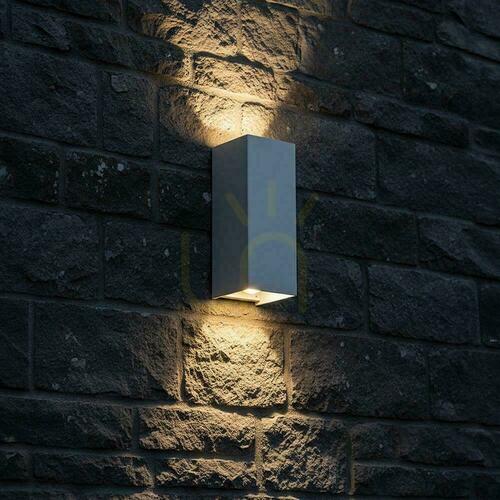
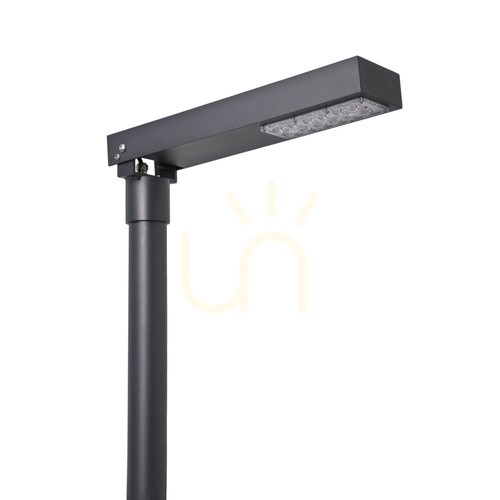
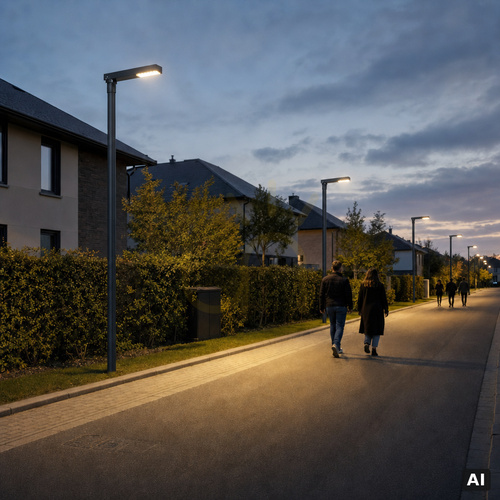
IP65 outdoor lights are dust-tight and protected against jets of water from any angle, so they can go on a fully exposed wall, a gatepost or a garage front with nothing overhead to shelter them. In a British garden that matters: rain here rarely falls straight down, and the wall that takes the prevailing south-westerly gets soaked from the side for months on end.
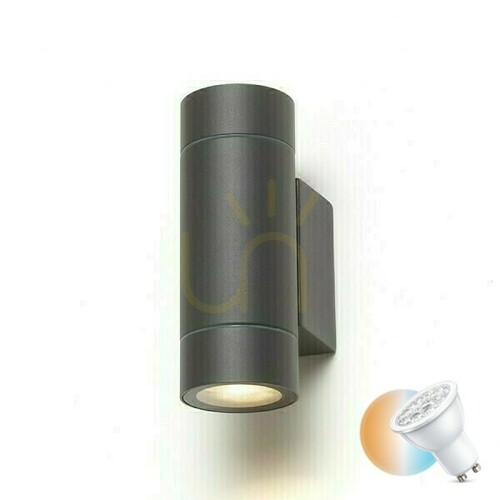
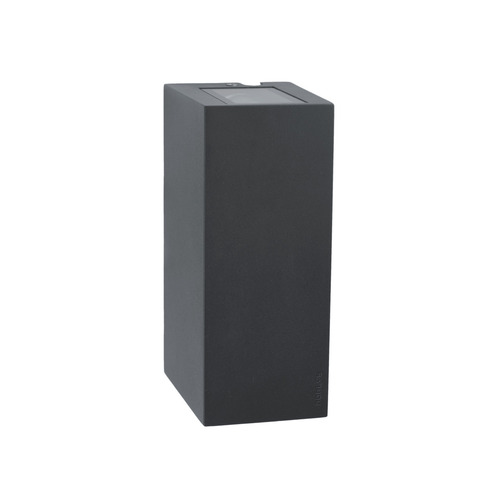
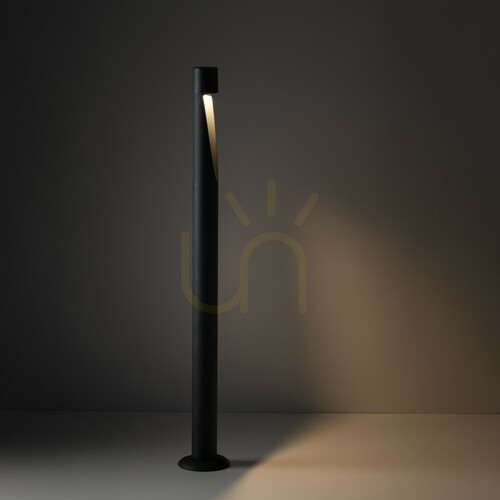
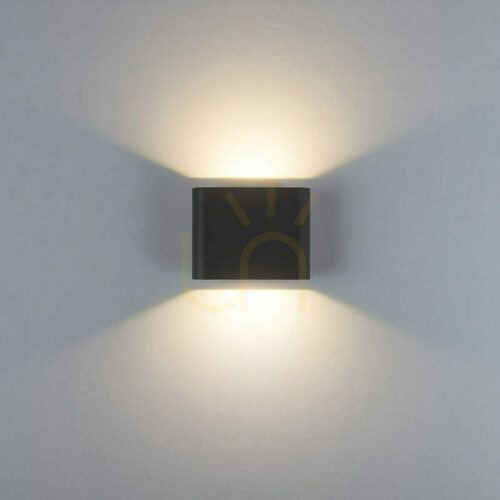
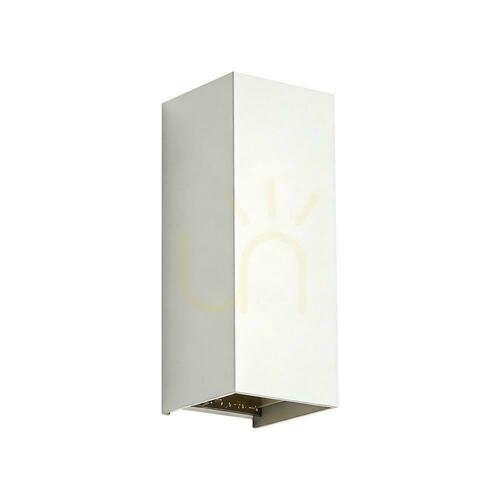
The rating says nothing about style. Wall lanterns, bulkheads, up-and-down lights, bollards, spike spots, step lights and floodlights can all carry it. What it guarantees is that the housing, seals and cable entry have passed a test that a sheltered-porch IP44 fitting would fail.
What the two digits actually test
IP stands for Ingress Protection, defined in BS EN 60529. The first digit covers solids and dust, the second covers water.
-
6 – dust-tight. The fitting sits in a chamber of fine talc for several hours with the inside held under vacuum. No dust may get in. Useful by a gravel drive, in a carport or a workshop, where grime on the LED board cuts light output.
-
5 – water jets. A 6.3 mm nozzle delivers around 12.5 litres a minute from roughly 2.5–3 m, over every face of the fitting, for at least three minutes. Think garden hose or a storm blowing straight at the house.
It is not a submersion rating. A light that may sit in standing water needs IP67, and anything in a pond needs IP68.
Choosing by location
| Where it goes |
Rating |
Typical set-up |
| Under a deep porch canopy or carport roof |
IP44 is enough |
wall light at 1.5–1.8 m, 400–800 lm |
| Front of house, exposed wall |
IP65 |
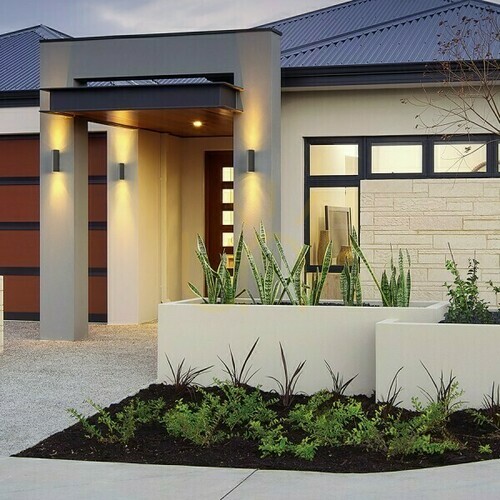
lanterns either side of the door, 1.5–1.8 m high |
| Garden path, borders |
IP65 |
bollards every 3–4 m, 100–300 lm each |
| Driveway, side return, yard |
IP65 |
floodlight or bulkhead, 1,500–3,000 lm, often with PIR |
| Coastal or very exposed site |
IP65 or IP66 |
316 stainless steel, solid brass or copper |
| Decking or paving, set flush |
IP67 |
drive-over or walk-over ground lights |
A quick test: if any roof or canopy keeps rain off the fitting, IP44 will do. If rain can hit it directly, buy IP65.
Integrated LED or a replaceable lamp? A sealed LED module means fewer joints for water to find and no lens to open for years. A GU10 or E27 lantern lets you change the bulb and the colour of light later, at the cost of one more seal to look after.
Fitting it so the rating holds
The number only applies to a light installed exactly as the instructions say. Most leaks come from the installation, not the housing:
- match the cable to the gland – an undersized cable leaves a gap that wicks water inside;
- respect the mounting orientation; some wall lights must never go upside down, or the drain hole ends up on top;
- on fittings with a replaceable GU10 or E27 lamp, reseat the gasket and tighten the glass evenly after every lamp change;
- buried runs normally use SWA (steel-wire armoured) cable, laid deep enough to clear a spade and marked with warning tape.
In England and Wales, a new outdoor circuit is notifiable work under Part P of the Building Regulations, and installations follow BS 7671, including 30 mA RCD protection. Swapping a like-for-like fitting on an existing point is simpler, but mains wiring is still a job for a qualified electrician.
Salt, frost and misted glass
Powder-coated aluminium suits most of the country. Near the sea, salt air pits cheaper metals quickly, so 316 stainless, solid brass or copper last far longer, and a rinse with fresh water every month or so helps. UV-stabilised polycarbonate stays clear for years and shrugs off a stray football or stone that could crack a glass lens.
Condensation inside the lens after a cold night usually means the housing is breathing in damp air through a poorly seated seal or cable entry. Some quality fittings use a pressure-equalising vent to stop exactly that. Clean with a soft cloth and plain water; no solvents, and never a pressure washer.
Questions people ask
Are IP65 outdoor lights fully waterproof?
They are weatherproof rather than waterproof. Rain, snow and a hose are fine; submersion is not. For a spot where water pools, look at IP67.
Is IP44 enough for outside lights in the UK?
Only in sheltered places, such as under a porch or deep eaves. On an open wall facing the weather, IP65 is the safer choice.
Are there outdoor lights rated better than IP65?
Yes. IP66 withstands powerful jets, IP67 short immersion up to 1 m and IP68 continuous immersion. For a typical house wall, they add little over IP65.
Can I pressure wash an IP65 light?
No. A pressure washer is far more forceful than the IP65 test and can drive water past the seals. Only IP69K fittings are built for that.
How high should outdoor lights be at the front of the house?
Usually 1.5–1.8 m, roughly at or just above eye level beside the door, so the face of a visitor is lit without glare. Warm white at 2700–3000 K is kinder to neighbours and draws fewer insects.
Can I fit an IP65 wall light with a sensor myself?
Swapping a fitting like for like is not notifiable, and in England neither is extending an existing circuit outdoors, but a new circuit is notifiable under Part P and all work must meet BS 7671. Either way, mains work belongs with a registered electrician unless you are genuinely competent.
If your spot is properly covered, read about IP44 garden lights instead. For more on lighting the rest of the garden and the front of the house, see outdoor lights.