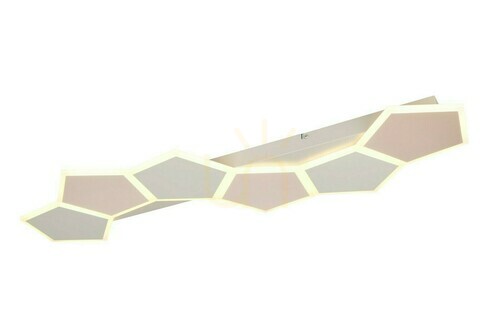
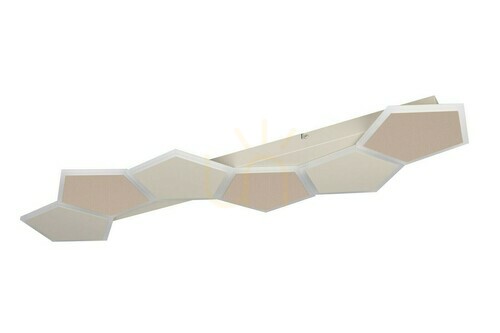
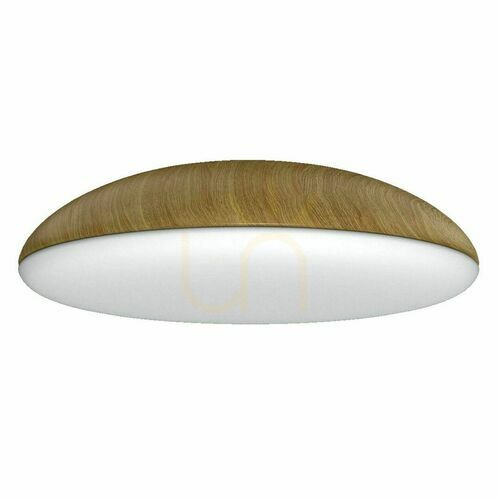
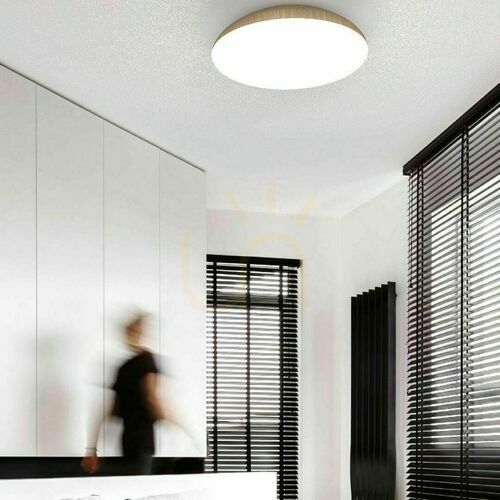
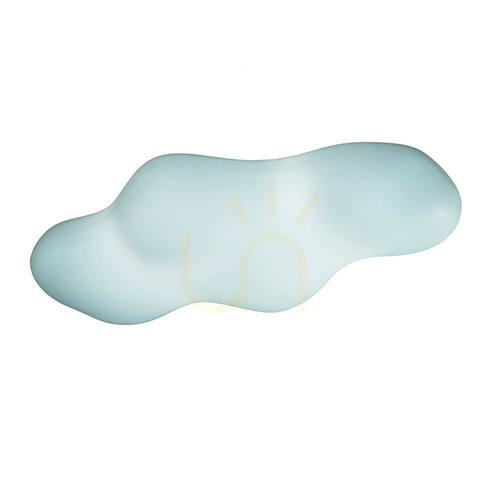
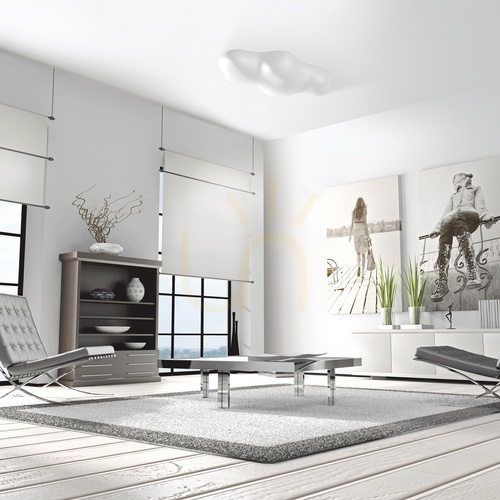
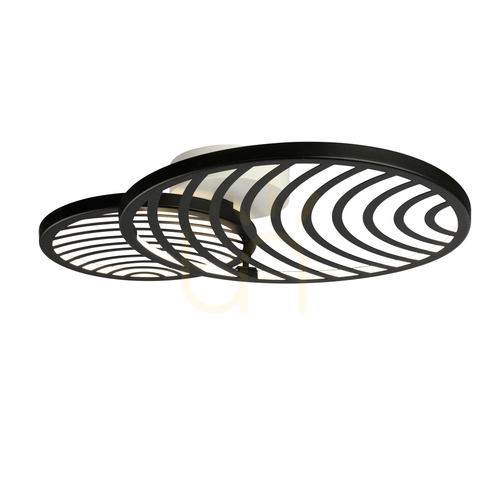
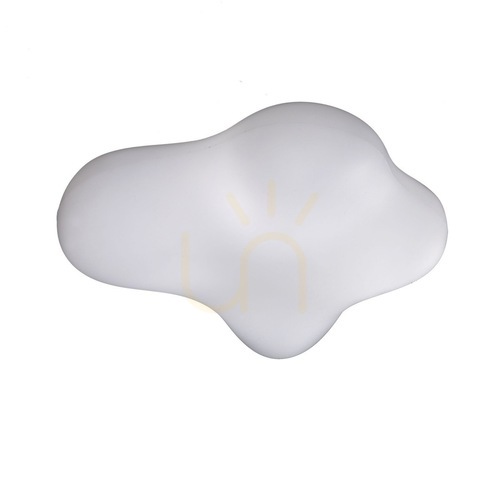
Designer ceiling lights in the flush and semi-flush sense are the fittings that sit against the ceiling instead of hanging from it — a disc, a shallow dome, a drum, a ring, or a short-stemmed shade that drops 15 to 30 cm and no further. They are what a room under 2.5 m can actually take, and they are the least glamorous corner of the design catalogue for an honest reason: there is very little to draw. A pendant designer has a shade, a stem, a canopy and a metre of air to work with. A flush designer has the depth of a soup plate.
Flush or semi-flush
Flush
The fitting is bolted straight to the ceiling with no gap. Nothing projects into head space, dust settles on top of the diffuser rather than inside it, and the light is thrown down and sideways in one soft field. This is the correct answer for a corridor, a small hallway, a landing, a utility room, and any ceiling at or below about 2.4 m in a route people walk through.
Semi-flush
A short stem or a set of standoffs holds the shade 10 to 30 cm below the ceiling. That gap changes two things: light now reaches the ceiling as well as the floor, which makes a low room feel taller rather than flatter, and the fitting reads as an object rather than as a service. Semi-flush is almost always the better-looking choice, and it is the one to avoid directly over a doorway or in a very low room.
How big, and how many
A single disc in the middle of a ceiling is the default that makes rooms feel small — it lights the floor and leaves the walls dark. Two smaller fittings, or one fitting plus lamps at the edges of the room, will always beat one large one.
Planning numbers for flush and semi-flush fittings
| Room |
Diameter |
Light to plan for |
| Hallway or small landing |
25 to 35 cm |
Around 100 lumens per square metre is enough for a route you pass through |
| Bedroom, 12 to 16 m² |
40 to 50 cm |
100 to 150 lumens per square metre from the ceiling, with the rest from bedside lamps |
| Living room, 20 to 25 m² |
50 to 60 cm, or two fittings at 40 cm |
100 to 150 lumens per square metre, dimmable, plus wall and table light |
| Kitchen |
Two or more fittings |
250 to 300 lumens per square metre, with the worktop lit separately from underneath the cupboards |
Where you use more than one, space them at roughly the same distance apart as they sit above head height, and keep the outer ones about half that distance from the walls. That produces even light without the scalloped bright patches you get from fittings pushed into the corners.
What separates a considered flush fitting from a builder's one
-
The edge. A rolled or stepped rim catches light and gives the disc a profile. A raw pressed edge reads as equipment. This is most of the difference at a glance.
-
The diffuser. Genuine opal glass glows evenly and looks solid when switched off. Thin acrylic shows the LED board through it as a grid of hot spots, particularly when photographed, and yellows over years of heat.
-
The ceiling line. Look at how the fitting meets the plaster. A generous flange forgives an uneven ceiling; a knife edge shows every ripple.
-
Serviceability. A socket you can reach — E27, E14 or GU10 at 230 V — means the fitting outlives its light source. An integrated LED module usually cannot be relamped, so ask whether the module or the driver is a spare part before you buy a fitting you intend to keep for fifteen years.
-
Colour quality. 2700 K for living rooms and bedrooms, 3000 K in a kitchen or bathroom, and CRI 90 or better anywhere there is wood, stone or skin to look at. A flush fitting is often the only light in the room, so its colour rendering is the room's colour rendering.
Bathrooms, kitchens and damp rooms
Flush fittings end up in exactly the rooms that have rules. Above a bath or inside a shower enclosure, and in the zone extending 60 cm around them, the minimum is IPX4 against splashing; most ceiling fittings sold for those positions are rated IP44 or better. A ceiling directly above a shower is also the worst place in the house for a fitting you cannot open, because condensation finds any gasket eventually — a sealed, gasketed diffuser with a stated rating beats an ordinary fitting hung high. Outside the zones, an ordinary fitting is permitted; brass and unlacquered copper will still tarnish quickly in an unventilated bathroom, while chrome, nickel and painted steel survive.
The low-ceiling strategy
If the room is under 2.4 m, the ceiling fitting is not going to be the interesting object, so stop asking it to be. Choose something quiet and well made overhead, put it on a dimmer, and spend the attention at eye level instead — wall brackets cost no headroom at all, and a pair of table lamps at the edges of the room does more for how a low room feels than any ceiling fitting can. The exception is the dining table: nobody walks on it, so a proper hanging fitting is allowed there even in a low room, and it will be the thing people look at.
Questions people ask
How low can a ceiling be before a pendant is out of the question?
Keep the bottom of any fitting 2.1 m above the floor where people walk. At a 2.4 m ceiling that leaves 30 cm of fitting, which is semi-flush territory. Over a table the constraint disappears, because the tabletop, not the floor, sets the height.
Are there real named designs in flush mounts?
Fewer than in pendants, and that is a fact about the format rather than an oversight. The recognised examples tend to be either a ceiling version of a pendant family — the same shade, mounted tight — or ring and disc fittings from architectural manufacturers, where the design work is in the diffuser and the edge rather than in a silhouette. Anyone promising a famous flush icon is usually selling a pendant with the stem removed.
Can a flush fitting be dimmed?
If the lamp or the module says it is dimmable. With replaceable lamps, use a trailing-edge dimmer and check the dimmer's minimum load. With an integrated module, dimming has to be a stated feature — it cannot be added later.
Does a semi-flush fitting collect dust?
An upward-open one does, and in a kitchen it collects grease as well. Closed drums and domes are the low-maintenance choice; if you want the uplight from a semi-flush in a kitchen, accept that it wants wiping twice a year.
What should I look at alongside these?
If the ceiling turns out to be high enough after all, design ceiling lights compares the hanging types, and design pendant lights covers suspended shades. For light at eye level in a low room, see design wall lights. By period, art deco ceiling lights covers the same flush format with interwar geometry.